
Is a Small Foot Wound Dangerous in Diabetes? How Fast It Can Turn
Medically reviewed by Dr. Ashutosh Shah, M.B., M.S., M.Ch., D.N.B., Board Certified Plastic, Reconstructive & Cosmetic Surgeon
Review date: 22 September 2026
Is a Small Foot Wound Dangerous in Diabetes?
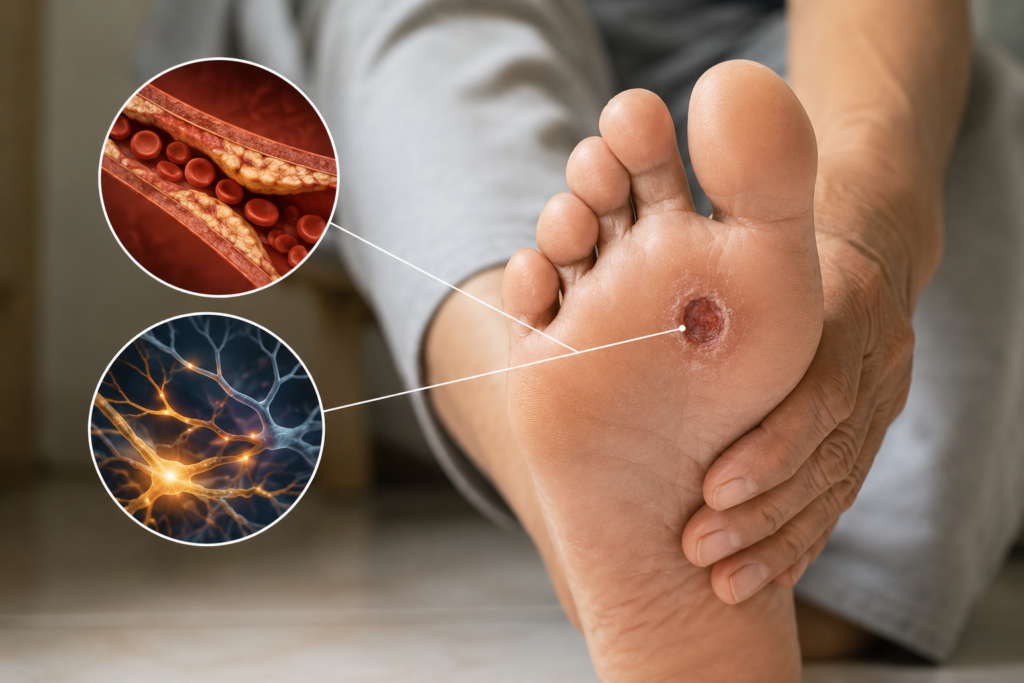
Yes. A small foot wound can become serious in diabetes, particularly when sensation is reduced or blood circulation is poor. A cut that looks only a few millimetres wide may hide deeper tissue damage, become infected, or fail to heal because pressure continues on the area. In a numb foot, you may not feel the injury getting worse. That is why a new diabetic foot wound should not simply be watched at home. It should be assessed promptly, ideally within 24 hours.
The exact speed of progression varies from person to person. A wound does not automatically reach tendon in two weeks or bone in three weeks, but diabetic foot complications can progress surprisingly quickly when infection, pressure, neuropathy or poor circulation is present. Current diabetic foot guidance emphasizes early assessment and rapid escalation when infection or deeper tissue involvement is suspected.
Same Day Red Flags: Do Not Wait for a Routine Appointment
Seek same-day medical assessment if a diabetic foot wound has any of these features:
| Warning sign | Why it matters |
|---|---|
| Fever or chills | May indicate systemic infection |
| Spreading redness | Infection may be extending beyond the wound |
| Increasing warmth or swelling | Can indicate infection or deeper inflammation |
| Pus or new discharge | Suggests possible infection |
| Foul smell | Can occur with infected or necrotic tissue |
| Blackening of skin or tissue | May indicate gangrene or severe tissue damage |
| Increasing wound depth | Possible involvement of deeper structures |
| New severe pain or tenderness | May indicate infection, especially if sensation is usually reduced |
| Blue, pale or unusually cold foot | May indicate impaired circulation |
| Sudden deterioration | Requires prompt clinical reassessment |
NICE classifies diabetic foot infection according to the extent of redness and tissue involvement, while IWGDF guidance recommends urgent surgical assessment for severe infection and certain deep or complicated infections.
Why Is a Small Wound More Dangerous in Diabetes Than in Anyone Else?
A small cut on a diabetic foot can behave differently because several risk factors can occur together.
Reduced sensation
Peripheral neuropathy can reduce the ability to feel pain, pressure, heat or injury. Someone may therefore continue walking on a wound without realizing how much mechanical stress it is receiving.
Reduced circulation
Peripheral arterial disease can reduce blood flow to the foot. Poor perfusion can make healing more difficult and can increase the consequences of infection.
Repeated pressure
A wound on the sole may be exposed to thousands of steps. If pressure is not reduced, the wound can remain open or become deeper.
Infection
Bacteria can enter through a break in the skin. Infection can spread into surrounding soft tissue and, in more advanced cases, involve deeper structures such as tendon, joint or bone.
High blood glucose
Poorly controlled glucose can be associated with impaired wound healing and increased infection risk.
This combination is why a wound that appears minor should not be judged only by its surface size.
How Fast Can a Minor Cut Become Limb Threatening?
There is no universal timetable for every diabetic foot wound.
A superficial clean cut may heal uneventfully with appropriate care. Another wound can deteriorate rapidly when there is neuropathy, pressure, poor blood flow or infection.
The progression requested in this guide, from day 1 through week 3, should therefore be understood as a risk-based timeline, not a prediction that every wound reaches the same depth on a particular day.
A wound that is becoming deeper, wetter, more swollen, more red or more painful should be reassessed rather than waiting for the next scheduled dressing.
Diabetic Foot Wound Progression and Action Table
| Time point | What may be happening in the tissue | What it may look like | What should already have been done | Red flag at this point |
|---|---|---|---|---|
| Day 1 | Skin barrier has been broken; pressure and contamination can begin affecting healing | Small cut, blister, abrasion or puncture | Clean assessment, documentation of size and depth, pressure reduction and clinical review | Bleeding that does not settle, deep puncture, poor circulation or obvious infection |
| Day 3 | Early healing should be underway if the wound is uncomplicated | Wound should not be progressively enlarging, increasingly red or producing pus | Appropriate dressing, glucose management, footwear/offloading advice and follow-up plan | Increasing redness, warmth, swelling, discharge or odour |
| Week 1 | New tissue should gradually begin covering the wound | Wound may still be open but should show signs of improvement | Wound measurements and healing progress should be reassessed | No improvement, increasing depth, spreading redness or new tissue breakdown |
| Week 2 | Persistent pressure, infection or poor circulation may prevent normal closure | Wound remains open, deeper or repeatedly breaks down | Escalation should be considered if healing is poor or complications are present | Deepening wound, exposed deeper tissue, pus, foul smell or systemic symptoms |
| Week 3 | A wound that remains open needs an explanation rather than indefinite dressing changes | Persistent ulcer, drainage, callus-related breakdown or increasing tissue damage | Specialist assessment may be required depending on wound depth, infection and circulation | Suspected tendon, joint or bone involvement, black tissue or spreading infection |
The key point is not that every wound follows this exact sequence. It is that lack of improvement is itself useful information. A diabetic foot wound should be monitored objectively rather than judged only by how small it looks.
What Should You Do in the First 24 Hours?
If you notice a small cut on a diabetic foot, do not wait to see whether it becomes painful.
1. Stop unnecessary pressure
Avoid walking unnecessarily on the affected area, especially if the wound is on the sole or another weight-bearing location.
2. Inspect the entire foot
Check the wound and surrounding skin for redness, swelling, warmth, discharge, odour, colour change or increasing size.
3. Protect the wound
Use an appropriate clean dressing after assessment and avoid repeatedly touching the wound with unclean hands.
4. Do not cut or scrape the wound yourself
Avoid aggressive home debridement, cutting callus around the wound or applying unverified chemicals.
5. Arrange clinical assessment
A new diabetic foot wound deserves professional assessment, particularly when sensation or circulation is reduced.
6. Check your glucose as advised
If you monitor blood glucose, follow your usual monitoring plan and inform your healthcare team if readings are unusually high during an apparent infection.
Which Small Wounds Still Need to Be Seen the Same Day?
Size does not determine urgency by itself.
A wound may be tiny but still require same-day assessment if it is:
- On a foot with significant numbness
- On a poorly perfused foot
- Caused by a puncture or contaminated object
- Increasing in size
- Surrounded by spreading redness
- Producing pus or foul-smelling discharge
- Associated with swelling or increasing warmth
- Over a pressure point that cannot be adequately offloaded
- Associated with fever or chills
- Associated with black or grey tissue
A minor wound not healing in diabetes also deserves reassessment rather than repeated dressing changes without identifying why it is not progressing.
What Does the Clinic Check at a First Wound Visit?
A proper diabetic foot assessment looks beyond the visible cut.
Wound size and depth
The clinician assesses the location, length, width and depth of the wound and checks whether deeper structures may be involved.
Infection
The surrounding skin is examined for redness, warmth, swelling, discharge and other signs of infection. NICE distinguishes mild infection from infection involving deeper tissues or more extensive erythema.
Sensation
Neuropathy assessment helps determine whether the patient can reliably feel pressure or injury.
Circulation
The foot is examined for signs of reduced arterial blood flow. Further vascular testing may be required when circulation is uncertain.
Pressure and footwear
The clinician considers whether walking, footwear, callus or another mechanical factor is repeatedly stressing the wound.
Bone involvement
If the wound is deep or there is concern for osteomyelitis, further evaluation may include probing, imaging and appropriate laboratory or microbiological assessment. IWGDF guidance emphasizes appropriate assessment when deeper infection or osteomyelitis is suspected.
When Is a Foot Wound Serious?
The question when is a foot wound serious should not be answered by size alone.
A wound becomes more concerning when there is evidence of:
Depth: the wound extends beyond superficial skin.
Infection: redness, warmth, swelling, pus or systemic symptoms develop.
Ischaemia: blood supply appears inadequate.
Neuropathy: the patient cannot reliably feel worsening pressure or injury.
Failure to heal: the wound remains open without meaningful improvement.
Deep involvement: tendon, joint or bone may be exposed or infected.
Gangrene: blackening or tissue death appears.
This is why a small ulcer can sometimes be more clinically important than a larger but clean superficial wound.
Which Signs Mean Going to Hospital Rather Than Waiting for OPD?
Not every diabetic foot wound requires hospital admission. Many can be assessed and managed through outpatient or specialist diabetic foot services.
Hospital level assessment becomes much more important when there are signs of severe infection, systemic illness, gangrene, severe ischaemia or a deep infection requiring urgent intervention.
Go for urgent hospital assessment if there is:
- Fever with a deteriorating foot wound
- Chills or signs of systemic illness
- Rapidly spreading redness or swelling
- Blackening or gangrene
- Severe or rapidly worsening infection
- Suspected deep abscess
- Severe reduction in blood supply
- Suspected deep bone or soft tissue infection
IWGDF guidance recommends urgent surgical consultation for severe infection and for moderate infection complicated by extensive gangrene, necrotizing infection, deep abscess, compartment syndrome or severe lower limb ischaemia.
What Can a Small Diabetic Foot Wound Need?
Treatment depends on the cause and depth.
It may involve:
- Appropriate wound cleaning and dressing
- Pressure relief or offloading
- Treatment of infection when infection is confirmed
- Removal of unhealthy tissue when clinically indicated
- Assessment and treatment of poor circulation
- Footwear modification
- Blood glucose management
- Follow-up measurements to document healing
Antibiotics are not automatically required for every open wound. Infection should be assessed clinically rather than treating every wound as infected.
For wounds that do not heal, specialist evaluation can help identify pressure, infection, vascular disease or another reason for delayed closure.
A Small Wound Is Not the Same as a Small Problem
The most important mistake is assuming:
“It is only a small cut, so I can wait.”
In diabetes, the surface appearance can underestimate the underlying risk.
A small cut on diabetic foot should be protected, assessed and monitored. If sensation is reduced, circulation is poor, or the wound is on a pressure-bearing part of the foot, the threshold for professional assessment should be particularly low.
For more information about persistent wounds, see the clinic’s guide to Non-healing foot ulcer.
If swelling, redness and discharge suggest a collection of infected tissue, see Foot abscess.
For practical wound protection and daily precautions, see Diabetic foot home care.
For clinic location and appointment details, use Clinic address and contact.
What Should You Remember?
A diabetic foot wound should never be judged only by its size.
A tiny wound can become complicated when neuropathy, poor circulation, repeated pressure or infection is present. There is no reliable rule saying that a wound will reach tendon in exactly two weeks or bone in exactly three weeks. The safer approach is early assessment, pressure reduction, appropriate wound care and rapid escalation when the wound deteriorates.
If there is fever, spreading redness, blackening, foul smell or pus, do not wait for routine follow-up. Seek same-day medical assessment.
FAQs
Medical review note: The reviewer information above is based on the clinic’s published profile for Dr. Ashutosh Shah, which identifies him as M.B., M.S., M.Ch., D.N.B. and a Board Certified Plastic Surgeon.
There is no safe size threshold. A tiny wound can still become serious when neuropathy, poor circulation or infection is present.
Some superficial wounds can heal, but a new diabetic foot wound should be assessed rather than assumed to be harmless.
Do not deliberately wait several days. Arrange prompt assessment, particularly if sensation or circulation is reduced.
No. Neuropathy can reduce pain sensation, so a serious wound may remain surprisingly painless.
Basic protection and clean dressing may be appropriate while arranging assessment, but do not rely on home treatment alone if the wound is new, deep, infected or not improving.
Fever, rapidly spreading redness, blackening, severe infection, severe circulation problems, foul-smelling discharge or suspected deep infection require urgent medical assessment. IWGDF specifically recommends urgent surgical consultation for several severe or complicated diabetic foot infections.