
Red, Hot, Swollen Foot Without a Wound: Infection, Charcot or Gout?
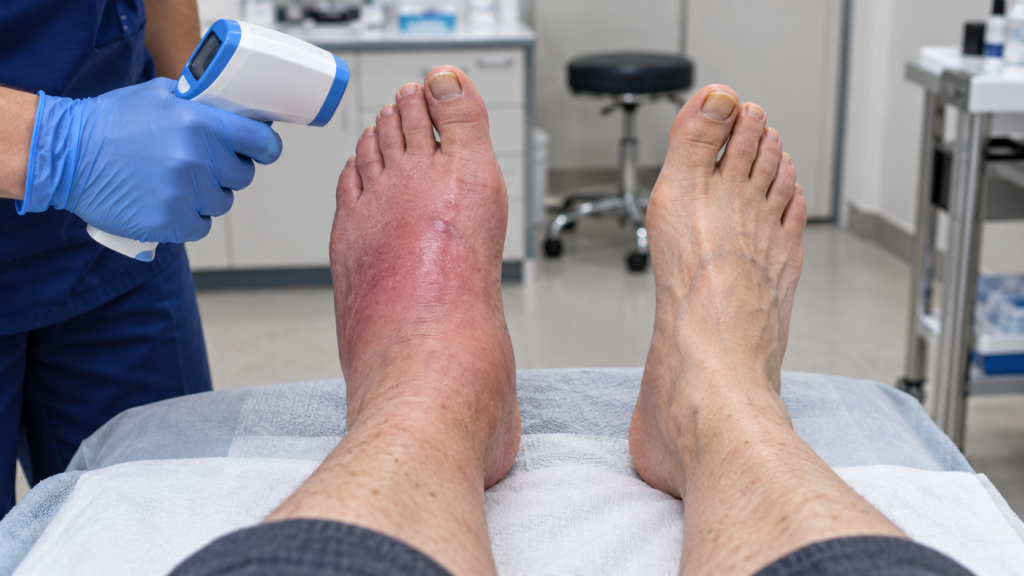
A red, hot, swollen foot in diabetes should not automatically be dismissed as a minor injury, gout attack or simple swelling, especially when there is no visible wound.
Three important possibilities are cellulitis or another infection, early Charcot foot and gout. Deep vein thrombosis can also enter the differential, particularly when swelling involves the leg.
The difficulty is that these conditions can look similar at first. A person with diabetic neuropathy may have little or no pain even when a serious foot problem is developing. NICE specifically classifies an unexplained hot, swollen foot in a person with diabetes, with or without pain, as an active diabetic foot problem. Suspected acute Charcot arthropathy should be referred promptly for specialist assessment.
If the foot is suddenly red, hot and swollen, same-day medical assessment is the safer approach rather than waiting several days to see whether the swelling disappears.
What Are the Three Common Causes and How Do They Differ?
Cellulitis
Cellulitis is a bacterial infection of the skin and underlying soft tissues. The foot or surrounding skin may become red, warm, swollen and tender. The redness may spread, and fever or feeling generally unwell can occur.
In a person with diabetes, infection deserves particular attention because it can progress into deeper tissues.
NICE defines diabetic foot infection using clinical findings such as swelling or induration, erythema, local tenderness or pain, local warmth and purulent discharge.
However, cellulitis is not always easy to distinguish from Charcot inflammation or gout based on appearance alone.
Early Charcot Foot
Charcot neuro-osteoarthropathy is a destructive inflammatory condition affecting the bones and joints of the foot, usually in the presence of peripheral neuropathy.
One of the most important charcot foot early signs is a foot that becomes unexpectedly warm, swollen and red, sometimes with surprisingly little pain.
NICE specifically advises clinicians to suspect acute Charcot when there is redness, warmth, swelling or deformity, particularly when the skin is intact and neuropathy is present. It also says to consider Charcot even when deformity or pain is absent.
This is why a diabetic person should not assume:
“There is no wound, so nothing serious is happening.”
Gout
Gout is an inflammatory arthritis caused by urate crystal deposition. It commonly affects the big toe but can also involve other joints in the foot and ankle.
A typical attack develops suddenly, with severe joint pain, redness, warmth and swelling. The affected joint can become extremely sensitive to touch.
This makes gout a genuine possibility when a diabetic foot suddenly becomes red and swollen.
But cellulitis vs gout foot cannot always be determined safely from appearance alone. Infection can also produce a hot, red and swollen area, and a person with neuropathy may not experience the expected level of pain.
Why Is Early Charcot Foot So Easily Missed?
Early Charcot can resemble infection, gout, trauma or ordinary inflammation.
The major problem is neuropathy.
When protective sensation is reduced, a person may not feel the pain that would normally make them stop walking. The foot may therefore continue to bear weight while the underlying bones and joints are inflamed or injured.
The IWGDF recommends immediate knee high immobilisation or offloading when active Charcot is suspected while diagnostic testing is performed. Early immobilisation and reduced weight bearing are intended to limit progression to deformity.
NICE similarly recommends non weight bearing while definitive treatment is arranged when acute Charcot is suspected.
That means a suspected Charcot foot should not be treated as a normal swollen foot that can simply be walked on until it feels better.
What Does the Temperature Difference Between Both Feet Tell You?
Comparing the affected foot with the opposite foot can provide useful information.
The IWGDF recommends measuring foot skin temperature when assessing and monitoring Charcot neuro-osteoarthropathy. Infrared thermometry is preferred where available because it provides an objective measurement.
A temperature difference of more than 2°C between the affected and unaffected foot is an important clinical warning in a person with suspected Charcot.
NICE uses a sustained temperature difference of less than 2°C, together with stable imaging, as part of the assessment of resolution of acute Charcot.
How to interpret it
A warmer foot does not prove that the person has Charcot.
It tells the clinical team that there is an inflammatory process that needs explanation.
Possible causes include:
- Acute Charcot
- Infection
- Gout
- Trauma
- Other inflammatory conditions
The comparison is therefore one part of the examination, not a diagnosis by itself.
What Tests Separate Infection From Charcot?
There is no single test that automatically separates infection from Charcot in every patient.
The clinician starts with a history and physical examination, including:
- Neuropathy assessment
- Skin examination
- Temperature comparison
- Pulses and circulation assessment
- Examination for wounds or breaks in the skin
- Assessment of swelling and deformity
- Assessment of pain and tenderness
- Review of recent trauma or increased activity
- Assessment for systemic symptoms
Blood Tests
When infection is suspected, blood tests may help assess systemic inflammation and other abnormalities.
However, normal inflammatory markers do not completely exclude bone infection in a person with diabetes. NICE specifically warns that osteomyelitis may be present despite normal inflammatory markers, normal X rays or a negative probe to bone.
X Ray
If Charcot is suspected, a weight bearing X ray of the affected foot and ankle is recommended by NICE.
Early disease can sometimes be difficult to see on plain X ray.
MRI
If the X ray is normal but clinical suspicion of Charcot remains, NICE recommends considering MRI. MRI can also be useful when deeper infection or bone involvement needs investigation.
Joint Fluid Testing
When gout or septic arthritis is suspected and the diagnosis remains uncertain, sampling fluid from the affected joint can help distinguish crystal arthritis from infection.
Gout is commonly associated with sudden severe joint pain, swelling, heat and redness, particularly around the big toe.
The important point is that gout should not simply be assumed because the foot is red and painful, particularly in a person with diabetes.
Why Does Walking on an Undiagnosed Charcot Foot Cause Permanent Deformity?
This is one of the most important reasons for acting quickly.
An active Charcot foot is structurally vulnerable. Continued weight bearing while the bones and joints are inflamed can allow progressive collapse, fractures, dislocations and changes in foot shape.
The IWGDF recommends initiating knee high immobilisation or offloading immediately when active Charcot is suspected, even while further diagnostic testing is being completed.
The objective is to protect the foot while the diagnosis is being clarified.
A person with suspected Charcot should therefore not continue normal walking simply because there is no open wound.
For further information, see Charcot foot.
Differential Table: Red, Hot and Swollen Foot Without a Wound
| Condition | Onset speed | Pain in a numb foot | Temperature difference between feet | Fever | Skin appearance | Immediate action |
|---|---|---|---|---|---|---|
| Cellulitis | Often develops over hours to days | Pain may be reduced or absent with neuropathy | May be warmer than the other foot | May occur, but can be absent | Red, warm, swollen skin; redness may spread | Same-day assessment |
| Early Charcot | Can develop over days | Pain may be surprisingly mild or absent | Often clearly warmer than the other foot; a >2°C difference is an important warning | Usually absent unless another process is present | Red, hot, swollen foot, often with intact skin | Same-day assessment and urgent Charcot evaluation |
| Gout | Often sudden, sometimes overnight | Usually severe pain, although neuropathy can alter symptoms | Local warmth is common | Usually absent, but fever requires urgent assessment | Hot, red, swollen joint, commonly the big toe | Same-day assessment |
| Deep vein thrombosis | Often develops over hours to days | Calf or leg pain may occur | One leg may be warmer or swollen | Usually absent | Swollen, red, blue or darkened skin may occur | Same-day assessment for suspected DVT |
Every row ends with same-day assessment because a new red, hot and swollen foot in a person with diabetes should not be safely diagnosed at home.
NICE classifies an unexplained hot, swollen diabetic foot as an active diabetic foot problem, and suspected acute Charcot requires prompt specialist assessment.
DVT can cause swelling, pain and red, blue or darkened skin in one leg and also requires urgent medical assessment when suspected.
Can a Diabetic Foot Swell Without an Injury?
Yes.
A swollen foot without an obvious injury can occur with Charcot arthropathy, infection, gout, DVT and other inflammatory or vascular conditions.
This is particularly important in diabetes because neuropathy can hide the pain that would normally signal an injury.
An unexplained hot, swollen foot should therefore be assessed rather than automatically attributed to a minor strain.
How Do I Tell Infection From Gout?
There is considerable overlap.
Features that can suggest gout
- Sudden onset
- Severe joint pain
- Often centred around the big toe
- Very tender joint
- Previous attacks of gout
- Known high urate or previous gout diagnosis
NHS guidance describes gout as sudden severe joint pain with hot, swollen and red skin, commonly around the big toe.
Features that can suggest infection
- Spreading redness
- Increasing warmth and swelling
- Skin infection or break in the skin
- Purulent discharge when a wound is present
- Fever or systemic illness
- Rapid deterioration
NICE recommends reassessment when suspected diabetic foot infection worsens rapidly or significantly, fails to start improving within one to two days of treatment, or when there are concerns about serious conditions such as ischaemia, osteomyelitis, necrotising fasciitis or sepsis.
But these patterns are not enough to safely rule one condition in or out.
A clinician may need blood tests, imaging or joint fluid analysis depending on the presentation.
What If There Is No Wound at All?
No wound does not mean no diabetic foot emergency.
This is particularly important for Charcot.
NICE specifically says acute Charcot should be suspected when there is redness, warmth, swelling or deformity, particularly when the skin is intact.
That is why the phrase swollen foot no wound diabetes should immediately raise a different question:
Why is the foot swollen?
If the answer is not obvious, assessment should not be delayed.
Why Is One Foot Hotter Than the Other?
Inflammation increases local blood flow and tissue activity, which can make an affected foot warmer.
In Charcot, temperature difference between the affected and unaffected foot is an important clinical monitoring tool. IWGDF recommends objective temperature measurement where available, while clinical palpation can also be used when quantitative equipment is unavailable.
The difference matters more when it occurs alongside:
- Swelling
- Redness
- Neuropathy
- Recent trauma
- Foot shape change
- Difficulty walking
A temperature difference alone does not diagnose Charcot, cellulitis or gout.
It is a reason to examine the whole foot and determine the cause.
Does Swelling Without Pain Mean It Is Not Serious?
No.
This is one of the most dangerous assumptions in a neuropathic diabetic foot.
Loss of protective sensation can reduce the pain produced by tissue injury. NICE specifically says to think about acute Charcot even when pain is not reported.
A painless hot, swollen foot can therefore still represent an active diabetic foot problem.
Pain level should not be used as the only measure of severity.
Should I Wait to See If the Swelling Settles?
A new unexplained red, hot and swollen diabetic foot should not be watched at home for several days.
NICE recommends referral within one working day for active diabetic foot problems that are not immediately limb or life threatening, while limb threatening or life threatening problems require immediate acute care.
Suspected acute Charcot requires prompt specialist assessment and protection of the foot from further weight bearing while definitive treatment is arranged.
The safer approach is assessment today rather than waiting for the swelling to settle on its own.
Which of These Presentations Is a Same-Day Emergency?
All four conditions in the differential table require same-day assessment when they present as a new unexplained red, hot or swollen foot in a person with diabetes.
However, some findings require an even higher level of urgency.
Seek immediate emergency care if there is:
- Fever or signs of sepsis
- Rapidly spreading infection
- Black or dead tissue
- Gangrene
- Severe ischaemia
- Suspected deep soft tissue infection
- Suspected bone infection with serious clinical concern
- Severe deterioration
- A hot, swollen foot with major deformity
- Symptoms suggesting DVT with chest pain or breathlessness
NICE recommends immediate acute referral for diabetic foot problems associated with fever or sepsis, limb ischaemia, suspected deep soft tissue or bone infection, or gangrene.
For suspected DVT, chest pain or breathlessness alongside leg symptoms can indicate pulmonary embolism and requires emergency treatment.
What Should You Do Before You Are Seen?
Until the cause is established, avoid treating the foot as an ordinary swelling.
If Charcot is a possibility, avoid unnecessary weight bearing and follow the clinical team’s instructions about immobilisation or offloading. IWGDF recommends immediate immobilisation and reduced weight bearing when active Charcot is suspected.
Do not massage a newly swollen foot when DVT has not been excluded.
Do not continue normal exercise or long walks simply because there is no wound.
Do not start antibiotics or gout medicines on your own simply because the foot looks infected or inflamed. The correct treatment depends on the diagnosis.
Once assessed, the clinical team may recommend specialist footwear or offloading. For people with Charcot or a history of foot deformity, appropriate footwear can be an important part of longer term protection. See Safe footwear for Charcot foot.
For additional information about swelling, see Foot swelling.
Final Takeaway
A red hot swollen foot in diabetes is not a symptom to watch casually, even when there is no wound and even when pain is minimal.
The three important possibilities are cellulitis, early Charcot foot and gout, with DVT also needing consideration in the appropriate clinical setting.
The patterns can overlap:
- Cellulitis tends to produce infected, warm and spreading skin inflammation.
- Charcot can produce a markedly warm, swollen and red foot with surprisingly little pain, particularly when neuropathy is present.
- Gout commonly causes sudden, intensely painful inflammation around a joint, especially the big toe.
- DVT usually produces one sided leg swelling and may cause pain and skin colour changes.
No single symptom can reliably distinguish them.
A new unexplained hot, red and swollen diabetic foot deserves same-day medical assessment. Early recognition of Charcot and prompt treatment of infection can prevent progression to more serious foot complications.
FAQs
Yes. Charcot, infection, gout and DVT can all cause swelling without an obvious injury.
Charcot foot is a destructive inflammatory condition affecting the bones and joints of a neuropathic foot. Early signs include warmth, swelling and redness.
They can look similar. Sudden severe joint pain suggests gout, while spreading redness and systemic illness can suggest infection, but examination and testing may be needed.
Inflammation can increase skin temperature. A significant temperature difference is an important finding when assessing possible Charcot.
No. Neuropathy can reduce pain, and early Charcot may occur with little or no pain.
No. A new unexplained red, hot and swollen diabetic foot should receive same-day assessment.