
Choosing Safe Footwear for Charcot Foot
From the Diabetic Foot Practice of Dr. Ashutosh Shah
With 22+ years of surgical experience, Dr. Ashutosh Shah, M.Ch., DNB (Plastic Surgery) works across plastic and reconstructive surgery, diabetic wounds, pressure management and complex foot reconstruction.
This guide focuses on an important part of Charcot foot management: protecting a foot whose structure and pressure pattern may have changed significantly.
Charcot foot can alter the bones, joints and overall shape of the foot. When diabetic neuropathy reduces protective sensation, significant damage can develop without the amount of pain a patient might expect.
Footwear therefore becomes an important protective tool.
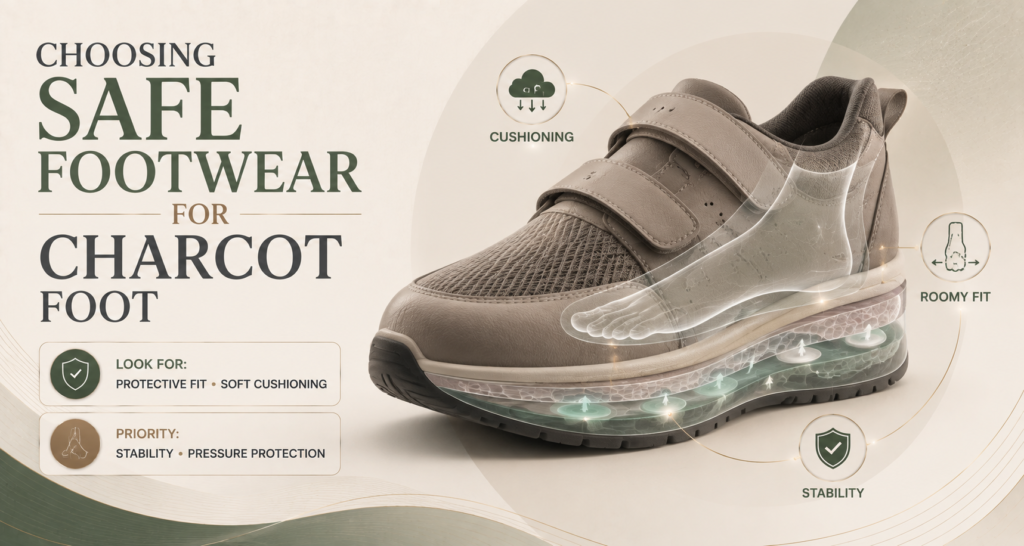
Charcot foot footwear should accommodate deformity, protect vulnerable skin and help redistribute pressure. Some patients may require custom shoes, specialised insoles or a Charcot Restraint Orthotic Walker (CROW) rather than ordinary footwear.
EDFC’s guidance on Charcot foot explains the importance of immobilisation and custom orthotics as part of treatment.
Key Takeaways
Comfort alone is not enough. Neuropathy may hide harmful pressure.
Foot shape matters. Charcot deformity can make normal footwear unsuitable.
Active Charcot requires medical treatment. Special shoes alone are not sufficient.
Pressure redistribution is important. Insoles or orthoses may be needed.
Footwear requirements can change. Regular reassessment is useful.
What Is Charcot Foot?
Charcot foot, also known as Charcot neuroarthropathy, involves progressive damage to bones and joints in a foot with reduced protective sensation.
It can lead to:
- fractures,
- joint instability,
- dislocation,
- arch collapse,
- altered foot shape,
- abnormal pressure,
- and ulceration.
Diabetic neuropathy is a major associated factor.
Why Can Ordinary Shoes Become Unsafe?
Charcot deformity may create areas that no longer fit comfortably or safely into conventional footwear.
There may be:
- bony prominences,
- increased width,
- arch collapse,
- unusual pressure points,
- or significant shape changes.
A standard shoe may repeatedly press against these areas.
Because neuropathy reduces sensation, harmful pressure may not cause pain.
What Type of Footwear May Be Needed?
There is no single shoe appropriate for every Charcot foot.
Depending on the condition, options may include:
- extra-depth footwear,
- custom orthopaedic footwear,
- pressure-relieving insoles,
- custom braces,
- or a CROW.
The footwear and prosthetics options available through EDFC include preventive, therapeutic and orthopaedic solutions for diabetic feet.
What Is a CROW?
CROW stands for Charcot Restraint Orthotic Walker.
It is a custom orthosis designed to protect and support a Charcot foot while reducing harmful movement and pressure.
A CROW is different from simply purchasing a larger or softer shoe.
It requires appropriate fitting and clinical guidance.
Is Special Footwear Enough for Active Charcot?
Not necessarily.
A newly warm, red and swollen foot may represent active Charcot neuroarthropathy.
During the active stage, immobilisation and substantial reduction of loading may be required.
Continuing normal walking in a wider shoe can allow further structural damage.
A newly warm or swollen diabetic foot therefore needs prompt medical assessment.
How Should Charcot Footwear Fit?
The footwear should accommodate the individual foot without creating focal pressure.
Important considerations include:
- sufficient depth,
- adequate width,
- space for deformity,
- stable support,
- secure fastening,
- smooth internal surfaces,
- suitable insoles,
- and pressure redistribution.
Regular skin inspection remains essential.
Why Are Insoles Important?
Charcot deformity changes how the sole contacts the ground.
This can create excessive pressure beneath areas that were not previously overloaded.
A customised insole can help accommodate the altered shape and redistribute pressure.
The aim is not merely softness. It is controlled pressure management.
Can Foot Pressure Be Tested?
Yes.
Pressure assessment can help identify areas exposed to greater loading.
One option provided through EDFC is pedobarogram testing, which can contribute to understanding plantar pressure patterns.
This information may assist footwear or insole planning in selected cases.
Can You Return to Regular Shoes?
Some people with a stable Charcot foot may eventually use carefully selected footwear.
Others require long-term custom shoes or orthotic support because structural changes remain.
The decision depends on:
- stability,
- deformity,
- pressure distribution,
- ulcer history,
- sensation,
- and disease stage.
The absence of pain should not be used as the main sign that ordinary footwear is safe.
What Should You Check Every Day?
Inspect the foot for:
- redness,
- swelling,
- callus,
- blisters,
- cracks,
- new wounds,
- discharge,
- or changes in shape.
Also check inside the footwear for damaged material, folded insoles or foreign objects.
When Is Charcot Foot Urgent?
A foot that becomes unusually warm, red or swollen should be assessed promptly.
Sudden changes in shape, instability or a new ulcer also require medical attention.
Charcot changes and infection can sometimes produce overlapping signs, making clinical assessment important.
Matching the Footwear to the Foot
Patients in Surat living with Charcot deformity can access diabetic foot, pressure and footwear assessment through Elegance Diabetic Foot Care (EDFC).
You can read more about the clinic’s diabetic foot care approach, which combines prevention, non-surgical management and surgical treatment where required.
For physician information, Dr. Ashutosh Shah’s profile outlines his qualifications and reconstructive surgical background.
Charcot footwear should never be selected simply because a shoe is labelled “diabetic.” It needs to match the shape, pressure pattern and stage of the individual foot.
If you have Charcot deformity, difficulty fitting footwear, a previous ulcer or a newly warm and swollen foot, connect with Elegance Diabetic Foot Care for appropriate evaluation.
FAQs
It depends on foot shape, pressure and the stage of Charcot disease.
It is a Charcot Restraint Orthotic Walker.
Some stable cases may, while others need custom footwear.
Not necessarily. Pressure distribution and support matter.
Yes. It should be assessed promptly.