
When Is Debridement Surgery Needed?
Diabetic Wound & Tissue Preservation Guidance by Dr. Ashutosh Shah
Written By: Dr. Ashutosh Shah
Qualifications: M.Ch., DNB (Plastic Surgery)
Specialty: Plastic, Reconstructive Surgery & Diabetic Foot Management
Experience: 22+ Years
Clinic: Elegance Diabetic Foot & Ulcers Clinic, Surat
Dr. Ashutosh Shah has more than 22 years of surgical experience and works in diabetic foot surgery, chronic wound management, reconstruction and limb preservation. In diabetic wounds, removing unhealthy tissue can be an important part of treatment, but debridement should be combined with assessment of infection, circulation, pressure and the underlying cause of the wound.
Last Updated: August 2026
Introduction
A diabetic foot wound does not always contain healthy tissue capable of healing normally. Dead, infected or severely damaged tissue may remain inside the wound and interfere with recovery.
This is where debridement surgery may become necessary.
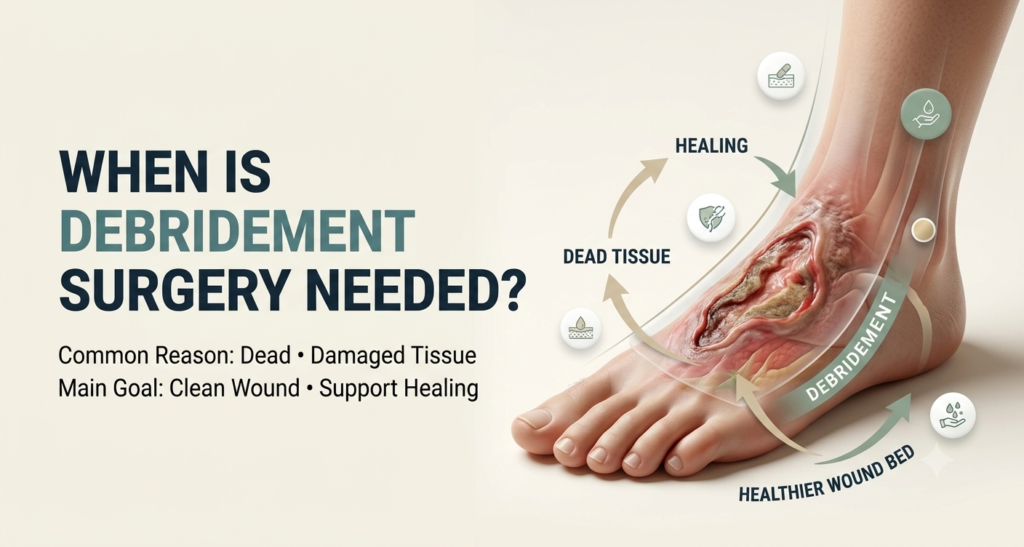
Debridement is the removal of unhealthy or nonviable tissue from a wound. The purpose is to create a cleaner wound environment, allow clinicians to better assess its true depth and support subsequent wound management.
However, debridement is not simply about “cutting away” tissue. In a diabetic foot, circulation, infection, sensation, pressure and the amount of viable tissue all need consideration.
At Elegance Diabetic Foot & Ulcers Clinic in Surat, diabetic wound management includes evaluation and treatment of ulcers, infections and tissue damage with an emphasis on wound healing and limb preservation.
Key Takeaways
- Debridement removes dead, damaged or infected tissue from a wound.
- Diabetic foot ulcers may require debridement when unhealthy tissue interferes with healing.
- Not every wound requires surgical debridement.
- Infection and poor circulation should be assessed as part of treatment planning.
- Some wounds need more than one debridement session.
- Debridement alone does not remove the underlying cause of an ulcer.
- Pressure relief, wound care and diabetes management remain important after the procedure.
- Severe infection may require urgent surgical treatment.
- The aim is to preserve as much healthy, functional tissue as reasonably possible.
What Is Debridement Surgery?
Debridement surgery is a procedure in which dead, infected, contaminated or otherwise nonviable tissue is removed from a wound.
Healthy tissue needs an appropriate environment to repair itself. When a wound contains necrotic tissue, thick slough or infected material, healing can become more difficult.
Removing this material can allow the wound to be evaluated more accurately and help subsequent wound treatment.
Patients with diabetes may require particularly careful planning because neuropathy, impaired circulation, infection and abnormal pressure can occur together.
Why Is Debridement Important in a Diabetic Foot Wound?
Diabetic foot wounds can become complicated because diabetes may affect sensation, circulation and the body’s ability to respond to injury.
Neuropathy can allow an injury to worsen without causing significant pain.
If dead tissue develops, it may obscure deeper structures and complicate assessment of the wound.
Debridement can remove unhealthy tissue so that the wound bed and its true extent can be examined more clearly.
Patients can explore EDFC’s diabetic foot ulcer and wound-care services to understand how wound treatment fits within broader diabetic foot management.
When Might Debridement Be Considered?
| Wound Situation | Why Debridement May Be Considered | What May Be Needed Next |
|---|---|---|
| Dead or necrotic tissue | Nonviable tissue may interfere with wound management | Wound reassessment and dressing |
| Thick slough | Can cover the wound bed | Cleaning and ongoing wound care |
| Infected tissue | Diseased tissue may need removal as part of infection control | Antibiotics and infection monitoring where indicated |
| Deep diabetic ulcer | True wound depth may be difficult to assess | Pressure relief and deeper evaluation |
| Abscess or collection | Infected material may require drainage | Infection treatment and follow-up |
| Recurrent unhealthy tissue | Further tissue may become nonviable | Repeat debridement may be required |
| Exposed deeper structures | Indicates a more complex wound | Specialist wound or reconstructive planning |
The decision should be based on clinical examination rather than appearance alone.
What Does Dead Tissue Look Like?
Dead tissue can appear black, brown, grey or yellow depending on the type of tissue and wound environment.
Black or dark tissue is sometimes described as eschar.
Yellow or grey material may represent slough, although wound appearance alone does not always reveal exactly what tissue is present.
Patients should avoid trying to cut or remove this tissue themselves.
This is especially important for people with diabetes because reduced sensation and poor circulation can make seemingly minor injuries much more serious.
Does Every Diabetic Foot Ulcer Need Debridement?
No.
The treatment of a diabetic foot ulcer depends on its characteristics.
Some wounds may contain tissue that requires removal, while others may primarily require pressure relief, appropriate dressings or treatment of another underlying problem.
Circulation is particularly important.
If blood supply is severely compromised, the wound-management strategy may need to account for vascular status before aggressive tissue removal is considered.
Debridement is therefore a treatment tool, not an automatic step for every ulcer.
How Is Surgical Debridement Performed?
During surgical or sharp debridement, unhealthy tissue is carefully removed using appropriate surgical instruments.
The extent of removal depends on what tissue remains viable.
In some cases, the procedure is relatively limited. In more severe infection, debridement may need to extend deeper to remove affected tissue.
The goal is generally to preserve healthy structures while removing tissue that cannot reasonably recover.
The wound may be left open for continued wound care rather than immediately closed, depending on infection, contamination and tissue condition.
Is Debridement the Same as Amputation?
No. Debridement and amputation are different procedures.
Debridement selectively removes unhealthy tissue while attempting to preserve viable structures.
Amputation involves removal of part of a toe, foot or limb when tissue cannot be preserved safely or functionally.
Early wound management and infection control can form part of a limb-preservation strategy, although debridement cannot guarantee that amputation will always be avoided.
In advanced infection or irreversible tissue death, more extensive surgery may still become medically necessary.
Can Debridement Help Control Infection?
It can be an important part of infection management when infected or dead tissue is present.
Antibiotics alone may not always be sufficient when there is significant nonviable tissue, pus or a deep infected collection.
Removing diseased tissue can help address part of the infection burden.
However, debridement is not a substitute for all other infection treatment.
Depending on the situation, patients may also require antibiotics, drainage, imaging, laboratory testing or additional surgery.
When Is Debridement Urgent?
Urgent surgical assessment may be necessary when a diabetic foot wound is accompanied by rapidly spreading infection, extensive tissue death, deep abscess or other signs of severe infection.
Concerning signs can include increasing swelling, redness, discharge, foul smell, fever, rapidly changing skin colour or systemic illness.
Pain is not always a reliable warning sign in diabetic neuropathy.
A person with reduced sensation can have a serious wound without severe pain.
Why Must Blood Circulation Be Checked?
A wound needs adequate blood flow to heal.
Peripheral arterial disease can reduce circulation to the foot, limiting oxygen and nutrients reaching damaged tissues.
If circulation is significantly impaired, wound healing can remain difficult even after unhealthy tissue has been removed.
This is why debridement should not be viewed in isolation.
Vascular assessment and restoration of blood flow may become important parts of treatment in selected patients.
Can Debridement Be Needed More Than Once?
Yes. Some diabetic wounds require repeated debridement.
A single procedure may remove the unhealthy tissue present at that moment, but additional nonviable tissue can sometimes become apparent later.
Repeat debridement may also be necessary as the wound evolves.
This does not automatically mean that the first procedure failed.
Complex wounds often change over time and require repeated assessment.
The decision to perform another debridement should depend on the condition of the wound rather than following a fixed number of procedures.
Does Debridement Make the Wound Look Bigger?
Sometimes the wound may appear larger after unhealthy tissue has been removed.
This can be alarming for patients.
Before debridement, dead tissue may conceal the actual depth or extent of the wound. Once this tissue is removed, the true wound bed becomes visible.
A larger-looking wound immediately after debridement does not necessarily mean that the condition has worsened.
The important question is whether viable tissue remains and whether the wound now has a better environment for ongoing treatment.
What Happens After Debridement?
Debridement is often the beginning of the next stage of wound management rather than the end of treatment.
After the procedure, care may involve:
- appropriate wound dressings,
- infection management,
- blood glucose management,
- pressure relief,
- customised footwear or offloading,
- vascular assessment,
- nutritional support when indicated,
- and regular wound review.
The exact plan depends on wound depth, infection, circulation and the patient’s overall condition.
Why Is Offloading Important After Debridement?
If pressure contributed to the ulcer, continuing to walk on the same pressure point can interfere with healing even after successful debridement.
Offloading means reducing pressure on the affected area.
This may involve footwear modifications, orthotic devices, casts or other pressure-relieving approaches depending on the wound.
EDFC incorporates customised footwear and pressure-management strategies into diabetic foot care because correcting the wound without addressing repeated mechanical pressure can leave the original cause unresolved.
Can You Walk Normally After Debridement?
That depends on the location and severity of the wound.
Some patients need to limit weight-bearing or use an offloading device.
Others may be able to walk with specific footwear or protection.
Walking directly on a healing pressure ulcer simply because pain is absent can be dangerous in someone with neuropathy.
Patients should follow the individual weight-bearing and footwear instructions provided by their treating team.
How Long Does a Wound Take to Heal After Debridement?
There is no single healing timeline.
Healing depends on wound size and depth, infection, circulation, blood glucose control, nutrition, pressure, smoking status, kidney disease and other health factors.
A superficial wound with good circulation behaves differently from a deep infected ulcer with poor blood supply.
Debridement may improve the wound environment, but it does not eliminate all the factors influencing healing.
Can a Wound Be Closed Immediately After Debridement?
Not always.
If infection or contamination remains a concern, immediate closure may not be appropriate.
Some wounds are managed open with dressings or other wound-care techniques while the tissue becomes healthier.
Once the wound is adequately prepared, selected defects may later be closed or reconstructed.
The decision depends on the wound rather than on a fixed rule that every debrided wound should immediately receive stitches.
When Is Reconstruction Needed?
Large or deep wounds may eventually require reconstructive treatment after infection and unhealthy tissue have been adequately controlled.
Depending on the defect, options can range from simpler wound closure to skin grafting or flap reconstruction.
The purpose is to obtain durable coverage while preserving as much function as possible.
This is particularly relevant when tendons, bones or other important structures become exposed.
Can Debridement Prevent Amputation?
Debridement can be an important part of a limb-preservation strategy, particularly when removing infected or dead tissue helps control a wound.
But it cannot guarantee that amputation will never be necessary.
The outcome depends on the severity of infection, circulation, tissue viability, bone involvement, overall health and response to treatment.
The priority should be removing dangerous tissue while preserving as much healthy and functional foot as medically reasonable.
When Should a Diabetic Foot Wound Be Checked?
A person with diabetes should seek assessment for a wound that is not healing or shows signs of deterioration.
Warning signs include:
- increasing redness or swelling,
- discharge,
- foul odour,
- black or discoloured tissue,
- a wound becoming deeper,
- exposed tissue,
- fever,
- spreading infection,
- or sudden changes in the appearance of the foot.
Reduced sensation means absence of pain should not be interpreted as proof that the wound is minor.
Conclusion
Debridement surgery may be needed when a diabetic foot wound contains dead, infected or nonviable tissue that interferes with wound management and healing.
The procedure aims to remove unhealthy tissue while preserving viable structures.
However, debridement alone does not solve every diabetic foot ulcer.
Infection, circulation, pressure, blood glucose, wound depth and underlying deformity also need attention. Some wounds require repeat debridement, while others may eventually need reconstruction or more extensive surgery.
Effective treatment therefore focuses not simply on cleaning the wound but on creating the conditions needed for healing, function and limb preservation.
Wound Preservation Care at EDFC
At Elegance Diabetic Foot & Ulcers Clinic, diabetic foot wounds are assessed according to tissue viability, infection, circulation, neuropathy and pressure. Patients with ulcers or infected wounds can explore the clinic’s diabetic foot wound and surgical care options as part of a broader treatment plan.
Dr. Ashutosh Shah, M.Ch., DNB (Plastic Surgery), has more than 22 years of surgical experience and works in diabetic foot management, reconstruction, wound care and limb-preservation procedures.
Patients who want to understand how complex diabetic wounds are approached can learn more about EDFC and its diabetic foot-care programme before deciding on the next stage of treatment.
Don’t Wait for a Diabetic Wound to Become Painful
Neuropathy can make a serious diabetic foot wound surprisingly painless. If a wound develops black tissue, discharge, swelling, odour or fails to improve, early assessment matters. Patients in Surat can contact EDFC for a diabetic wound evaluation to determine whether debridement or another treatment is needed.
Frequently Asked Questions
Debridement is the removal of dead, infected or nonviable tissue from a wound to create a cleaner wound bed for further treatment.
No. The need depends on tissue condition, infection, circulation and other wound characteristics.
Appropriate pain control or anaesthesia is used according to the procedure. People with neuropathy may have reduced sensation, but this does not mean treatment should be performed without appropriate medical care.
Dead tissue can hide the true extent of a wound. Removing it may reveal a larger or deeper wound bed that was already present.
Removing infected or dead tissue can be an important part of infection control, but antibiotics, drainage or other treatment may also be required.