
HbA1c, Albumin and Haemoglobin in Wound Healing
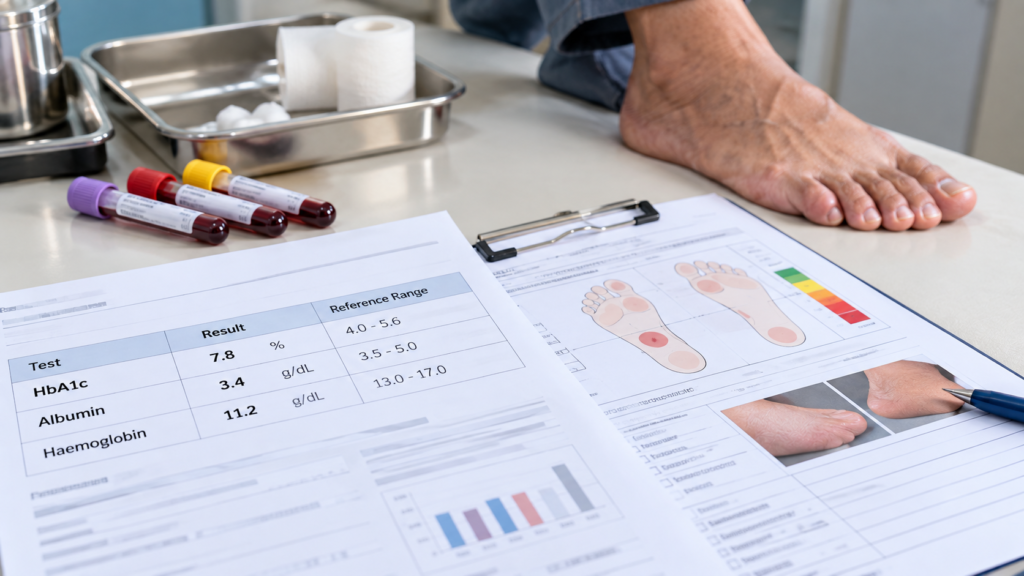
A diabetic foot ulcer does not heal because of wound dressing alone.
Healing depends on several things working together: blood-sugar management, adequate blood flow, infection control, pressure relief, wound care and enough nutrition to support new tissue.
Three blood markers often come up when a wound is slow to heal: HbA1c, albumin and haemoglobin. Each tells clinicians something different, and none should be interpreted on its own.
An important point is that there is no single HbA1c, albumin or haemoglobin number that guarantees that a wound will heal. These results help the clinical team identify problems that may need correction while the wound itself is treated.
What Does HbA1c Tell You About Wound Healing?
HbA1c reflects average blood-glucose exposure over roughly the previous two to three months. It is useful for understanding longer-term glucose control, although conditions affecting red blood cells can make the result less reliable.
Persistently high glucose can make infection and wound management more difficult. Hyperglycaemia is also associated with poorer surgical outcomes and a higher risk of postoperative infection.
But HbA1c should not be treated as a pass-or-fail wound-healing number.
For elective surgery, the 2026 ADA Standards of Care recommend a preoperative A1C goal below 8% when possible, with an individualised risk-benefit assessment. However, the ADA specifically states that surgery should not be postponed based on A1C or glucose-management indicator alone, because doing so can unnecessarily delay needed treatment.
For an existing diabetic foot ulcer, glucose control is only one part of the treatment plan.
Why Does High Blood Sugar Matter?
When glucose remains high, several processes involved in wound recovery can be affected.
A wound may have:
- Greater difficulty controlling infection
- Impaired immune response
- Abnormal inflammatory activity
- Reduced quality of tissue repair
- More difficulty maintaining good overall metabolic control
This does not mean that bringing HbA1c down suddenly will close an ulcer.
HbA1c changes over weeks to months because it reflects longer-term glucose exposure. The ADA generally recommends measuring HbA1c about every three months when treatment goals are not being met, although the exact schedule depends on the individual.
For someone with an active ulcer, the immediate priorities are still wound assessment, infection management when present, pressure relief, circulation assessment and appropriate wound care.
What Does Albumin Tell You?
Albumin is a blood protein made mainly by the liver.
A low albumin result can occur for several reasons, including inadequate nutrition, inflammation, liver disease, kidney disease, fluid changes and other medical conditions.
This is why albumin should not be treated as a simple nutrition score.
A low albumin level may indicate that a person is medically or nutritionally vulnerable, but correcting the number alone does not automatically make a wound heal.
If albumin is low in someone with a diabetic foot ulcer, the clinical team may look at:
- Recent weight loss
- Appetite
- Food intake
- Muscle loss
- Kidney function
- Liver function
- Inflammation
- Infection
- Overall nutritional status
The goal is to identify and correct the underlying problem rather than simply trying to push albumin above an arbitrary number.
Why Does Nutrition Matter?
A healing wound needs energy, protein and micronutrients to support tissue repair.
People with chronic wounds can have increased nutritional requirements, particularly when they have poor intake, infection, significant tissue loss or other illnesses.
However, there is no single protein target that is appropriate for every person with a diabetic foot ulcer.
Protein needs depend on factors such as:
- Body weight
- Age
- Kidney function
- Liver function
- Nutritional status
- Wound size and severity
- Infection
- Overall calorie intake
- Other medical conditions
The ADA recommends an individualised nutrition plan rather than one fixed eating pattern for everyone with diabetes. Medical nutrition therapy should take the person’s health status, treatment goals and nutritional needs into account.
If you have a diabetic foot ulcer and are losing weight or struggling to eat enough, ask your clinician whether a dietitian or nutrition assessment is appropriate.
How Does Haemoglobin Affect Wound Healing?
Haemoglobin carries oxygen in the blood.
A person with significant anaemia may have reduced oxygen delivery to tissues, depending on the severity and cause of the anaemia.
Because oxygen is important for tissue repair and infection defence, anaemia can become one of several factors considered when a wound is slow to heal.
But haemoglobin above 10 g/dL is not a universal wound-healing target.
The correct response to low haemoglobin depends on why it is low.
Possible causes include:
- Iron deficiency
- Vitamin B12 deficiency
- Folate deficiency
- Chronic kidney disease
- Chronic inflammation
- Blood loss
- Other medical conditions
The appropriate treatment therefore depends on the diagnosis rather than simply trying to increase the haemoglobin number.
HbA1c, Albumin And Haemoglobin: What Do They Each Tell You?
| Marker | What it tells the clinician | When it may be concerning | How it is addressed | Realistic correction |
|---|---|---|---|---|
| HbA1c | Longer-term glucose exposure | Higher levels may indicate suboptimal diabetes control | Individualised diabetes treatment, diet and monitoring | Usually assessed over weeks to months |
| Albumin | One marker affected by nutrition, inflammation and other illnesses | Low result may indicate medical or nutritional vulnerability | Investigate the cause and improve nutrition/underlying illness | Depends strongly on the cause |
| Haemoglobin | Oxygen-carrying capacity of blood | Anaemia may contribute to impaired oxygen delivery | Identify and treat the cause of anaemia | Depends on cause and severity |
| Total protein | Overall concentration of circulating proteins | Low result may prompt nutritional or medical assessment | Investigate nutrition, liver, kidney and inflammatory causes | Depends on underlying cause |
| Vitamin D | Vitamin status relevant to general health and bone/metabolic function | Deficiency may require correction | Supplementation when deficiency is confirmed or clinically indicated | Usually weeks to months |
| Zinc | Essential micronutrient involved in many biological processes | Deficiency can occur in some nutritionally vulnerable patients | Dietary improvement or supplementation when indicated | Depends on deficiency and treatment |
These values should be interpreted together with the wound examination, medical history and other investigations. There is no universal laboratory panel or single numerical threshold that predicts whether a diabetic foot ulcer will heal.
How Much Protein Should You Eat With A Foot Ulcer?
This is one of the most common questions, but there is no safe one-number answer for everyone.
A person with a diabetic foot ulcer may need adequate protein to support tissue repair, but increasing protein without considering kidney function or other medical conditions may not be appropriate.
For example, someone with chronic kidney disease may have very different dietary requirements from someone with normal kidney function.
Instead of choosing a protein target from the internet, ask your doctor or dietitian to calculate your nutritional needs.
A practical diet should generally provide nutrient-dense foods and enough total energy while keeping diabetes management in mind. The ADA recommends individualised medical nutrition therapy and emphasises nutrient-dense foods such as vegetables, whole fruits, legumes, lean proteins, whole grains, nuts and seeds, while limiting highly processed foods and sugar-sweetened beverages.
Can Vitamin Supplements Speed Up Wound Healing?
Only when they address a genuine deficiency or specific clinical need.
Taking multiple supplements does not automatically make a diabetic ulcer heal faster.
Vitamin D, zinc, iron, B12, folate and other nutrients should be considered in the context of the person’s diet, symptoms, medical history and laboratory results.
If a deficiency is present, correcting it can be part of good medical care.
But supplements should not replace:
- Wound assessment
- Infection treatment
- Offloading
- Blood-sugar management
- Vascular assessment
- Appropriate wound dressing
- Regular clinical follow-up
The IWGDF wound-healing guideline evaluates interventions based on clinical evidence and stresses that wound-healing interventions should be used alongside established multidisciplinary diabetic-foot care.
How Fast Can These Markers Improve?
The timeline depends on the marker and the underlying problem.
HbA1c
HbA1c represents approximately two to three months of glucose exposure, so meaningful improvement is generally assessed over weeks to months rather than days.
Albumin
Albumin can change with nutrition, inflammation, fluid balance, kidney disease, liver disease and other factors.
Therefore, a low result should prompt investigation rather than a promise that a particular diet will correct it within a fixed number of days.
Haemoglobin
Haemoglobin may improve over weeks or longer depending on the cause and treatment.
Iron-deficiency anaemia, for example, needs different management from anaemia caused by kidney disease or chronic inflammation.
Should Surgery Be Delayed If HbA1c Is High?
Not automatically.
For elective surgery, the ADA’s 2026 guidance recommends aiming for an A1C below 8% within three months when possible, while using an individualised risk-benefit assessment. It also states that surgery should not be postponed on the basis of A1C or glucose-management indicator alone.
This distinction matters.
A planned elective operation may sometimes be optimised first if blood glucose is poorly controlled or other medical risks need attention.
But an urgent procedure for infection, tissue destruction or another limb-threatening problem should not simply be postponed until laboratory values reach an arbitrary target.
What If The Wound Has Fever Or Spreading Infection?
Treat the urgent problem first.
A diabetic foot wound with signs of serious infection requires clinical assessment and appropriate treatment. Nutrition and glucose optimisation remain important, but they should not be used as a reason to delay necessary treatment.
Seek urgent medical attention for signs such as:
- Fever or chills
- Rapidly spreading redness
- Increasing swelling
- Pus or significant drainage
- Foul-smelling wound discharge
- Black or dying tissue
- Rapidly worsening wound
- Severe new pain
- Sudden colour or temperature changes in the foot
A wound with significant infection may require antibiotics, drainage, debridement, hospital care or surgery depending on the clinical findings.
The IWGDF/IDSA diabetic-foot infection guidance emphasises appropriate assessment and treatment of infection rather than relying on wound-healing supplements or nutritional correction alone.
What About A Non-Healing Diabetic Foot Ulcer?
If an ulcer is not progressing toward healing, the answer is rarely just “take more protein.”
The wound should be reassessed systematically.
The clinical team may need to review:
Blood glucose
Is diabetes adequately controlled?
Infection
Is there local or deeper infection?
Blood flow
Is arterial circulation sufficient for healing?
Pressure
Is the patient continuing to walk on an area that needs offloading?
Wound bed
Does the wound need debridement or another form of wound-bed preparation?
Nutrition
Is there weight loss, inadequate intake or a nutritional deficiency?
Medical conditions
Are kidney disease, anaemia, inflammation or other conditions affecting recovery?
The IWGDF wound-healing guideline places wound-healing interventions within a broader standard of multidisciplinary diabetic-foot care rather than treating a laboratory value in isolation.
Blood Tests For The Diabetic Foot
Blood tests can provide useful information when a diabetic foot wound is being assessed.
Depending on the clinical situation, the healthcare team may request tests such as:
- HbA1c
- Blood glucose
- Complete blood count
- Haemoglobin
- Albumin
- Total protein
- Kidney-function tests
- Liver-function tests
- Inflammatory markers
- Iron studies
- Vitamin levels when clinically indicated
Not every patient needs every test.
The correct tests depend on the wound, medical history, symptoms and findings on examination.
The Most Important Point
HbA1c, albumin and haemoglobin are pieces of the wound-healing picture, not pass-or-fail numbers.
Good diabetic foot care combines:
Blood-sugar management + adequate nutrition + infection control + good circulation + pressure relief + appropriate wound care.
If one of these areas is failing, the wound may continue to struggle even when the other markers look reasonable.
For this reason, a non-healing ulcer should be reassessed rather than treated by trying to correct one laboratory value alone.
Related Diabetic Foot Resources
For more information, read the clinic’s resources on Blood Tests for the Diabetic Foot, Sugar Control, Diet for Diabetes, and Non-Healing Foot Ulcer.
These resources should be used alongside professional assessment rather than as a substitute for examination of an active diabetic foot wound.
Frequently Asked Questions
There is no universal HbA1c value that guarantees wound healing. For elective surgery, the 2026 ADA recommends an A1C goal below 8% when possible, but it does not recommend postponing surgery based on A1C alone.
There is no single protein target suitable for everyone. Requirements should be individualised according to body weight, nutritional status, kidney function and wound severity.
Significant anaemia can reduce oxygen-carrying capacity and may be one factor affecting healing. The cause and severity of anaemia should be investigated rather than treating a haemoglobin number alone.
There is no fixed timeline. Albumin is influenced by nutrition, inflammation, fluid balance, liver disease, kidney disease and other factors.
Not automatically. Elective procedures may require medical optimisation, but urgent treatment of infection or a limb-threatening wound should not be delayed simply to correct a nutritional marker.