
Flap Surgery for Foot Wounds in Bharuch: When Is a Skin Graft Not Enough?
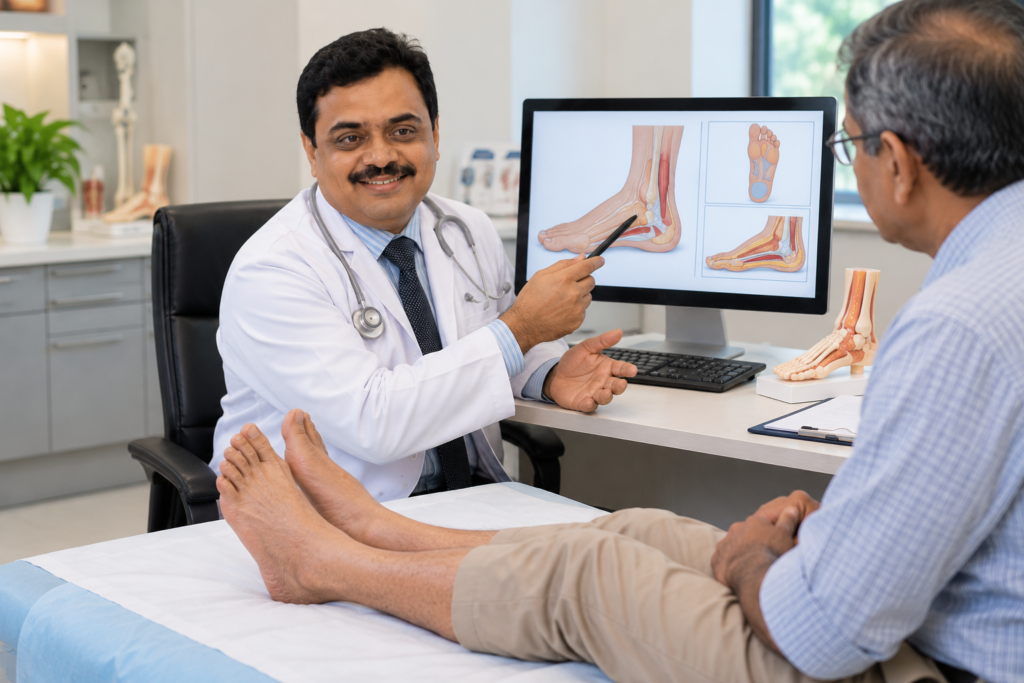
A skin graft can cover some foot wounds, but it may not provide enough protection when deeper structures are exposed or the wound lacks suitable supporting tissue. Flap surgery for foot wound in Bharuch may be considered for selected complex wounds because a flap transfers living tissue with its blood supply. The decision depends on wound depth, infection, circulation, tissue loss and the patient’s overall health.
What is flap surgery for a diabetic foot wound?
Flap surgery is a reconstructive procedure in which tissue is moved from one area to another while maintaining or reconnecting its blood supply. Depending on the wound, the transferred tissue may include skin, fat, fascia or muscle.
For a diabetic foot wound, reconstruction may be considered when a large or deep area of tissue has been lost and simpler wound closure is unlikely to provide adequate coverage. This can happen after severe infection, surgical removal of unhealthy tissue or a wound that exposes bone or tendon.
A flap is not required for every diabetic foot ulcer. Many wounds can heal with appropriate wound care, pressure relief, infection management and attention to blood circulation. A specialist must assess whether reconstruction is necessary.
When is a skin graft not enough?
A skin graft is a layer of skin transferred to a prepared wound surface. It does not carry its own blood supply after transfer; it relies on the receiving wound bed to develop a blood supply.
A graft may be unsuitable when the wound is too deep, the base is not healthy enough or important structures need more substantial coverage. A flap can bring vascularised tissue into the defect, but it also requires careful planning and adequate blood flow.
| Wound finding | Why a simple skin graft may not be suitable | What the surgeon may consider |
|---|---|---|
| Exposed bone | The wound may lack suitable soft-tissue support | Flap reconstruction in selected cases |
| Exposed tendon | A graft may not receive adequate support from the wound bed | Vascularised tissue coverage, depending on the defect |
| Deep tissue loss | The defect may need more volume or durable coverage | Local, regional or free flap |
| Wound over a weight-bearing area | The area needs coverage that can tolerate pressure and movement | Individualised reconstruction and pressure-relief planning |
| Unhealthy or infected wound bed | The wound may not be ready for definitive coverage | Infection treatment and wound preparation first |
| Poor circulation | The graft or flap may fail to heal | Vascular assessment and treatment where indicated |
These findings do not automatically mean that a flap is the correct choice. In some cases, the wound may first need debridement, infection control or improved circulation before reconstruction can be considered.
Skin graft vs flap surgery: What is the difference?
The main difference is the tissue’s blood supply and the type of wound it can cover.
A skin graft is generally suited to an appropriately prepared wound surface with healthy tissue underneath. A flap transfers tissue with its own blood supply or has its blood supply re-established, making it useful for selected defects that need deeper or more durable coverage.
The choice depends on the location and depth of the wound, the amount of tissue missing, circulation and the patient’s health. More complex surgery is not automatically better; the aim is to select the least complex option that can provide suitable coverage.
What types of flap can be used for foot wounds?
The reconstructive approach depends on the wound’s size, location and surrounding tissue.
Local flap
Tissue near the wound is moved to cover the defect. This may be suitable when nearby tissue is healthy and has an adequate blood supply.
Regional or pedicled flap
Tissue from a nearby area is transferred while remaining attached to its supplying blood vessels. This can provide coverage when local tissue is insufficient.
Free flap
Tissue is taken from another part of the body and transferred to the foot. The surgeon reconnects its blood vessels using microsurgical techniques. This may be considered for selected large or complex defects.
Not every patient is suitable for every technique. The surgical team weighs the benefits and risks against the wound’s requirements and the patient’s overall condition.
What must be checked before flap surgery?
Reconstruction is not simply a matter of covering the visible wound. The underlying reasons for poor healing must also be addressed.
Assessment may include:
- Wound depth and size: to identify the amount and type of tissue missing.
- Infection: to check for spreading infection, abscess or possible bone involvement.
- Blood circulation: to determine whether enough blood reaches the foot to support healing.
- Dead or damaged tissue: to decide whether debridement is needed.
- Blood glucose and general health: to support surgical planning and recovery.
- Sensation and pressure: to understand the risk of repeated injury.
- Foot structure and function: to plan coverage and reduce the risk of another ulcer.
When peripheral arterial disease is suspected, vascular testing and specialist input may be needed. Poor circulation can threaten both wound healing and flap survival.
Does infection need to be treated before reconstruction?
Often, yes. The timing depends on the severity and type of infection. A deep infection or abscess may require urgent surgical treatment, including drainage and removal of infected or dead tissue.
Definitive reconstruction may be delayed until the wound has been appropriately assessed and prepared. Some complex cases need treatment in stages rather than a single operation.
Do not try to manage a deep, worsening or infected diabetic foot wound with home dressings alone. Black tissue, pus, spreading redness, a foul smell, fever or rapid deterioration require urgent medical assessment. Reduced sensation can make a serious wound surprisingly painless.
What happens after flap surgery?
Recovery varies according to the wound, the type of flap and the patient’s health. The team will monitor the reconstructed tissue and provide a plan for wound care and activity.
Aftercare may include:
- Monitoring the flap’s colour, temperature, swelling and circulation.
- Following wound-care and dressing instructions.
- Managing infection and blood glucose as advised.
- Keeping pressure off the reconstructed area for the recommended period.
- Following instructions on movement and weight-bearing.
- Using suitable footwear or offloading devices when advised.
- Attending follow-up visits so the wound and reconstruction can be checked.
Walking too soon or placing pressure on the area before it is ready may compromise healing. Do not resume normal weight-bearing until the treating team advises that it is safe.
Can flap surgery prevent amputation?
Flap reconstruction may form part of a limb-preservation plan when the wound needs substantial tissue coverage and the patient is an appropriate candidate. However, it cannot guarantee that amputation will be avoided.
The outcome depends on several factors, including blood flow, infection severity, the amount of healthy tissue remaining, pressure on the foot and the patient’s general health. Sometimes amputation is still the safest option. The treatment goal is to preserve viable tissue and useful function when medically achievable.
Where can patients seek an assessment for flap surgery for foot wound in Bharuch?
A wound that is deep, repeatedly infected or failing to heal needs an assessment of more than its surface. Patients can contact the Bharuch diabetic foot OPD to ask about assessment and appointment arrangements.
The clinician can examine the wound, evaluate circulation and infection, and determine whether ongoing wound care, debridement, vascular treatment, a skin graft or flap reconstruction may be appropriate.
For an overview of possible procedures, read about Diabetic Foot Surgery. The need for surgery and the specific technique must be decided after an individual clinical assessment.
Frequently asked questions
Flap surgery may be considered when a wound has substantial tissue loss, exposes deeper structures or cannot be covered adequately with simpler methods. The decision depends on wound depth, circulation, infection control, available tissue and the patient’s overall health. Not every diabetic foot ulcer needs reconstruction.
Neither is always better. A skin graft may work for a suitable, healthy wound bed, while a flap may be needed for selected deeper defects requiring vascularised tissue coverage. The surgeon chooses based on wound location, depth, blood supply, pressure and the amount of tissue missing.
In selected cases, a flap can provide tissue coverage over exposed bone or tendon. Before reconstruction, the clinical team must assess infection, circulation and the condition of the wound. The most suitable technique depends on the defect and the patient’s ability to heal.
No. A non-healing wound may need reassessment of infection, blood circulation, pressure, glucose control or the original cause of the ulcer. Some wounds improve after these problems are addressed; others need debridement, vascular treatment or reconstruction. Treatment should be based on examination rather than wound duration alone.
Patients can contact the Bharuch diabetic foot OPD to ask about an appointment for wound assessment. The clinician can evaluate the wound and explain whether a skin graft, flap reconstruction or another treatment may be appropriate.
Conclusion
Flap surgery can help cover selected complex foot wounds when a skin graft or simpler closure is unlikely to provide adequate tissue coverage. The key considerations are wound depth, exposed structures, infection, blood circulation and the amount of healthy tissue available. Early specialist assessment helps determine the safest treatment plan and whether reconstruction is appropriate.