
Why Do Toes Change Color in Diabetes?
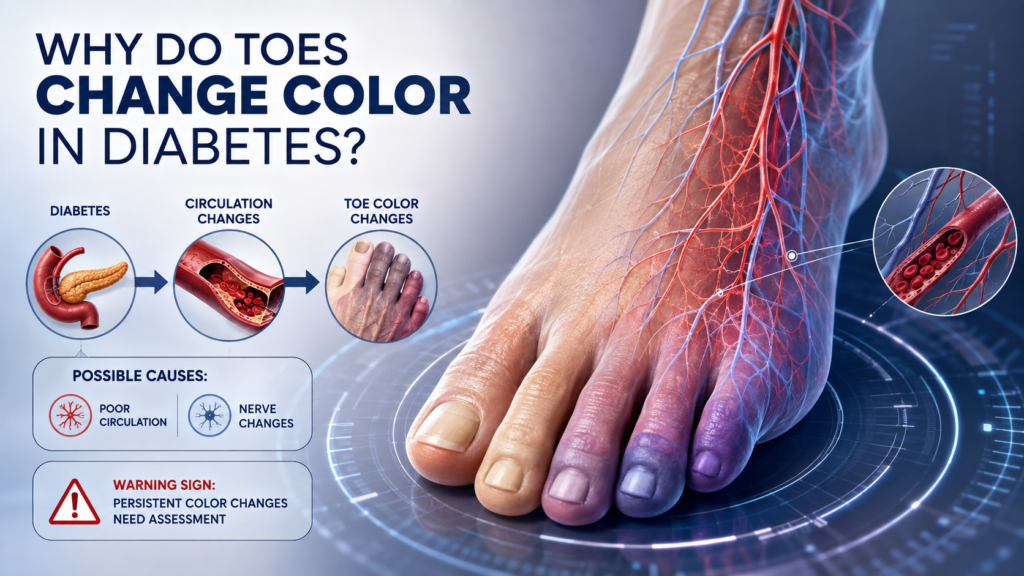
A visible colour change is a clinical clue rather than a diagnosis. At Elegance Diabetic Foot And Ulcers Clinic (EDFC), Surat, evaluation can consider circulation, sensation, pressure, infection, wounds, temperature, and tissue condition together.
Dr. Ashutosh Shah, M.Ch., DNB (Plastic Surgery) has more than 22 years of surgical experience, with reconstructive expertise relevant to diabetic wounds, threatened tissue, and limb-preservation planning.
A change in toe colour in a person with diabetes should not be ignored, especially when it is new, persistent, or getting worse. Toe color changing in diabetes can have several possible explanations, including repeated pressure, injury, inflammation, infection, reduced circulation, or tissue damage. The colour itself cannot confirm the cause, so an examination is important when the change is unexplained.
Diabetes can affect the feet in two important ways. Some people develop peripheral neuropathy, which reduces protective sensation. Diabetes can also be associated with reduced blood flow to the feet. NIDDK notes that nerve damage may prevent a person from noticing an injury, while poor blood flow can make wounds and infections harder to heal.
Different colours can provide different clues. A toe may look red because of pressure, irritation, inflammation, or infection. Pale, bluish, or purple changes may raise concern about circulation, depending on the circumstances. Darkening or black tissue can be associated with serious tissue injury, but a diagnosis should never be made from colour alone.
For patients in Surat, a changing toe should be assessed promptly when it is accompanied by swelling, warmth, a wound, discharge, increasing redness, unusual coldness, or darkening tissue. Importantly, a diabetic foot problem can sometimes be serious even without much pain.
Key Takeaways
- New toe discoloration in a person with diabetes deserves attention.
- Red, pale, blue, purple, or dark toes can have different possible causes.
- Colour alone cannot diagnose poor circulation, infection, or gangrene.
- Diabetic neuropathy can make significant foot problems surprisingly painless.
- Reduced circulation can interfere with wound healing.
- A rapidly darkening or black toe needs urgent medical assessment.
- Early evaluation can identify whether circulation, infection, pressure, injury, or another problem is involved.
Why Can Toes Change Colour in Diabetes?
Toe discoloration can occur for different reasons, including pressure, minor injury, inflammation, infection, altered circulation, bruising, or tissue damage. Diabetes does not make every colour change dangerous, but diabetes-related neuropathy and vascular disease can increase the importance of unexplained foot changes.
The appearance of the toe is only one part of the assessment.
A clinician may also need to know whether the toe feels warmer or colder than the surrounding foot, whether swelling is present, how quickly the colour changed, and whether there is a blister, wound, callus, or discharge.
Peripheral Arterial Disease (PAD): A condition in which narrowed arteries reduce blood flow to the limbs, commonly affecting the legs and feet.
Diabetes is associated with PAD, and reduced circulation can make diabetic foot wounds more difficult to heal.
What Can a Red Toe Mean in Diabetes?
A red toe may result from pressure, rubbing, inflammation, injury, or infection, among other causes. Redness that persists or occurs with warmth, swelling, a wound, discharge, or spreading skin changes should be professionally evaluated.
Footwear deserves attention.
A shoe may repeatedly rub one toe without the patient noticing significant discomfort, particularly when protective sensation is reduced.
Redness can therefore be an early visual warning of mechanical stress.
NIDDK advises people with diabetes to seek care when foot skin becomes red, warm, or painful because these can be signs of infection.
Why Can a Diabetic Toe Look Pale or White?
A persistently pale toe may require assessment of circulation, particularly when it is also unusually cold or associated with other changes. However, appearance alone cannot determine whether arterial blood flow is reduced, and clinical examination or vascular testing may be needed.
A temporary colour change from pressure is different from persistent pallor.
This is why clinicians consider the pattern of colour change together with pulses, temperature, circulation, symptoms, and medical history.
When circulation is suspected, Diabetic Foot Circulation Assessment can be placed here.
Why Can a Toe Become Blue or Purple?
Blue or purple discoloration can have several explanations, including bruising and circulation-related problems. A new or unexplained blue or purple toe in a patient with diabetes should be assessed, especially when it is cold, numb, painful, swollen, wounded, or changing rapidly.
Do not assume that every purple toe has the same cause.
For example, an injury can cause bruising, while altered circulation requires a different approach. Examination is needed to distinguish between these possibilities.
Changes in foot colour and temperature can provide useful clues during a diabetic foot and vascular examination.
What Does a Dark or Black Toe Mean in Diabetes?
A new dark or black area on a diabetic toe requires urgent medical assessment because serious tissue damage, impaired blood supply, or infection may be possible. However, black colour alone should not be used to diagnose gangrene without an appropriate clinical examination.
Gangrene: Death of body tissue caused by loss of blood supply or, in some cases, serious infection.
The NHS lists dark red, purple, or black colour changes among possible signs of gangrene and describes gangrene as a serious condition requiring urgent treatment.
A rapidly darkening toe should therefore not be watched at home for several days to see whether it improves.
Professional assessment is needed to determine tissue viability and whether circulation, infection, or another process is responsible.
Why Can a Serious Toe Problem Have Little Pain?
Diabetic peripheral neuropathy can reduce the ability to feel pain, temperature, and injury. As a result, a person may continue walking on an injured or pressured toe without experiencing the amount of discomfort normally expected from the tissue damage.
Diabetic Neuropathy: Nerve damage associated with diabetes that can cause numbness, tingling, pain, or reduced protective sensation.
NIDDK reports that up to half of people with diabetes have peripheral neuropathy.
This makes an important point:
No pain does not necessarily mean no problem.
Visual changes such as redness, swelling, blistering, wounds, or discoloration become particularly important when protective sensation is reduced.
Can Infection Change the Colour of a Diabetic Toe?
Yes, infection can cause visible changes, but colour alone cannot establish that infection is present.
A toe with infection may develop redness, warmth, swelling, tenderness, discharge, or changes around an existing wound. Some patients may also develop fever or feel generally unwell when an infection becomes more significant.
Diabetic foot infections can progress beyond the skin in some cases, making early assessment important.
Patients should not try to diagnose or treat a suspected deep infection using photographs or home remedies.
How Is Toe Discoloration Assessed?
Assessment may include examining the colour change, skin, wounds, swelling, temperature, sensation, circulation, pressure points, and foot pulses. Depending on the findings, additional vascular, wound, infection, or imaging investigations may be considered.
The clinician may ask:
When did the colour change start? Did it happen suddenly or gradually? Is the toe warmer or colder? Was there an injury? Is there a wound? Has the colour continued to spread or darken?
These details help determine what should be investigated next.
For patients who need broader conservative diabetic foot assessment, Nonsurgical Diabetic Foot Management can be included here.
Should You Massage or Heat a Discoloured Diabetic Toe?
Do not automatically massage or apply direct heat to an unexplained discoloured toe.
If sensation is reduced, a patient may not recognise excessive heat and could accidentally burn the skin. NIDDK specifically advises people with diabetic nerve damage to protect their feet from heat sources such as heating pads and hot-water bottles.
The underlying cause of the colour change should be identified before attempting home treatments.
When Does Toe Colour Change Need Urgent Care?
Seek prompt medical attention when toe discoloration is rapidly developing or worsening, particularly when the toe becomes very dark or black, unusually cold, significantly swollen, develops an open wound or discharge, or is accompanied by spreading redness or signs of systemic illness.
Do not wait for severe pain.
Neuropathy may reduce pain even when tissue is being damaged.
A new colour change that persists without an obvious explanation also deserves assessment, particularly in someone with previous diabetic foot ulcers, neuropathy, or known circulation problems.
Looking at More Than the Colour at EDFC
At Elegance Diabetic Foot And Ulcers Clinic in Surat, the purpose of evaluating a discoloured toe is to determine what is happening to the tissue, rather than assigning a diagnosis from appearance alone.
Assessment may consider blood flow, protective sensation, infection, pressure, wounds, previous diabetic foot problems, and tissue viability.
With more than 22 years of surgical experience, Dr. Ashutosh Shah brings plastic and reconstructive expertise that can be relevant when diabetic foot changes involve threatened tissue, wounds, or limb-preservation concerns.
Early evaluation is particularly valuable because neuropathy can make pain an unreliable indicator of severity.
Conclusion
Toe color changing in diabetes can have several explanations. Redness may be associated with pressure, irritation, inflammation, or infection, while pale, blue, purple, or dark changes may raise different concerns, including circulation and tissue health.
The important point is that colour alone cannot provide a diagnosis.
For people with diabetes, a new or persistent toe colour change deserves additional attention because neuropathy can hide pain and reduced circulation can complicate healing.
Patients in Surat can seek assessment at Elegance Diabetic Foot And Ulcers Clinic to determine whether circulation, pressure, infection, injury, or another factor is responsible.
A rapidly worsening, very dark or black, unusually cold, significantly swollen, wounded, or infected-looking toe should receive prompt medical attention.
Noticed an unexplained change in the colour of a toe?
Consult Dr. Ashutosh Shah at Elegance Diabetic Foot And Ulcers Clinic, Surat, for an individual diabetic foot assessment, particularly if the change is new, persistent, or worsening.
Frequently Asked Questions
Pressure, rubbing, inflammation, injury, or infection are among the possible causes. Persistent redness or redness with warmth, swelling, or a wound should be assessed.
Purple discoloration can have different causes, including bruising and circulation-related problems. New or unexplained discoloration requires clinical evaluation.
No. Colour alone cannot diagnose gangrene. However, a newly black or rapidly darkening toe is potentially serious and needs urgent medical assessment.
Yes. Altered blood flow can contribute to colour and temperature changes, although circulation cannot be accurately assessed from colour alone.
Neuropathy itself mainly affects nerves and sensation, but reduced sensation can allow unnoticed pressure or injury to progress and produce visible skin changes.