
Why Do Diabetic Feet Develop Calluses?
At Elegance Diabetic Foot And Ulcers Clinic (EDFC), Surat, assessment can focus on the callus as a marker of pressure. The clinician may consider its location, foot shape, footwear, sensation, circulation, skin condition, and whether there are signs of breakdown beneath or around it.
Diabetic patients should not cut, shave, or use strong medicated callus removers on their own. Professional assessment is especially important if the area develops bleeding, discharge, redness, swelling, colour changes, or an open wound.
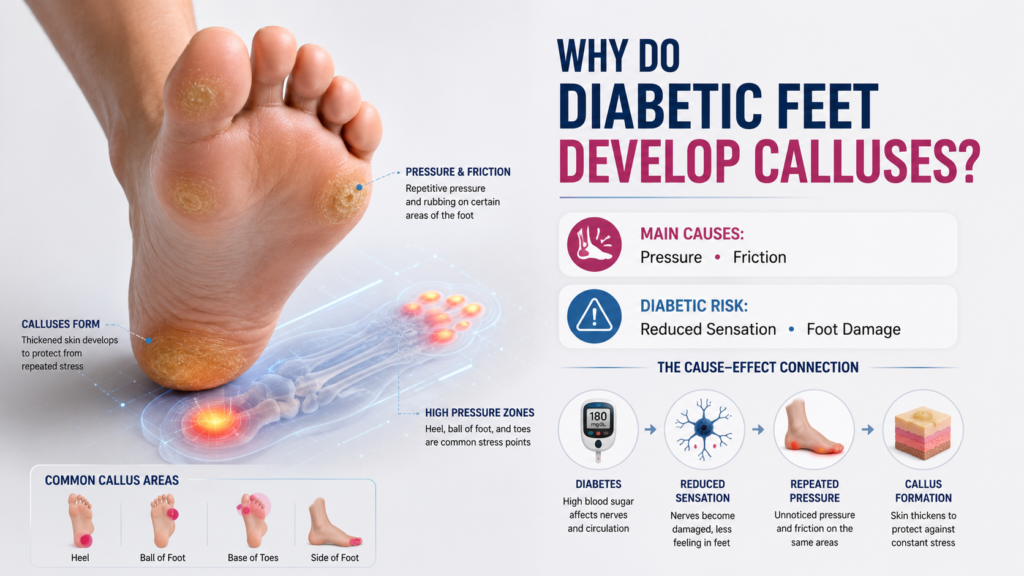
A callus on a diabetic foot is more than an area of hard or thick skin. It often develops where the foot experiences repeated pressure or friction. For a person with diabetes, this deserves attention because reduced sensation may make it harder to notice ongoing pressure, irritation, or early skin damage.
Calluses commonly form over weight-bearing areas, prominent joints, or places where footwear repeatedly rubs the foot. The skin responds to this mechanical stress by becoming thicker. In someone with normal sensation, discomfort may encourage a change in footwear or walking pattern. With diabetic peripheral neuropathy, however, the warning sensation can be reduced or absent.
This creates an important problem: pressure can continue even when the foot does not hurt.
A thick callus can also make it harder to assess the skin underneath. For this reason, repeatedly filing, cutting, or treating the visible hard skin at home does not address why the callus developed.
At Elegance Diabetic Foot And Ulcers Clinic (EDFC), Surat, assessment can focus on the callus as a marker of pressure. The clinician may consider its location, foot shape, footwear, sensation, circulation, skin condition, and whether there are signs of breakdown beneath or around it.
Diabetic patients should not cut, shave, or use strong medicated callus removers on their own. Professional assessment is especially important if the area develops bleeding, discharge, redness, swelling, colour changes, or an open wound..
Key Takeaways
- A diabetic foot callus often indicates repeated pressure or friction.
- Diabetic neuropathy can reduce the pain that normally warns a person about excessive pressure.
- A painless callus should not automatically be considered harmless.
- Removing hard skin without addressing pressure may allow the problem to return.
- Patients with diabetes should avoid cutting or shaving calluses themselves.
- Footwear and pressure redistribution can be important parts of prevention.
- Bleeding, drainage, swelling, redness, colour changes, or an open area need medical assessment.
Why Do Calluses Form on Diabetic Feet?
Calluses develop when an area of skin repeatedly experiences pressure or friction. On the foot, this may occur because of walking mechanics, prominent bones, toe position, footwear, or uneven pressure distribution. Diabetes itself is not the only cause, but diabetes can make the consequences more important.
Callus: An area of thickened skin that develops as a protective response to repeated mechanical pressure or friction.
A callus therefore provides useful information.
Instead of asking only, “How can this hard skin be removed?”, diabetic foot care should also ask:
“Why is so much pressure occurring at this exact location?”
Without answering that question, the callus may continue returning.
Why Is a Callus More Important When You Have Diabetes?
A diabetic foot callus deserves attention because some people with diabetes develop neuropathy, which reduces protective sensation. Continued pressure may then damage tissue without producing the amount of pain that would normally alert the person to a problem.
Peripheral Neuropathy: Nerve damage affecting the extremities that can reduce sensation, including the ability to detect pressure, pain, or injury.
Not everyone with diabetes has neuropathy. However, when sensation is reduced, relying on pain alone becomes unreliable.
A person may continue walking on a heavily loaded area because it does not feel particularly uncomfortable.
That is why regular visual foot inspection becomes important.
Can a Diabetic Foot Callus Hide a Wound?
Yes, skin damage can sometimes develop beneath or around a thick callus, particularly when repeated pressure continues. A callused area that develops bleeding, drainage, discolouration, swelling, separation of the skin, or another unexpected change should be professionally evaluated.
A callus should not automatically be interpreted as an ulcer. They are different conditions.
However, a thick layer of hard skin can make assessment of the underlying tissue more difficult.
This is one reason aggressive home trimming is unsafe. A patient with reduced sensation may remove too much tissue without immediately recognising that healthy skin has been injured.
How Is a Diabetic Foot Callus Assessed?
Assessment involves more than looking at the thickness of the callus. A clinician may consider its location, pressure pattern, foot structure, footwear, sensation, circulation, surrounding skin, previous ulcers, and whether tissue breakdown is developing underneath.
The location can provide clues.
A recurring callus beneath a particular part of the forefoot, for example, may indicate repeated loading of that area while walking.
Footwear may also be inspected to identify rubbing, tight areas, or uneven wear.
Circulation and sensation may need additional attention in patients with diabetes because both can influence foot safety and treatment decisions.
How Is a Diabetic Foot Callus Managed?
Management should address both the thickened skin and the pressure responsible for its formation. Depending on the patient, care may include professional callus reduction, pressure redistribution, footwear modification, foot-care education, and treatment of other factors contributing to repeated mechanical stress.
Professional reduction of excessive callus may be appropriate in selected patients, but this is different from cutting the callus at home.
The objective is controlled treatment without unnecessarily damaging healthy tissue.
Patients who need conservative diabetic foot care can learn more about Nonsurgical Management as part of an individual foot-care plan.
If the same callus rapidly returns, the pressure source needs further attention.
Why Should You Not Cut a Diabetic Foot Callus at Home?
People with diabetes should avoid cutting, shaving, peeling, or aggressively filing a callus themselves, particularly when sensation or circulation is impaired. Accidental damage can create an open wound that may not be noticed immediately.
Strong medicated corn or callus removers can also damage surrounding healthy skin.
The American Diabetes Association advises people with diabetes not to remove corns or calluses themselves and recommends discussing appropriate care with a healthcare professional.
Home care should focus on routine foot observation and following individual professional advice rather than performing invasive callus removal.
Why Does Footwear Matter?
Footwear can influence where pressure and friction occur on the diabetic foot. Shoes that are too tight, poorly shaped, worn internally, or unsuitable for the patient’s foot structure can repeatedly load vulnerable areas and contribute to callus formation.
The answer is not simply to buy a larger shoe.
Footwear needs appropriate length, width, depth, support, and fit for the individual’s foot.
When repeated pressure is contributing to callus formation, Diabetic Footwear Services may help patients understand options designed to reduce stress on vulnerable areas.
Offloading: Reducing or redistributing pressure away from a vulnerable or injured part of the foot.
Footwear and offloading recommendations should be individualised rather than based solely on shoe size.
Can Diabetic Foot Calluses Be Prevented?
Not every callus can be completely prevented, but repeated pressure can often be identified and managed.
Prevention may involve regular foot checks, properly fitting footwear, attention to pressure points, appropriate skin care, and periodic professional assessment for people at increased risk.
Patients should look at the soles, sides, heels, and spaces around the toes regularly, particularly when sensation is reduced.
A recurring callus should be treated as useful information: the foot is telling you where repeated mechanical stress is occurring.
When Should You See a Diabetic Foot Specialist?
A diabetic patient should seek professional assessment when a callus repeatedly returns, becomes unusually thick, changes colour, develops bleeding or drainage, or is associated with redness, swelling, skin breakdown, or an open wound. Reduced sensation or known circulation problems are additional reasons for careful evaluation.
Prompt assessment is particularly important when there are signs of infection, rapidly changing tissue colour, significant swelling, fever, or a worsening wound.
Do not wait for severe pain before seeking help. Neuropathy can make pain an unreliable warning sign.
Looking Beyond the Hard Skin at EDFC
At Elegance Diabetic Foot And Ulcers Clinic, Surat, a diabetic foot callus can be approached as a sign of how pressure is being distributed across the foot rather than simply as unwanted thick skin.
Assessment may therefore extend to sensation, circulation, footwear, foot structure, previous wounds, and areas exposed to repeated mechanical stress.
With more than 22 years of surgical experience, Dr. Ashutosh Shah brings a reconstructive perspective to diabetic foot care, particularly when pressure-related skin problems progress toward tissue breakdown or more complex wounds.
The goal is to recognise vulnerable areas early and determine an appropriate strategy for protecting the foot.
Conclusion
A callus on a diabetic foot should not simply be ignored because it is painless. It often identifies an area exposed to repeated pressure, and diabetic neuropathy can reduce the warning sensations that would normally encourage a person to protect that area.
Treatment is therefore not only about removing hard skin. Effective diabetic foot management considers why the callus developed, whether the tissue underneath remains healthy, and how repeated pressure can be reduced.
For patients in Surat, assessment at Elegance Diabetic Foot And Ulcers Clinic can help identify pressure points, sensation changes, footwear concerns, and early signs of skin breakdown.
Avoid cutting, shaving, or chemically treating a diabetic foot callus yourself. If the area is changing, repeatedly returning, bleeding, or developing into an open wound, professional assessment is important.
Noticed a recurring or thick callus on a diabetic foot?
Consult Dr. Ashutosh Shah at Elegance Diabetic Foot And Ulcers Clinic, Surat, for an assessment of foot pressure, sensation, skin condition, and appropriate preventive care.
Frequently Asked Questions
A callus is not automatically dangerous, but it can identify an area exposed to repeated pressure. When neuropathy is present, ongoing pressure may cause tissue damage without significant pain.
Self-cutting or shaving is not recommended. Patients with diabetes should have problematic calluses professionally assessed.
Persistent pressure, footwear, foot structure, or walking mechanics may continue loading the same area even after the thick skin has been reduced.
A heavily pressured callused area can be associated with underlying tissue damage and ulceration in an at-risk diabetic foot. Assessment and pressure management are important.
Yes. Diabetic neuropathy can reduce protective sensation, so lack of pain does not necessarily mean the area is free from harmful pressure.