
What Is a Pedobarogram Test and Why Is It Done?
Clinical Review: Dr. Ashutosh Shah, M.Ch., DNB (Plastic Surgery)
Focus: Diabetic Foot Care, Reconstruction & Foot Biomechanics
Experience: 22+ Years
Clinic: Elegance Diabetic Foot & Ulcers Clinic, Surat
Last Updated: August 2026
A diabetic foot can develop dangerous pressure points before there is an obvious wound. When sensation is reduced because of neuropathy, a person may continue walking on these areas without realising that the skin is being repeatedly stressed.
A pedobarogram test helps identify how pressure is distributed across the sole during standing and walking. EDFC describes pedobarography as a digital method for detecting abnormal pressure points and uses computerised pressure assessment as part of diabetic foot care.
Introduction
Your footprint does not tell the whole story of how your foot works.
Two people can have feet that look similar but load them very differently while walking. One may distribute body weight relatively evenly, while another may repeatedly overload a small area beneath the heel, forefoot or toes.
For a person with diabetes, that difference can matter.
Repeated pressure can contribute to callus formation and skin breakdown, particularly when neuropathy reduces protective sensation.
A pedobarogram helps turn this invisible pressure pattern into measurable information.
At Elegance Diabetic Foot & Ulcers Clinic in Surat, pedobarography is available as part of diabetic foot pressure assessment and can support decisions about offloading and customised footwear.
Key Takeaways
- A pedobarogram measures pressure distribution beneath the foot.
- The test can assess pressure while standing and walking.
- It is non-invasive and does not involve needles or surgery.
- High-pressure areas may increase the risk of callus and skin breakdown.
- Pressure assessment is particularly useful when diabetic neuropathy reduces sensation.
- Results can help guide offloading footwear, insoles and orthotics.
- Pedobarography can also help assess the mechanical reason behind recurrent ulcers.
- The test does not diagnose infection, neuropathy or poor circulation by itself.
- A complete diabetic foot assessment may require additional neurological and vascular tests.
- The pressure map should be interpreted together with a clinical examination.
What Is a Pedobarogram Test?
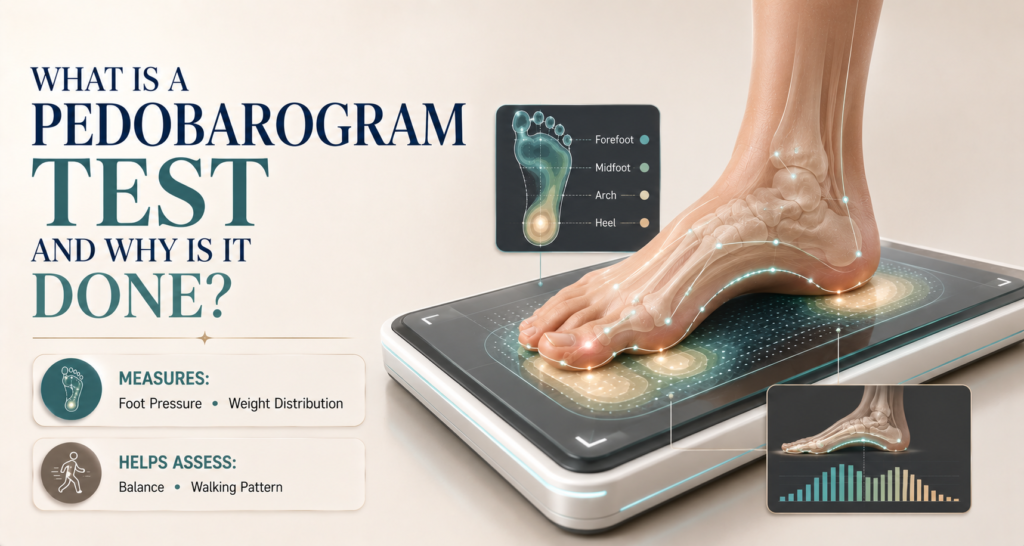
A pedobarogram is a foot pressure mapping test that measures how pressure is distributed across the sole while a person stands or walks.
Instead of showing only the shape of the foot, the test provides information about where the foot is carrying more or less pressure.
EDFC describes pedobarography as a digital investigation used to measure pressure distribution during standing and walking and identify high-pressure areas of the sole.
These findings can then be interpreted alongside foot shape, calluses, ulcers, deformities, sensation and walking pattern.
Why Is a Pedobarogram Done?
The test is performed to identify areas experiencing abnormal or excessive mechanical loading.
It may be particularly useful when a patient has:
- diabetes with neuropathy,
- repeated callus formation,
- recurrent foot ulcers,
- foot deformity,
- abnormal walking mechanics,
- previous diabetic foot surgery,
- or a need for customised offloading footwear.
The objective is not simply to obtain a colourful pressure map.
The clinically important question is:
Is a particular area of the foot repeatedly receiving enough pressure to put the skin at risk?
What Does a Pedobarogram Show?
A pedobarogram can provide information about pressure distribution across different parts of the foot.
| Finding | What It May Suggest |
|---|---|
| Concentrated forefoot pressure | Excessive loading beneath selected metatarsal areas |
| High heel pressure | Increased loading at the heel |
| Toe-tip pressure | Possible contribution from toe deformity |
| Outer-foot loading | Altered foot mechanics or alignment |
| Unequal right-left pressure | Asymmetrical loading pattern |
| Pressure near an old ulcer | Possible mechanical contribution to recurrence |
| Improved pressure after offloading | Footwear or orthotic modification may be redistributing load |
The pressure map is not a diagnosis on its own. It needs to be interpreted in the context of the patient’s foot and medical condition.
How Is a Pedobarogram Test Performed?
The exact system can vary, but the process is generally straightforward.
The patient places the feet on or walks across a pressure-sensitive platform.
Sensors measure forces beneath different areas of the foot.
Computer software then converts those measurements into a pressure distribution map.
The clinician can examine where pressure is concentrated and how it changes across the foot.
EDFC specifically describes its pedobarogram as measuring pressure while both standing and walking.
Is a Pedobarogram Painful?
No. Pedobarography is a non-invasive pressure assessment.
There are no injections, incisions or surgical procedures involved.
The patient generally needs to stand or walk naturally during the test.
For someone who already has an active ulcer or significant mobility limitation, the clinical team may need to adapt assessment according to the condition of the foot.
What Is the Difference Between Static and Dynamic Foot Pressure?
Static pressure refers to how pressure is distributed while standing.
Dynamic pressure examines loading as the foot moves through walking.
Both can provide useful but different information.
A pressure problem may not be obvious when someone is standing still. During walking, however, one part of the forefoot or a toe may repeatedly experience a much higher load.
This is why dynamic pressure assessment can be particularly useful when trying to understand recurrent pressure-related problems.
Why Is Foot Pressure Important in Diabetes?
Diabetes can affect the feet in several ways, but neuropathy is particularly relevant to pressure.
Protective sensation normally warns us when something hurts.
If a shoe repeatedly rubs one area or the foot is overloaded, discomfort encourages us to change position, remove the shoe or rest.
With significant neuropathy, that warning may be reduced.
A person can continue taking thousands of steps on an overloaded area without recognising the tissue stress.
This can contribute to:
Pressure → Callus → Tissue Damage → Ulcer
A pedobarogram can help identify the pressure component before or after skin breakdown occurs.
Can a Pedobarogram Detect Diabetic Neuropathy?
No. A pedobarogram measures pressure; it does not directly test nerve function.
This distinction is important.
A patient can have abnormal pressure without neuropathy, and a patient can have neuropathy without a major abnormality on pressure mapping.
EDFC lists neurosensory examination and pedobarogram as separate investigations because they answer different clinical questions. Vascular Doppler assessment is also listed separately for circulation.
A comprehensive diabetic foot examination may therefore combine several types of assessment.
Can a Pedobarogram Check Blood Circulation?
No.
Pressure mapping does not determine whether blood supply to the foot is adequate.
When poor circulation is suspected, vascular assessment is needed.
EDFC’s nonsurgical investigation service separately lists vascular audio Doppler for evaluating blood flow.
This distinction matters because pressure, neuropathy and circulation can all influence diabetic foot risk, but each requires a different type of evaluation.
Can a Pedobarogram Find Areas at Risk of Ulcers?
It can help identify high-pressure areas that may contribute to ulcer risk, especially when other risk factors such as neuropathy are present.
EDFC states that pedobarography is used to identify high-pressure areas of the sole that may be prone to ulcer formation.
However, a pressure map cannot predict with certainty that an ulcer will develop.
Skin condition, sensation, circulation, footwear, activity and deformity also influence risk.
Therefore, the test is best used as part of an overall assessment rather than as a standalone ulcer prediction tool.
Why Are Calluses Important on a Pressure Map?
A callus often forms where the skin repeatedly experiences mechanical stress.
If a thick callus repeatedly develops beneath the same metatarsal head or another location, pressure mapping may help determine whether that area is being excessively loaded.
For a patient with diabetic neuropathy, callus should not automatically be considered a harmless cosmetic problem.
It can act as a warning sign that the tissue beneath it is experiencing repeated stress.
Patients with diabetes should also avoid cutting corns or calluses themselves because accidental skin injury can become problematic.
How Can a Pedobarogram Help With Diabetic Foot Ulcers?
Consider a patient who repeatedly develops an ulcer beneath the same area of the forefoot.
Dressings may heal the skin.
But why does the ulcer keep returning?
Pressure mapping may show that the area is repeatedly overloaded during walking.
That information can change the treatment strategy from simply treating the wound to addressing the mechanical cause.
The next step might involve:
- modifying footwear,
- changing an insole,
- adding external offloading,
- evaluating a deformity,
- or considering corrective treatment in selected cases.
Can a Pedobarogram Help Prevent Ulcer Recurrence?
Potentially, yes.
If recurrent ulceration is related partly to abnormal pressure, identifying and reducing that pressure may help address one important risk factor.
But recurrence prevention requires more than a pressure test.
Patients may also need:
- regular foot inspection,
- diabetes management,
- neuropathy assessment,
- appropriate footwear,
- callus management,
- wound follow-up,
- and circulation assessment where indicated.
Pedobarography provides one piece of the prevention plan.
How Does a Pedobarogram Help With Offloading?
Offloading means reducing pressure on a vulnerable area.
A pressure map can help show where that reduction is needed.
For example, if one area beneath the forefoot is experiencing disproportionate pressure, footwear or an orthotic may be designed to redistribute load away from that location.
EDFC describes pedobarography as supporting the selection of offloading footwear for high-pressure areas.
This makes treatment more individualised than simply giving every patient the same soft insole.
Can Pedobarography Help Design Custom Footwear?
Yes. This is one of its practical applications.
EDFC states that therapeutic footwear can be made using pedobarogram readings to reduce pressure at specific points, while its nonsurgical information describes tailor-made footwear designed to distribute pressure more appropriately.
Patients who require pressure management can explore EDFC’s footwear and prosthetic services.
Custom footwear should still be checked after fitting because foot shape, activity and pressure patterns can change.
Is a Soft Shoe Enough for High Foot Pressure?
Not necessarily.
A shoe can feel soft while still allowing excessive pressure at one specific location.
Fit, depth, width, insole design, foot deformity and walking mechanics all influence pressure.
This is why footwear for a high-risk diabetic foot should not be chosen solely on comfort during a brief trial.
The goal is to protect the foot where it actually receives excessive load.
Can Pedobarography Help With Foot Deformities?
Yes, particularly when the clinician wants to understand how a deformity changes pressure distribution.
Examples may include:
- high arch foot,
- flat foot,
- claw toes,
- hammertoes,
- prominent metatarsal areas,
- and other structural abnormalities.
The visible deformity tells the clinician what the foot looks like.
The pressure map helps show how the deformity loads the ground.
Combining the two can provide a more useful biomechanical picture.
Can It Help With a High Arch Foot?
A high arch can reduce the amount of midfoot surface participating in weight distribution and may concentrate pressure beneath other areas.
Pedobarography may identify where that pressure is occurring.
The result can help guide footwear, orthotic modification or further biomechanical assessment.
This is particularly relevant in a diabetic patient who repeatedly develops callus or ulceration beneath the same pressure point.
Can a Pedobarogram Be Used Before Surgical Offloading?
It may provide useful information in selected patients.
Surgical offloading aims to correct a mechanical factor that is repeatedly producing abnormal pressure.
A pressure map can help clinicians understand where the overload occurs, but surgical decisions cannot be based on the map alone.
The surgeon also needs to examine:
- deformity,
- tendon balance,
- joint movement,
- bone alignment,
- neuropathy,
- circulation,
- wound location,
- and overall health.
EDFC offers both nonsurgical diabetic foot management and corrective surgical options, allowing pressure findings to be interpreted within the broader clinical picture.
Can the Test Be Repeated After Treatment?
Yes, repeat pressure assessment can sometimes be useful.
For example, after changing footwear or an orthotic, clinicians may want to know whether pressure at the original high-risk location has actually decreased.
This can help answer an important question:
Did the intervention change pressure distribution as intended?
Follow-up testing is not necessary at identical intervals for every patient. It should be used when the result could influence management.
Does a Normal Pedobarogram Mean My Diabetic Foot Is Safe?
No.
A pedobarogram evaluates pressure distribution. It does not rule out every diabetic foot problem.
A person can still have:
- neuropathy,
- poor circulation,
- infection,
- skin disease,
- nail problems,
- or other complications.
This is why EDFC’s investigation pathway includes separate assessments for nerve function, pressure and vascular status.
A normal pressure pattern therefore does not replace regular diabetic foot care.
Who May Benefit From a Pedobarogram?
A clinician may consider the test for someone with:
- diabetes and recurrent callus,
- previous diabetic foot ulcer,
- repeated ulceration at the same location,
- suspected abnormal pressure,
- foot deformity,
- neuropathy with high-risk feet,
- difficulty with footwear,
- or a need for customised orthotics or offloading footwear.
It can also be useful when clinical examination suggests that biomechanics are contributing to a wound.
Not every person with diabetes automatically needs frequent pressure mapping.
What Should You Do Before a Pedobarogram?
Usually, the test requires little preparation.
However, bring the footwear, insoles or orthotics you regularly use if your clinician requests them.
Also mention:
- previous ulcers,
- current wounds,
- previous foot surgery,
- numbness,
- calluses,
- pain,
- and recent changes in walking.
These details help the clinician interpret the pressure findings rather than viewing the map in isolation.
When Should You Have a Diabetic Foot Assessment?
Do not wait for a pressure test if you already have warning signs of an active diabetic foot problem.
Seek medical assessment if you notice:
- an open wound,
- increasing redness,
- swelling,
- discharge,
- a new blister,
- black or discoloured tissue,
- rapidly increasing callus,
- sudden change in foot shape,
- or a wound that is not healing.
Pressure mapping may eventually form part of the assessment, but infection, circulation problems and active tissue damage can require more immediate attention.
Why Is Pedobarography Useful Even When the Foot Does Not Hurt?
Pain is not a reliable indicator of risk in a neuropathic diabetic foot.
A person may have substantial pressure beneath one area but little or no discomfort because protective sensation has been reduced.
This is precisely why objective examination can be valuable.
The absence of pain should not automatically reassure someone who has diabetes, neuropathy, recurrent callus or a history of foot ulcers.
Conclusion
A pedobarogram test helps show how pressure is distributed across the sole during standing and walking.
In diabetic foot care, this information can help identify high-pressure areas that may contribute to calluses, tissue damage and recurrent ulceration. It can also support the planning of offloading footwear, customised insoles and selected biomechanical treatments.
But the pressure map is only one part of the picture.
It does not replace nerve testing, circulation assessment, wound examination or a clinical evaluation of foot deformity.
The real value of pedobarography comes from connecting the test result to a practical question:
Where is the foot overloaded, why is it happening, and what can be changed to protect that area?
Pedobarogram Testing at EDFC, Surat
Elegance Diabetic Foot & Ulcers Clinic provides computerised pedobarography as part of its diabetic foot assessment services in Surat. The clinic describes the test as a way to detect abnormal pressure points and support preventive footwear planning.
Patients can explore EDFC’s diabetic foot investigations, which also include neurosensory and vascular assessments for evaluating other important components of diabetic foot risk.
Dr. Ashutosh Shah has more than 22 years of surgical experience, and his clinical profile notes the use of computerised pedobarography for identifying abnormal pressure points in diabetic foot care.
Patients can also read about EDFC’s diabetic foot services or contact the clinic for an individual foot assessment in Surat.
Your Feet Can Be Under Pressure Before They Hurt
If you have diabetes and repeatedly develop calluses, ulcers or pressure marks in the same area, finding where your foot is overloaded may help guide the next step.
A diabetic foot evaluation can determine whether pedobarography, neuropathy testing, vascular assessment, customised footwear or another form of treatment is appropriate.
Frequently Asked Questions
A pedobarogram is a non-invasive test that measures pressure distribution beneath the feet during standing or walking.
It can identify high-pressure areas that may contribute to callus, skin breakdown or recurrent ulceration, especially when neuropathy reduces protective sensation.
No. It is a non-invasive pressure-mapping test and does not require needles or surgery.
No. Pedobarography measures pressure. A separate neurosensory examination is used to assess diabetic neuropathy
No. Circulation requires a vascular assessment, such as Doppler testing when clinically indicated.