
How Does Surgical Offloading Help a Diabetic Foot?
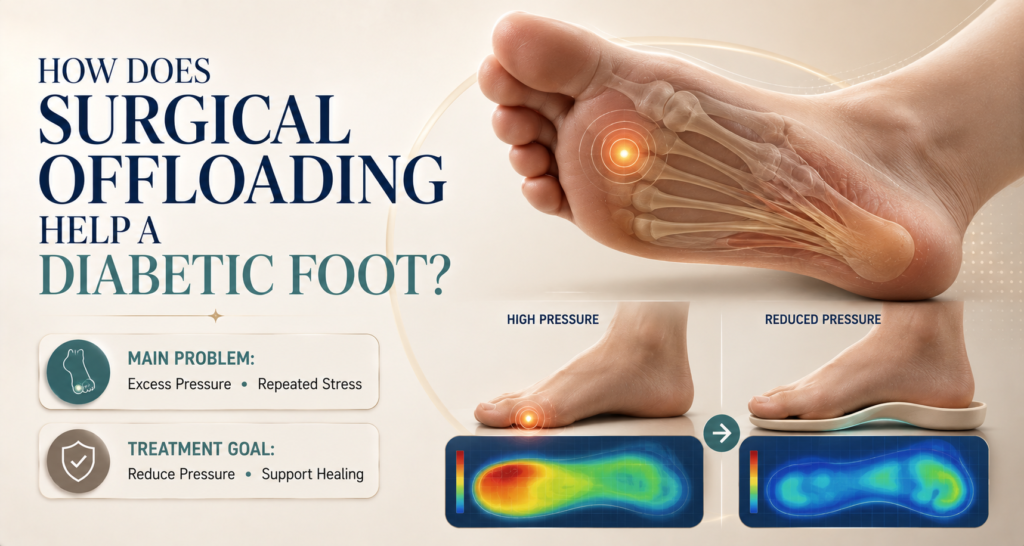
Diabetic Foot Pressure & Ulcer Prevention Guidance by Dr. Ashutosh Shah
Clinical Guidance By: Dr. Ashutosh Shah, M.Ch., DNB (Plastic Surgery)
Specialty: Plastic, Reconstructive Surgery & Diabetic Foot Management
Experience: 22+ Years
Clinic: Elegance Diabetic Foot & Ulcers Clinic, Surat
Last Updated: August 2026
A diabetic foot ulcer may heal with dressings, infection control and good diabetes management, yet return in exactly the same place. One possible reason is that the wound has healed, but the abnormal pressure that caused it has not been corrected.
This is where surgical offloading can become important. At Elegance Diabetic Foot & Ulcers Clinic, surgical diabetic foot care includes procedures intended to reduce abnormal pressure and address selected biomechanical problems of the foot.
Introduction
When someone with diabetes develops a foot ulcer, attention naturally goes to the wound: How deep is it? Is it infected? How can it be closed?
But another question can be just as important:
Why is this particular part of the foot repeatedly receiving too much pressure?
A prominent bone, tight tendon, toe deformity, restricted ankle movement or altered foot mechanics can repeatedly overload a small area. If neuropathy has reduced sensation, the patient may continue walking on that pressure point without feeling significant pain.
External offloading with specialised footwear, orthotics, braces or casts may help redistribute pressure. But in carefully selected patients, the mechanical problem itself may need correction.
This approach is called surgical offloading or internal offloading.
Key Takeaways
- Surgical offloading aims to reduce abnormal pressure inside a diabetic foot by correcting selected mechanical causes.
- It is different from simply dressing or closing an ulcer.
- External offloading remains important and is often tried or used alongside other treatment.
- Surgery may be considered for recurrent or difficult-to-heal ulcers associated with a correctable deformity or pressure point.
- Procedures can involve tendons, toes, bones or other structures depending on the cause.
- Not every diabetic foot ulcer requires surgery.
- Infection, blood circulation, neuropathy, glucose control and overall health must also be assessed.
- Surgery does not eliminate the need for appropriate footwear and lifelong diabetic foot care.
What Is Surgical Offloading in a Diabetic Foot?
Surgical offloading is a group of procedures designed to reduce excessive mechanical pressure on a high-risk or ulcerated part of the diabetic foot by changing the underlying biomechanics.
It is sometimes called internal offloading.
For example, if a deformity repeatedly concentrates pressure beneath one part of the foot, simply healing the skin does not necessarily remove that pressure.
Surgical offloading attempts to address the mechanical contributor itself.
EDFC includes surgical offloading among its diabetic foot surgical treatments, alongside procedures such as flexor tenotomy, correction of hammertoes and claw toes, metatarsal osteotomies, Achilles tendon lengthening and selected bony procedures.
Why Is Pressure So Important in Diabetic Foot Ulcers?
Pressure becomes particularly dangerous when diabetes has affected sensation in the feet.
Normally, pain tells you to stop putting pressure on an injured area.
With diabetic peripheral neuropathy, this warning system may be reduced.
A patient can therefore continue walking on an overloaded area without realising how much repetitive stress is occurring.
Over time, the sequence can become:
abnormal pressure → callus → tissue damage → skin breakdown → ulcer
If the pressure remains after the ulcer heals, recurrence may occur.
That is why diabetic foot treatment should look beyond the wound itself.
What Is the Difference Between External and Surgical Offloading?
Both approaches aim to reduce pressure, but they do it differently.
| External Offloading | Surgical Offloading |
|---|---|
| Uses something outside the foot | Changes selected structures contributing to pressure |
| May include specialised footwear | May include tendon procedures |
| May include casts or braces | May include correction of toe deformities |
| Orthotics or insoles may redistribute pressure | Selected bony procedures may redistribute pressure |
| Often an important nonsurgical approach | Considered only in appropriately selected patients |
| Depends partly on appropriate use of the device | Involves surgical risks and recovery |
External offloading should not be viewed as an inferior treatment. Depending on the ulcer and the patient, it may be exactly what is required.
EDFC also provides nonsurgical diabetic foot management, including assessment and pressure-management approaches.
When May Surgical Offloading Be Considered?
Surgical offloading may be considered when a diabetic foot has a persistent or recurrent high-pressure area associated with a correctable biomechanical problem, particularly when appropriate conservative offloading has not provided sufficient long-term control.
Possible situations include:
- recurrent ulceration at the same pressure point,
- toe deformities producing repeated skin breakdown,
- prominent bones causing focal pressure,
- abnormal forefoot loading,
- restricted ankle movement contributing to excessive plantar pressure,
- deformity that cannot be adequately accommodated with footwear,
- or selected ulcers that remain difficult to heal despite appropriate wound and pressure management.
The presence of an ulcer alone does not automatically mean surgery is needed.
Why Can an Ulcer Return After It Has Healed?
A closed wound and a corrected foot are not necessarily the same thing.
Imagine an ulcer beneath a repeatedly overloaded area.
Dressings and wound treatment may eventually close the skin. But once normal walking resumes, the same pressure may return.
Callus may develop again.
Then tissue underneath the callus may become damaged.
Eventually, the ulcer can reopen.
This is why recurrent ulcers should prompt clinicians to investigate why pressure keeps returning to that location.
How Is Abnormal Foot Pressure Identified?
Clinical examination is fundamental.
The clinician assesses the foot while considering:
- ulcer location,
- callus pattern,
- toe position,
- ankle movement,
- tendon tightness,
- bony prominence,
- arch structure,
- footwear,
- gait,
- neuropathy,
- and previous ulcer history.
Pressure assessment can provide additional information in selected patients.
EDFC states that its Surat facility uses a computerised pedobarogram to assess abnormal pressure points as part of diabetic foot evaluation.
The aim is not simply to identify where an ulcer exists, but to understand why that location is being overloaded.
Which Operations Can Be Used for Surgical Offloading?
There is no single operation called “the diabetic foot offloading surgery.”
Surgical offloading is a strategy.
The procedure is selected according to the mechanical problem.
EDFC’s ulcer-healing and preventive surgery service lists several approaches that may be used in appropriate cases, including surgical offloading, flexor tenotomy, hammertoe and claw-toe correction, selected bone procedures, metatarsal osteotomies, Achilles tendon lengthening and arch-related procedures.
The important principle is:
Different pressure problems require different corrections.
How Does Flexor Tenotomy Help With Offloading?
A curled or clawed toe may concentrate pressure at the tip of the toe or against footwear.
In selected cases, a tight flexor tendon contributes to this deformity.
Flexor tenotomy involves releasing the tight tendon so the toe can adopt a less pressure-producing position.
By changing toe position, pressure on a vulnerable area may decrease.
EDFC describes flexor tenotomy as one surgical offloading approach for pressure associated with selected toe deformities.
It is not suitable for every toe ulcer, so the deformity and its cause must first be evaluated.
Why Are Hammertoes and Claw Toes Important?
Toe deformities change where pressure occurs.
Instead of pressure being distributed normally, a bent toe may repeatedly rub against the shoe or place excessive pressure on its tip.
For someone with normal sensation, discomfort may lead to a change in footwear or activity.
For someone with diabetic neuropathy, the warning pain may be absent.
Repeated pressure can therefore cause:
- corns,
- calluses,
- blisters,
- skin breakdown,
- and eventually ulceration.
Correcting a significant deformity can sometimes form part of an internal offloading strategy.
Can Bone Cause a Recurrent Diabetic Foot Ulcer?
Yes.
A prominent or abnormally positioned bone can create a focal high-pressure area.
In selected patients, the clinician may consider a procedure that changes or removes the offending prominence or changes bone alignment.
EDFC lists options such as selected bone shaving/removal, metatarsal osteotomy and plantar exostectomy within its diabetic foot surgical services.
These are specialised procedures and are not interchangeable.
The exact operation depends on foot anatomy, ulcer location, stability and overall clinical condition.
What Is a Metatarsal Osteotomy?
An osteotomy involves surgically cutting and repositioning a bone.
In diabetic foot offloading, selected metatarsal osteotomies may be used to change how pressure is distributed beneath the forefoot.
This may be relevant when a particular metatarsal area is repeatedly overloaded.
The decision requires careful assessment because changing pressure in one location can potentially shift loading somewhere else.
Successful offloading therefore requires thinking about the whole foot, not only the ulcer.
How Does Achilles Tendon Lengthening Reduce Foot Pressure?
A tight Achilles tendon can limit how far the ankle moves upward, known as ankle dorsiflexion.
When clinically significant equinus is present, the mechanics of walking may increase pressure on parts of the plantar forefoot.
In carefully selected patients, Achilles tendon lengthening may be considered to reduce this mechanical overload.
EDFC includes Achilles tendon lengthening among its surgical diabetic foot options, and its clinical material describes it as a potential internal offloading procedure in selected biomechanical situations.
It should not be performed simply because a patient has a diabetic foot ulcer. The relevant biomechanical abnormality needs to be demonstrated first.
Does Surgical Offloading Directly Heal the Wound?
Not in the same way as a dressing or wound closure.
The purpose of offloading is primarily to reduce the mechanical force interfering with healing or contributing to recurrence.
A diabetic foot ulcer may simultaneously require:
- wound cleaning or debridement,
- infection treatment when infection is present,
- vascular assessment,
- appropriate dressings,
- glucose management,
- pressure reduction,
- nutritional support where relevant,
- and sometimes reconstructive wound coverage.
Surgical offloading therefore usually forms one part of a broader treatment plan.
Does Every Nonhealing Diabetic Foot Ulcer Need Offloading Surgery?
No.
Many diabetic foot ulcers can be managed without internal offloading surgery.
External pressure relief is an important part of diabetic foot ulcer management, and surgery is not appropriate simply because healing is slow.
Before surgery is considered, the treating team needs to ask why the wound is not healing.
Possible factors include:
- continued pressure,
- infection,
- poor circulation,
- uncontrolled glucose,
- deep tissue involvement,
- osteomyelitis,
- inappropriate footwear,
- deformity,
- or several factors together.
Treating only one factor may not be enough.
Why Must Blood Circulation Be Checked Before Surgery?
A wound needs adequate blood supply to heal.
Diabetes is associated with peripheral arterial disease in some patients. If circulation to the foot is significantly compromised, even technically successful offloading surgery may have difficulty healing.
Clinical assessment may therefore include pulse examination and vascular investigations when indicated.
Severe ischaemia can change treatment priorities substantially.
In some situations, restoring blood flow may need attention before or alongside wound reconstruction and mechanical correction.
What About Infection?
Infection requires prompt assessment.
Signs that may suggest infection include:
- increasing redness,
- swelling,
- warmth,
- pus or discharge,
- worsening wound appearance,
- foul odour,
- spreading inflammation,
- fever or systemic illness.
However, patients with diabetes can sometimes have serious infection without dramatic pain.
If a diabetic foot becomes rapidly swollen, discoloured, increasingly red, produces discharge or is associated with fever or illness, urgent medical evaluation is important.
Surgical offloading should never distract from immediate infection control when infection is the priority.
Can Surgical Offloading Prevent Amputation?
The goal of comprehensive diabetic foot care is to heal wounds, control infection, preserve function where possible and reduce the risk of serious complications.
Correcting a recurrent pressure problem may contribute to limb-preservation strategies in appropriately selected patients.
However, no offloading operation can guarantee that amputation will never become necessary.
Severe infection, extensive tissue destruction, poor circulation and other medical factors can substantially affect outcome.
Promises of guaranteed limb salvage should therefore be avoided.
What Happens After Surgical Offloading?
Surgery does not mean the patient can immediately walk normally on the operated foot.
Postoperative instructions depend on the procedure performed.
Patients may need:
- protected weight bearing,
- temporary reduction in activity,
- dressings,
- wound monitoring,
- postoperative footwear or another offloading device,
- gradual return to walking,
- and regular follow-up.
The exact plan should be individualised.
Ignoring postoperative pressure restrictions can jeopardise wound and surgical healing.
Will Special Footwear Still Be Needed After Surgery?
Often, yes.
Surgery may correct one major mechanical problem, but diabetes and neuropathy may continue to make the foot vulnerable.
Appropriate footwear can help protect the foot from:
- friction,
- repetitive pressure,
- accidental injury,
- and new pressure points.
Dr. Ashutosh Shah’s clinical profile describes customised footwear and well-fitting postoperative footwear as part of diabetic foot management after corrective procedures.
So internal offloading should not be interpreted as permission to return to barefoot walking or unsuitable footwear.
Can a New Pressure Point Develop After Surgery?
Potentially.
When pressure is reduced in one area, forces during standing and walking may redistribute elsewhere.
This is sometimes referred to as transfer pressure or a transfer lesion when a new high-pressure area becomes problematic.
It is one reason why surgical planning must consider the biomechanics of the entire foot.
Postoperative examination, footwear and pressure monitoring remain important even when the original ulcer has healed.
What Are the Risks of Surgical Offloading?
Risks vary substantially depending on the procedure.
Possible complications can include:
- wound-healing problems,
- infection,
- bleeding,
- swelling,
- delayed healing,
- recurrence,
- altered biomechanics,
- transfer of pressure to another location,
- instability,
- overcorrection or undercorrection,
- and the need for further treatment.
Diabetes, neuropathy and vascular disease can increase the complexity of surgical healing.
A surgeon should explain the risks specific to the proposed procedure before treatment.
Who May Not Be Suitable for Immediate Surgical Offloading?
Suitability is individual.
Surgery may need to be delayed, modified or avoided when other problems require priority treatment.
Examples may include significant untreated infection, inadequate blood flow, unstable medical conditions or a mechanical problem that can be adequately managed nonsurgically.
The key question is not:
“Does the patient have diabetes?”
It is:
“Is there a surgically correctable mechanical problem, and can surgery be performed with an acceptable healing risk?”
Why Is Biomechanics Important in Diabetic Foot Care?
Biomechanics describes how structures of the foot and leg interact during standing and movement.
A diabetic ulcer is therefore not always only a skin problem.
For example:
- a tight tendon may change loading,
- a claw toe may concentrate pressure,
- a prominent bone may create a focal pressure point,
- restricted ankle movement may increase forefoot loading.
If the mechanical cause is ignored, wound treatment alone may become a repeated cycle.
Understanding biomechanics can help clinicians decide whether external or internal offloading is appropriate.
How Can You Reduce the Risk of Another Ulcer After Surgery?
Long-term prevention remains essential.
Patients should:
- inspect their feet every day,
- avoid walking barefoot,
- wear appropriately fitted footwear,
- follow postoperative pressure restrictions,
- manage blood glucose with their diabetes-care team,
- attend regular foot examinations,
- report new calluses or skin changes early,
- and never cut corns or calluses themselves.
EDFC’s nonsurgical guidance also emphasises daily foot care, appropriate footwear and avoiding barefoot walking as part of diabetic foot prevention.
When Should You See a Diabetic Foot Specialist?
Seek medical evaluation when you notice:
- a new diabetic foot ulcer,
- an ulcer that is not improving,
- repeated ulcers in the same location,
- increasing callus over one pressure point,
- new foot or toe deformity,
- redness or swelling,
- discharge,
- black or discoloured tissue,
- or a sudden change in foot shape or temperature.
A recurrent wound should not simply be dressed repeatedly without considering the underlying cause.
Conclusion
Surgical offloading for a diabetic foot is designed to reduce abnormal pressure by addressing a selected biomechanical problem inside the foot.
It may involve tendon release or lengthening, correction of toe deformities, selected bone procedures or another corrective operation depending on where the pressure originates.
However, not every diabetic foot ulcer requires surgery.
External offloading, wound care, infection management, circulation assessment, glucose control and appropriate footwear remain fundamental parts of treatment.
For the right patient, the important shift is from asking only “How do we close this wound?” to also asking “Why did this wound develop here, and how can we reduce the pressure that keeps bringing it back?”
Surgical Diabetic Foot Care at EDFC, Surat
Elegance Diabetic Foot & Ulcers Clinic provides surgical and nonsurgical diabetic foot care in Surat. Its diabetic foot surgery service includes surgical offloading and several corrective procedures used for selected pressure and deformity problems.
Dr. Ashutosh Shah is a plastic surgeon with experience in diabetic foot reconstruction, internal offloading, tendon transfer and foot biomechanics. His profile states that he has practised since 2004 and received training in diabetic foot surgery at Ganga Hospital, Coimbatore.
Patients can learn more about the diabetic foot clinic or contact EDFC for a diabetic foot assessment in Surat.
If the Ulcer Keeps Returning, Look Beyond the Wound
Repeated dressing can treat the wound surface, but a recurrent ulcer may be telling you that pressure, deformity or another underlying problem remains.
A diabetic foot assessment can determine whether the next step should be better external offloading, wound treatment, vascular or infection management, or a carefully selected corrective procedure.
Frequently Asked Questions
Surgical offloading refers to selected procedures that reduce excessive pressure on an ulcer-prone area by correcting an underlying mechanical problem in the foot.
No. Debridement removes unhealthy or dead tissue from a wound. Surgical offloading aims to reduce the mechanical pressure contributing to tissue breakdown or ulcer recurrence.
It may be considered when a correctable deformity or biomechanical problem is causing persistent or recurrent pressure and appropriate nonsurgical offloading is insufficient.
Reducing abnormal pressure may support healing and help address one reason for recurrence, but outcomes also depend on circulation, infection, glucose control, wound condition and other factors.
Depending on the problem, options may include flexor tenotomy, toe correction, selected bony procedures, metatarsal osteotomy or Achilles tendon lengthening. There is no single procedure suitable for every patient.
Often, yes. Appropriate footwear remains important because diabetes and neuropathy can continue to make the foot vulnerable to pressure and injury.