
How Can a High Arch Foot Be Corrected?
Prepared With Clinical Guidance From: Dr. Ashutosh Shah, M.Ch., DNB (Plastic Surgery)
Special Focus: Diabetic Foot Care, Reconstruction & Biomechanical Correction
Experience: 22+ Years
Clinic: Elegance Diabetic Foot & Ulcers Clinic, Surat
Last Updated: August 2026
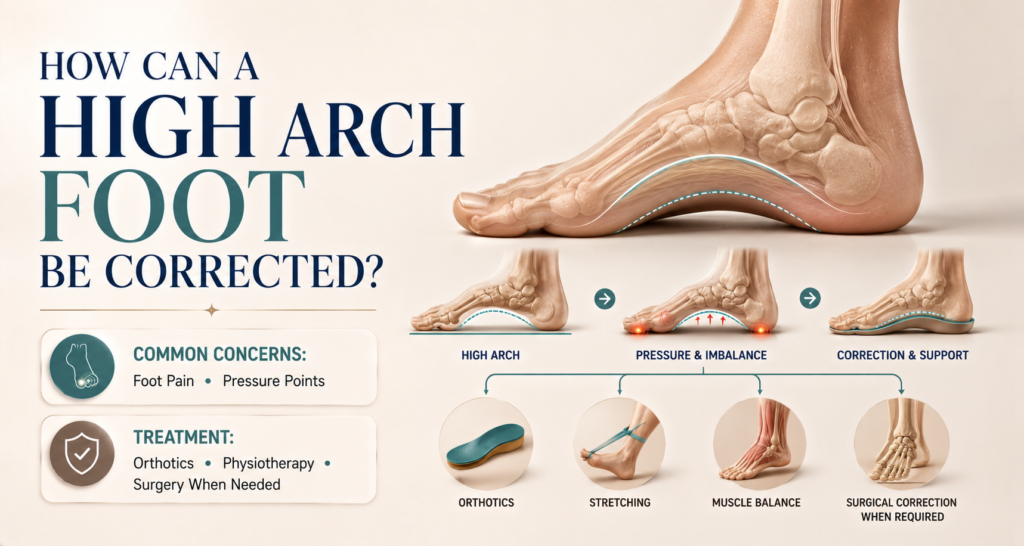
A high arch may look like a simple difference in foot shape, but in some people it significantly changes how body weight is distributed during standing and walking. Instead of pressure spreading evenly across the foot, excessive force may become concentrated under the heel, forefoot or outer border.
For a person with diabetes and reduced foot sensation, these pressure points deserve particular attention. At Elegance Diabetic Foot & Ulcers Clinic (EDFC), evaluation can include the foot’s shape, sensation, circulation, footwear and biomechanics before deciding whether conservative management or corrective treatment is appropriate.
Does the middle of your foot barely touch the ground when you stand? Do you repeatedly develop calluses beneath the heel or ball of the foot? Does your foot tend to roll outward while walking?
These can occur with a high arch foot, medically known as pes cavus or cavus foot.
Not every high arch requires correction. Some people have naturally high arches and experience no major symptoms. The problem becomes more important when the foot is painful, unstable, progressively deformed or creates concentrated pressure that threatens the skin.
In diabetes, this becomes particularly important when neuropathy reduces the ability to feel repetitive pressure or injury.
High arch foot correction therefore does not mean simply flattening the arch. Treatment aims to improve pressure distribution, stability and function while addressing the underlying cause of the deformity.
Key Takeaways
- A high arch foot is also called pes cavus or cavus foot.
- Not every high arch needs medical or surgical correction.
- Cavus feet can concentrate pressure beneath specific parts of the foot.
- Diabetes-related neuropathy can make these pressure points more dangerous because injury may not be felt.
- Appropriate footwear and orthotic modification may help flexible or manageable deformities.
- Persistent callus or recurrent ulceration should prompt assessment of the underlying pressure source.
- Tendon imbalance may contribute to some high arch deformities.
- Rigid or severe deformities may require corrective surgery in selected patients.
- Surgery should address the individual biomechanics rather than simply the visible arch.
- Long-term footwear and foot monitoring remain important even after correction.
What Is a High Arch Foot?
A high arch foot is a foot shape in which the longitudinal arch remains unusually elevated, including when weight is placed on the foot.
The medical term pes cavus describes this high-arched configuration.
Depending on the individual, the deformity can involve more than the arch. It may be associated with changes in heel position, the forefoot, toes, tendons and muscle balance.
Some patients may also develop clawing of the toes or a tendency for the foot and ankle to become unstable.
For this reason, cavus foot should be considered as a biomechanical condition, not simply an unusually high-looking arch.
What Causes a High Arch Foot?
There are several possible causes.
Some people naturally have high arches without an underlying disease. In other patients, cavus deformity may be associated with neurological or neuromuscular conditions that alter the balance of muscles acting on the foot.
Previous injury or structural abnormalities may also contribute.
The cause matters because a progressive neurological cavus foot needs a different assessment from a stable high arch that has existed for many years.
If a high arch is new, worsening or associated with weakness or other neurological symptoms, further evaluation may be necessary.
Why Can a High Arch Create Excessive Foot Pressure?
A normally functioning foot distributes forces across multiple areas as you stand and walk.
With a high arch, the midfoot may participate less effectively in weight distribution. This can concentrate pressure elsewhere.
Common high-pressure areas can include:
- the heel,
- the ball of the foot,
- areas beneath individual metatarsal heads,
- the outer border of the foot,
- and the tips or tops of deformed toes.
Over thousands of steps, repeated focal loading can become clinically important.
The problem is not simply how much pressure occurs once, but how often the same tissue experiences that pressure.
Why Is High Arch Foot More Concerning in Diabetes?
A high arch does not automatically become dangerous because someone has diabetes.
The concern increases when diabetes is accompanied by peripheral neuropathy, poor circulation, previous ulceration or other diabetic foot complications.
Neuropathy can reduce protective sensation.
A person may therefore continue walking on a high-pressure area without experiencing the pain that would normally signal a problem.
The sequence may become:
High arch → concentrated pressure → callus → repeated tissue stress → skin breakdown → diabetic foot ulcer
This is why callus patterns can provide valuable information about foot mechanics.
Can a High Arch Cause Diabetic Foot Ulcers?
Yes, a high arch can contribute to ulcer risk when it creates repetitive focal pressure, particularly in a neuropathic foot.
However, not every ulcer in a person with high arches is caused by the arch.
Other factors such as footwear, toe deformity, infection, circulation and activity level must also be considered.
If an ulcer repeatedly occurs in the same place, the clinician should investigate whether a persistent mechanical pressure point is contributing.
Simply closing the wound may not solve the reason it developed.
What Symptoms Can a High Arch Foot Cause?
Some people have no symptoms.
Others may experience:
- pain while standing or walking,
- repeated calluses,
- pressure beneath the forefoot,
- heel discomfort,
- difficulty finding comfortable footwear,
- ankle instability,
- repeated ankle sprains,
- claw or hammertoe deformity,
- or recurrent skin breakdown.
Patients with significant neuropathy may have surprisingly little pain despite substantial pressure.
Therefore, absence of pain does not always mean absence of a problem in a diabetic foot.
How Is a High Arch Foot Assessed?
Assessment begins with examining the entire foot and ankle.
The clinician may evaluate:
- arch height,
- whether the deformity is flexible or rigid,
- heel alignment,
- forefoot position,
- toe deformities,
- ankle movement,
- tendon function,
- muscle strength,
- sensation,
- circulation,
- callus location,
- previous ulcers,
- and footwear.
The foot may need to be assessed both while sitting and while standing.
Walking pattern is also relevant because some pressure problems become apparent only during movement.
Why Is Pressure Mapping Useful?
Looking at the foot tells us about its shape. Pressure assessment can provide additional information about how that shape behaves during weight bearing.
EDFC’s diabetic foot evaluation includes access to computerised pedobarographic assessment for identifying abnormal pressure distribution in selected patients.
This can be particularly helpful when a patient repeatedly develops callus or ulceration at a particular location.
The purpose is not simply to produce a pressure map. The information should help answer a clinical question:
Where is excessive pressure occurring, and what is causing it?
Patients can learn more about EDFC’s broader diabetic foot assessment and treatment services before deciding on a management plan.
Can High Arch Feet Be Corrected Without Surgery?
Yes. Many high arch feet can be managed without surgery, particularly when the deformity is flexible, symptoms are manageable and there is no major progressive structural problem.
The goal of nonsurgical treatment is usually not to permanently change the bones of the arch.
Instead, management aims to:
- redistribute pressure,
- improve comfort,
- support stability,
- accommodate the foot shape,
- and protect vulnerable areas.
The appropriate approach depends on the individual foot.
How Can Special Footwear Help a High Arch Foot?
Footwear can play an important role in pressure management.
A high arch foot may need shoes with adequate width and depth, particularly when toe deformities are also present.
Appropriate cushioning and pressure redistribution may help protect high-risk areas.
For patients with diabetic neuropathy, footwear should also minimise rubbing and accommodate the shape of the foot without creating new pressure points.
Patients should avoid selecting footwear solely because it feels soft. The shoe needs to fit the actual biomechanics and dimensions of the foot.
Can Orthotics Correct a High Arch?
Orthotic devices may help redistribute pressure and improve support, particularly when the deformity remains sufficiently flexible.
They do not necessarily permanently lower the structural arch.
A customised orthotic can be designed to accommodate the shape of the foot and reduce excessive loading in selected areas.
This distinction is important.
The objective is not always to make the foot look anatomically average. In diabetic foot care, the more important objective may be to create a safer pressure pattern.
What If a High Arch Keeps Producing Calluses?
Repeated callus formation deserves attention, especially in a person with diabetes.
Callus often forms where the skin experiences repeated mechanical stress.
Removing a callus may temporarily reduce the thickened skin, but if the pressure remains unchanged, the callus can return.
Repeated callus at exactly the same location should therefore prompt questions about:
- footwear,
- foot shape,
- gait,
- toe position,
- bony prominence,
- and pressure distribution.
Patients should not cut diabetic foot calluses themselves because accidental injury can create a wound.
When Does a High Arch Foot Need Surgery?
Surgery may be considered when a high arch deformity causes significant symptoms, instability, progressive deformity or recurrent pressure-related problems that cannot be adequately controlled with appropriate conservative treatment.
In diabetic foot care, another important consideration is recurrent ulceration associated with a surgically correctable pressure source.
However, having a high arch alone is not an indication for surgery.
The decision depends on:
- severity,
- flexibility,
- underlying cause,
- pressure pattern,
- skin condition,
- circulation,
- neuropathy,
- previous ulceration,
- and overall health.
What Surgery Is Used for High Arch Foot Correction?
There is no single operation for every cavus foot.
A high arch can result from different combinations of muscle imbalance, tendon tightness and bone position.
Therefore, surgery may involve one or more corrective components.
Selected procedures can include:
- tendon balancing or transfer,
- tendon release or lengthening,
- correction of toe deformities,
- osteotomy to reposition bone,
- correction of prominent pressure-producing structures,
- and more extensive stabilising procedures in severe deformity.
The procedure should be selected according to what is producing the abnormal mechanics.
EDFC’s diabetic foot surgery and corrective treatment service includes procedures aimed at correcting selected deformities and reducing abnormal pressure.
Why Are Tendons Important in High Arch Foot Correction?
Muscles move the foot by pulling through tendons.
If opposing muscle groups become imbalanced, one set of forces may dominate another. Over time, this can contribute to abnormal positioning of the foot or toes.
In selected patients, tendon procedures may help rebalance these forces.
Depending on the problem, treatment can involve releasing, lengthening or transferring a tendon.
However, tendon surgery should not be performed merely because an arch looks high. The surgeon needs to identify a meaningful functional imbalance.
What Is Tendon Transfer?
A tendon transfer redirects the pull of a functioning muscle to help improve balance or movement elsewhere in the foot.
It can be useful in selected deformities caused by muscle imbalance.
The objective is functional.
Rather than simply changing appearance, the procedure attempts to modify the forces acting on the foot.
Dr. Ashutosh Shah’s diabetic foot practice includes experience with tendon transfer and biomechanical correction as part of selected reconstructive diabetic foot treatment.
Can Bone Surgery Correct a High Arch?
Sometimes.
If the deformity has become rigid, soft-tissue procedures alone may not provide adequate correction.
An osteotomy involves cutting and repositioning a bone to change alignment.
Different osteotomies can address different components of cavus deformity.
The exact procedure depends on where the deformity originates.
Changing bone alignment also changes pressure distribution, so surgical planning must consider how the entire foot will load after correction.
What Is Internal Offloading?
Internal or surgical offloading refers to modifying structures within the foot to reduce abnormal pressure.
For example, if a deformity repeatedly overloads one location and appropriate external offloading cannot adequately control it, a selected corrective operation may redistribute pressure more permanently.
This approach is particularly relevant when a diabetic foot ulcer repeatedly returns because the underlying mechanical problem remains.
EDFC’s approach to corrective diabetic foot surgery includes internal offloading concepts for appropriately selected patients.
Can High Arch Surgery Help Prevent Recurrent Ulcers?
Correcting a significant pressure-producing deformity may reduce one important risk factor for recurrent ulceration in selected patients.
However, surgery cannot guarantee that another diabetic foot ulcer will never develop.
Neuropathy may remain.
Diabetes remains.
New pressure points can develop.
Footwear can become inappropriate.
Circulation can change.
Therefore, surgery should be considered part of a long-term diabetic foot protection strategy, not a permanent exemption from foot care.
Can Pressure Move Somewhere Else After Correction?
Yes, potentially.
Changing the mechanics of the foot can reduce pressure at one location while increasing loading elsewhere.
This is known as pressure transfer, and in some circumstances a new high-pressure area can become problematic.
That is why surgeons should not focus only on the existing callus or ulcer.
The entire foot needs to be considered before correction.
Follow-up after surgery is also important to identify new pressure areas early.
Why Must Blood Circulation Be Checked?
Any surgical wound needs sufficient blood flow to heal.
Some people with diabetes also have peripheral arterial disease, which can reduce circulation to the foot.
If circulation is inadequate, wound healing after surgery may be compromised.
Vascular assessment is therefore an important part of planning diabetic foot surgery when circulation is in question.
The priority may sometimes be improving blood flow before undertaking elective deformity correction.
What Happens If There Is Already a Diabetic Foot Ulcer?
The ulcer needs a complete assessment.
Clinicians should determine:
- depth,
- infection status,
- tissue viability,
- circulation,
- pressure source,
- possible bone involvement,
- and the patient’s general medical condition.
Wound treatment may include appropriate debridement, dressings, infection management and external offloading.
If a correctable deformity is a major reason the wound persists or repeatedly returns, surgical correction may subsequently be considered.
What Happens After High Arch Foot Surgery?
Recovery depends heavily on the operation performed.
A limited tendon procedure and a major bony reconstruction have very different recovery requirements.
Patients may need a period of:
- protected or restricted weight bearing,
- wound care,
- swelling management,
- postoperative footwear or immobilisation,
- gradual rehabilitation,
- and regular clinical follow-up.
Patients should follow the surgeon’s weight-bearing instructions carefully because premature loading can interfere with healing.
Will I Still Need Special Footwear After Correction?
Possibly, and for many patients with diabetic neuropathy, protective footwear remains important.
Corrective surgery may improve one significant mechanical problem, but it does not restore normal protective sensation.
Appropriate footwear helps reduce repetitive friction and pressure and protects the foot from unnoticed injury.
Patients should therefore not return to barefoot walking simply because the deformity has been surgically corrected.
Is High Arch Foot Correction Permanent?
Structural surgical correction can produce long-term changes, but no treatment can guarantee that the foot will never change again.
Results depend partly on the underlying cause.
A stable structural deformity may behave differently from a progressive neuromuscular condition.
Ageing, muscle function, diabetes, neuropathy and footwear can continue influencing the foot over time.
Regular follow-up remains valuable.
What Are the Risks of High Arch Foot Surgery?
Risks depend on the specific procedure and the patient’s health.
Potential complications may include:
- infection,
- delayed wound healing,
- bleeding,
- swelling,
- nerve-related symptoms,
- incomplete correction,
- overcorrection,
- recurrence,
- altered pressure distribution,
- new pressure points,
- bone-healing problems after osteotomy,
- and the need for additional treatment.
Diabetes, neuropathy and poor circulation can increase surgical complexity.
The expected benefits should therefore be weighed against individual risk.
How Can Someone With Diabetes Protect a High Arch Foot?
Daily prevention is extremely important.
Check the entire foot every day, including the sole and between the toes.
Look for:
- redness,
- blisters,
- cuts,
- calluses,
- swelling,
- cracks,
- colour changes,
- and discharge.
Wear properly fitted footwear and avoid walking barefoot, even indoors.
Any new callus or skin breakdown should be assessed early rather than waiting for pain, particularly when sensation is reduced.
When Should a High Arch Foot Be Evaluated by a Specialist?
Consider specialist assessment when the high arch is associated with:
- recurrent calluses,
- a diabetic foot ulcer,
- repeated ulceration at the same location,
- worsening deformity,
- claw toes,
- ankle instability,
- weakness,
- difficulty walking,
- or difficulty finding safe footwear.
Urgent medical attention is appropriate if a diabetic foot develops spreading redness, significant swelling, discharge, black tissue, fever or rapidly worsening skin changes.
Conclusion
High arch foot correction should focus on pressure, stability and function rather than simply making the arch look lower.
Mild or flexible high arches may often be managed with appropriate footwear, orthotics and pressure redistribution.
When the deformity becomes rigid, unstable or repeatedly produces dangerous pressure points, selected patients may require tendon balancing, bony correction or another form of surgical offloading.
For someone with diabetes, the decision requires additional attention to neuropathy, circulation, wound history and skin condition.
The most important question is therefore not “How high is the arch?” but “What is this foot shape doing to pressure and function?”
High Arch Foot Assessment at EDFC, Surat
At Elegance Diabetic Foot & Ulcers Clinic in Surat, high arch feet can be assessed in the context of diabetic neuropathy, pressure distribution, deformity and ulcer risk.
When conservative pressure management is insufficient, selected patients may be evaluated for corrective diabetic foot surgery based on the underlying biomechanical problem.
Dr. Ashutosh Shah is a plastic surgeon whose diabetic foot work includes biomechanics, internal offloading and tendon-transfer procedures. Patients can also learn more about EDFC’s diabetic foot care approach before deciding whether specialist evaluation is appropriate.
Don’t Wait for a High-Pressure Area to Become an Ulcer
If you have diabetes and repeatedly notice a callus, redness or skin breakdown beneath a high arch foot, identifying the pressure source early may help protect the foot.
Use the EDFC consultation page to arrange an assessment in Surat and determine whether footwear, external offloading or corrective treatment is appropriate for your foot.
Frequently Asked Questions
Yes. Management may include footwear, orthotics and pressure redistribution. Rigid or symptomatic deformities may require surgical correction in selected patients.
A high arch foot is commonly called pes cavus or cavus foot.
Not automatically. However, a high arch can concentrate pressure, and the risk becomes more important when diabetic neuropathy reduces protective sensation.
Orthotics generally aim to support the foot and redistribute pressure rather than permanently change the underlying bony arch.
Surgery may be considered when significant deformity causes pain, instability, progressive changes or recurrent pressure-related skin breakdown that cannot be adequately managed conservatively.
There is no single procedure. Depending on the cause, surgery may involve tendon balancing, tendon lengthening, toe correction, osteotomy or other reconstructive procedures.