
What Is the Best Treatment for Foot Drop?
Foot Drop Treatment Guidance by Dr. Ashutosh Shah
Written By: Dr. Ashutosh Shah
Qualifications: M.Ch., DNB (Plastic Surgery)
Specialty: Plastic, Reconstructive Surgery & Diabetic Foot Management
Experience: 22+ Years
Clinic: Elegance Diabetic Foot & Ulcers Clinic, Surat
Dr. Ashutosh Shah has been involved in diabetic foot care since the early years of his surgical practice and has experience with reconstructive procedures, biomechanics, internal offloading and tendon transfer surgery. His approach to foot drop focuses on identifying the reason for muscle weakness before choosing between bracing, rehabilitation, nerve-related treatment or surgery.
Foot drop can make a simple activity like walking unexpectedly difficult. The front of the foot may not lift normally, causing the toes to drag on the floor. Some people compensate by lifting the knee unusually high, while others begin tripping or feeling unstable.
This often leads to the question: What is the best treatment for foot drop?
There is no single treatment that is best for every patient. Foot drop is a sign of an underlying nerve, muscle or neurological problem, rather than a disease by itself. Treatment may involve physiotherapy, an ankle-foot orthosis (AFO), nerve stimulation, management of the underlying condition or surgery in selected cases.
At Elegance Diabetic Foot & Ulcers Clinic in Surat, foot drop is evaluated as part of diabetic foot and muscle-tendon care, with treatment selected according to the cause, severity and remaining muscle function.
Key Takeaways
- Foot drop means difficulty lifting the front of the foot during walking.
- Nerve damage, muscle weakness, injury and neurological conditions can cause it.
- Diabetes may contribute through peripheral nerve damage.
- An AFO can support the foot but does not necessarily repair the underlying nerve problem.
- Physiotherapy may help maintain mobility, strength and gait in suitable patients.
- Nerve-related treatment depends on the location and cause of nerve dysfunction.
- Tendon transfer surgery may be considered for selected persistent cases.
- Sudden foot drop should be medically evaluated rather than treated only with a brace.
- The best treatment depends on why the foot drop developed.
What Is Foot Drop?
Foot drop is difficulty lifting the front part of the foot, usually because the muscles responsible for dorsiflexion are weak or paralysed.
During normal walking, these muscles lift the foot so that the toes clear the floor.
When this movement becomes weak, the toes may drag. A person may compensate by lifting the knee higher than usual, producing what is sometimes called a high-stepping gait.
Numbness or tingling may also occur when nerve dysfunction is involved.
EDFC’s dedicated foot drop treatment information identifies difficulty lifting the forefoot, dragging while walking, high-stepping gait and sensory symptoms among common signs.
What Causes Foot Drop?
Foot drop has several possible causes.
A nerve controlling the muscles that lift the foot may be compressed, injured or otherwise damaged. Muscle disease and certain neurological disorders can also affect movement.
In people with diabetes, peripheral neuropathy can contribute to nerve dysfunction. EDFC notes that diabetic neuropathy may affect the nerves involved in controlling foot movement.
Other possibilities include trauma, nerve compression and problems higher along the nerve pathway.
Because the causes differ, simply seeing that the foot is dropping does not tell us which treatment will work.
How Can Diabetes Lead to Foot Drop?
Long-standing diabetes can damage peripheral nerves.
When motor nerves are affected, muscle control may become weaker. This can interfere with lifting the foot normally.
Diabetes can also create additional concerns such as reduced sensation.
This combination deserves particular attention. A patient may walk abnormally because of weakness while simultaneously being less able to feel pressure, rubbing or an early wound.
Foot drop in a person with diabetes should therefore be considered in the wider context of neuropathy, circulation, skin protection and walking mechanics.
What Are the Early Signs of Foot Drop?
A person may first notice that one foot feels unusually heavy or catches the ground.
The toes may drag during walking, or the shoe may repeatedly scrape against the floor.
Other signs can include:
- difficulty lifting the front of the foot,
- frequent tripping,
- lifting the knee higher when walking,
- instability,
- weakness around the ankle,
- numbness or tingling,
- or a noticeable change in gait.
Sudden onset deserves prompt medical assessment, particularly when accompanied by additional weakness, numbness or neurological symptoms.
How Is Foot Drop Diagnosed?
Diagnosis begins by determining where the weakness is coming from.
The clinician may examine ankle and foot movement, muscle strength, sensation, gait and reflexes. Medical history can reveal diabetes, previous injury, surgery or neurological problems that may be relevant.
Additional neurological or nerve testing may sometimes be needed depending on the suspected cause.
The goal is not merely to confirm that the foot drops.
The more important task is to identify why it drops, because that determines whether treatment should focus on support, rehabilitation, nerve recovery or reconstruction.
Can an AFO Treat Foot Drop?
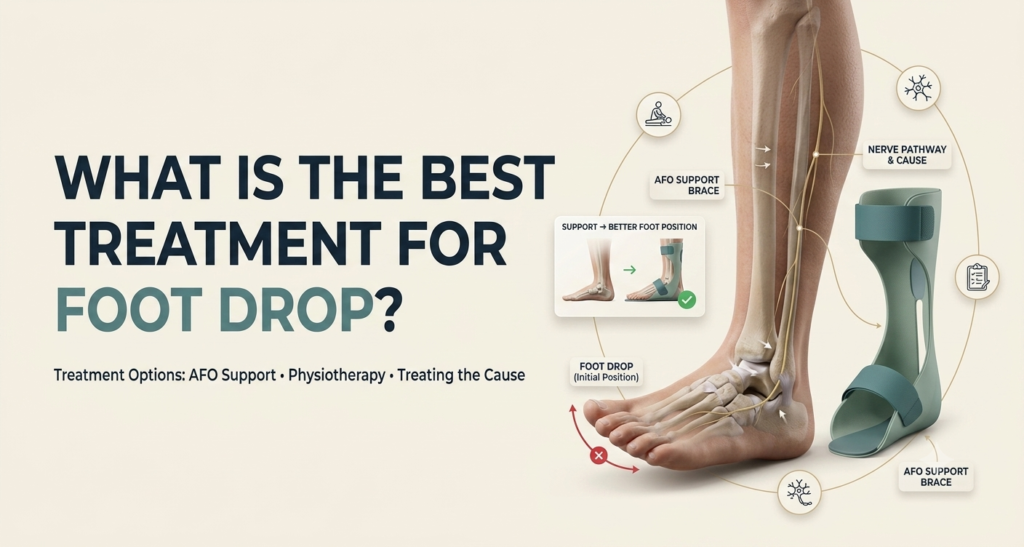
An ankle-foot orthosis can help manage foot drop by supporting the foot in a more functional position during walking.
The brace can reduce toe dragging and may improve stability.
EDFC offers custom ankle-foot orthotics for foot drop and ankle weakness, including different AFO designs according to the degree of support required.
However, an AFO is primarily a mechanical support device.
It does not automatically restore damaged nerve function.
For some patients, it may be used temporarily while recovery is monitored. For others with persistent weakness, it can become part of longer-term mobility management.
Can Physiotherapy Improve Foot Drop?
Physiotherapy can be an important part of treatment in selected patients.
Exercises may focus on maintaining joint movement, strengthening functioning muscles, improving balance and retraining gait.
Therapy may also help reduce compensatory walking habits that develop because the patient is trying to prevent the toes from dragging.
EDFC includes physical therapy among the treatment approaches used for foot drop.
However, exercise cannot repair every severely damaged nerve or permanently paralysed muscle. Its expected role depends on the cause and recovery potential.
Does Electrical Nerve Stimulation Help?
Electrical stimulation may be considered in selected patients when the relevant nerve and muscle pathways can respond appropriately.
The aim is to stimulate muscle activity and assist movement.
EDFC lists nerve stimulation among its foot-drop management options.
It is not appropriate for every type of paralysis.
The usefulness of stimulation depends on where the nerve problem is located, the degree of nerve damage and whether the muscles remain capable of responding.
Can Nerve Compression Be Treated?
Sometimes.
If a nerve is compressed, the treatment depends on the location and cause of compression.
EDFC’s nerve-surgery programme includes procedures such as nerve entrapment release and neurolysis. Neurolysis involves freeing a nerve from surrounding scar tissue in selected situations.
This does not mean every person with foot drop needs nerve surgery.
The nerve must first be evaluated to determine whether compression is actually responsible and whether surgical release has a reasonable indication.
When Is Tendon Transfer Used for Foot Drop?
Tendon transfer may be considered when foot drop is persistent and useful active muscle function is unlikely to recover sufficiently on its own.
Instead of trying to make a permanently weak muscle work normally, a functioning tendon can sometimes be redirected to perform part of the lost movement.
This is a reconstructive strategy.
It requires careful selection because the donor muscle and tendon must have adequate strength and the foot needs suitable flexibility and alignment.
EDFC includes tendon transfer among its corrective diabetic foot surgery options and Dr. Ashutosh Shah’s profile specifically notes experience with tendon transfer procedures and foot biomechanics.
Does Tendon Transfer Cure Nerve Damage?
No.
Tendon transfer does not repair the damaged nerve itself.
Instead, it changes the mechanical function of the foot by using a working muscle-tendon unit to help perform movement that a paralysed muscle can no longer provide adequately.
This distinction is important.
The aim is to improve function and gait, not to claim that the original nerve has been restored.
When Is Surgery Considered for Foot Drop?
Surgery may be discussed when conservative treatment is insufficient and there is a correctable structural or nerve-related problem.
Possible surgical directions can include nerve decompression in selected compression cases or tendon transfer when paralysis is persistent.
The timing depends on the cause and expected nerve recovery.
Operating too early may be unnecessary if meaningful recovery remains possible. Waiting indefinitely can also allow stiffness and abnormal walking patterns to become more established in certain cases.
The decision therefore needs individual assessment.
Can Foot Drop Recover Without Surgery?
Yes, in some cases.
If the underlying nerve problem is temporary and capable of recovering, function may improve over time.
Supportive treatment can help maintain safer walking during this period.
Other cases involve persistent or irreversible nerve dysfunction and may not recover fully.
The cause, severity and duration of weakness all influence prognosis.
A patient should therefore avoid assuming either that surgery is inevitable or that simply waiting will always restore normal movement.
Why Is Skin Protection Important in Diabetic Foot Drop?
This is especially important when neuropathy is present.
Foot drop changes the way the foot contacts the ground and fits inside footwear. An AFO also introduces additional contact surfaces against the foot and lower leg.
If sensation is reduced, pressure and rubbing may not cause enough pain to alert the patient.
The skin should therefore be checked regularly for redness, blisters, abrasions and wounds.
Foot drop treatment in diabetes should aim for better mobility without creating a new pressure injury.
Can Foot Drop Cause Diabetic Foot Ulcers?
Foot drop itself does not automatically cause an ulcer, but altered gait, abnormal pressure and poorly fitting footwear can contribute to skin stress.
When neuropathy is also present, the patient may continue walking on an injured area without noticing it.
This combination can increase concern about skin breakdown.
Proper footwear, pressure management and regular foot inspection therefore remain important alongside treatment of the weakness.
Is Foot Drop Permanent?
Not always.
Some cases improve as an injured or compressed nerve recovers.
Others remain persistent because nerve or muscle function has been permanently affected.
It is often difficult to determine prognosis from symptoms alone.
Duration, cause, clinical examination and appropriate nerve assessment can help estimate whether recovery remains possible.
Persistent foot drop does not necessarily mean that nothing can be done. Orthotic and reconstructive approaches may still improve walking function even when full nerve recovery is unlikely.
What Is the Best Treatment for Foot Drop?
The best treatment is the one directed at the cause while maintaining safe, functional walking.
A patient with temporary nerve weakness may benefit from support and rehabilitation while recovery occurs.
Someone with ongoing foot drop may need an AFO for stability.
A correctable nerve compression may require nerve-specific treatment.
Persistent paralysis in an appropriately selected patient may lead to consideration of tendon transfer.
For patients with diabetes, treatment also needs to account for sensation, circulation, skin integrity, pressure distribution and ulcer risk.
That is why there is no single device, exercise or operation that can accurately be called the best treatment for every patient.
When Should You See a Specialist?
Seek medical assessment if foot drop appears suddenly, continues to worsen or makes walking difficult.
Evaluation is also important if the weakness occurs with numbness, pain, repeated falls or balance problems.
For a person with diabetes, new weakness deserves particular attention because neuropathy and other foot complications may coexist.
A wound, blister, colour change, swelling or infection alongside foot drop should not be ignored.
Conclusion
The best treatment for foot drop depends on its underlying cause and whether useful nerve and muscle recovery remains possible.
An AFO may improve walking by supporting the foot. Physiotherapy can help selected patients maintain strength, movement and gait. Nerve stimulation or nerve-related procedures may have a role in specific cases.
When paralysis is persistent and appropriate functioning muscles remain available, tendon transfer surgery may sometimes provide a reconstructive option.
For people with diabetes, treatment should also protect the skin and manage abnormal pressure because improved movement should not come at the cost of creating another foot problem.
The first step is therefore not choosing between AFO or surgery. It is determining why the foot is dropping.
Restoring Safer Walking at EDFC
At Elegance Diabetic Foot & Ulcers Clinic, foot drop management forms part of a broader programme covering neuropathy, muscle-tendon problems, orthotics, corrective surgery and diabetic foot protection. The clinic’s dedicated foot drop treatment service includes options such as physical therapy, AFO support, nerve stimulation and surgical treatment when clinically appropriate.
Dr. Ashutosh Shah, M.Ch., DNB (Plastic Surgery), has more than 22 years of surgical experience and has worked in diabetic foot care since the early years of his practice. His official profile describes training in diabetic foot surgery at Ganga Hospital, Coimbatore, along with experience in biomechanics, internal offloading, tendon transfer and microvascular reconstruction.
Patients can also learn more about EDFC’s diabetic foot and reconstructive care, which includes surgical and nonsurgical management, customised footwear, pressure assessment and corrective procedures.
Don’t Just Lift the Foot – Find Out Why It Is Dropping
If you are repeatedly catching your toes, lifting your knee unusually high while walking or noticing new weakness around the ankle, an assessment can help determine whether the problem needs bracing, rehabilitation, nerve treatment or reconstructive surgery. Patients in Surat can contact EDFC for a foot drop assessment to discuss the appropriate next step.
Frequently Asked Questions
It depends on the cause. Some temporary nerve problems can improve, while permanent nerve or muscle damage may require long-term support or reconstructive treatment.
Treatment depends on the diagnosis. An AFO and physiotherapy are commonly used to support walking while the underlying cause and recovery potential are evaluated.
Yes. Diabetic neuropathy can damage nerves involved in controlling foot movement and may contribute to foot drop.
No. An AFO mechanically supports the foot and can improve walking, but it does not necessarily repair the underlying nerve damage.
Physiotherapy may improve strength, mobility and gait in suitable patients, but its effectiveness depends on the underlying nerve and muscle function.
It may be considered for selected patients with persistent paralysis when useful nerve recovery is unlikely and an appropriate functioning tendon is available for transfer.