
When Is Achilles Tendon Lengthening Needed?
Diabetic Foot Biomechanics & Pressure Correction by Dr. Ashutosh Shah
Written By: Dr. Ashutosh Shah
Qualifications: M.Ch., DNB (Plastic Surgery)
Specialty: Plastic, Reconstructive Surgery & Diabetic Foot Management
Experience: 22+ Years
Clinic: Elegance Diabetic Foot & Ulcers Clinic, Surat
Dr. Ashutosh Shah has more than 22 years of surgical experience, with work involving diabetic foot reconstruction, biomechanics, internal offloading and limb-preservation procedures. In selected diabetic foot problems, treatment may need to address not only the wound but also the abnormal mechanical forces that repeatedly place pressure on the same part of the foot.
A diabetic foot ulcer can heal and still return if the mechanical pressure that contributed to it remains unchanged. One possible source of abnormal pressure is a tight Achilles tendon, which can restrict upward movement of the ankle and increase loading on parts of the foot during walking.
In selected patients, Achilles tendon lengthening may be considered to improve ankle movement and reduce excessive plantar pressure.
However, this is not a routine operation for every diabetic foot ulcer or every person with a tight calf. The patient’s ankle movement, ulcer location, gait, sensation, circulation and overall foot mechanics need to be evaluated first.
At Elegance Diabetic Foot & Ulcers Clinic in Surat, diabetic foot management considers pressure and biomechanics alongside wound treatment, with the aim of creating conditions that support healing and reduce recurrent tissue damage.
Key Takeaways
- A tight Achilles tendon can limit ankle dorsiflexion.
- Restricted ankle movement may increase pressure under the forefoot during walking.
- High plantar pressure is particularly important in people with diabetic neuropathy.
- Achilles tendon lengthening may be considered in selected patients with equinus and recurrent pressure-related problems.
- The procedure is not necessary for every diabetic foot ulcer.
- Stretching, footwear and external offloading may be appropriate before surgery in some cases.
- Surgery changes biomechanics; it does not directly cure diabetes or neuropathy.
- Postoperative offloading and rehabilitation remain important.
- Excessive lengthening can create weakness and other mechanical problems.
- Long-term footwear and pressure management may still be necessary after surgery.
What Is Achilles Tendon Lengthening?
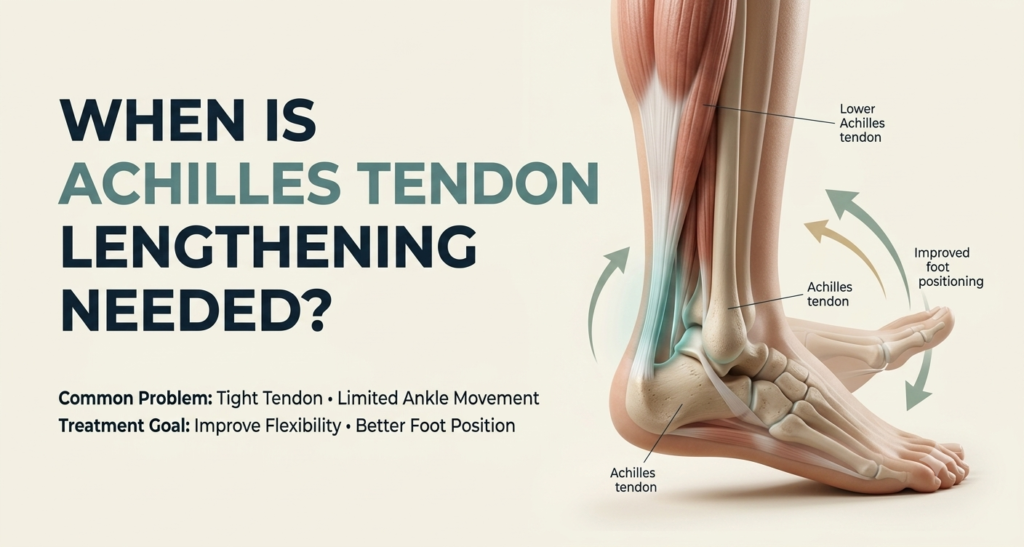
Achilles tendon lengthening is a surgical procedure designed to increase the functional length of a tight Achilles tendon and improve ankle dorsiflexion in appropriately selected patients.
The Achilles tendon connects the calf muscles to the heel.
When the calf-Achilles complex is excessively tight, the ankle may not move upward adequately while walking. This limitation is commonly described as equinus.
The body then compensates elsewhere during gait.
In a diabetic foot, these compensations can become particularly important when they repeatedly increase pressure beneath vulnerable areas of the foot.
What Does a Tight Achilles Tendon Do to the Foot?
A tight Achilles tendon can restrict how far the ankle bends upward.
During normal walking, the ankle needs adequate dorsiflexion as the body moves over the planted foot.
When this movement is restricted, the heel may rise earlier and additional forces can be transferred toward the front of the foot.
This does not mean every person with forefoot pressure has a tight Achilles tendon.
However, when equinus is present, it can become an important part of the biomechanical assessment.
How Can Achilles Tightness Affect a Diabetic Foot?
Achilles tightness may contribute to increased plantar pressure, particularly beneath the forefoot, when ankle movement is restricted.
For a person with normal sensation, excessive pressure may cause discomfort and encourage a change in activity.
Diabetic neuropathy changes this warning system.
A patient may continue walking on an area exposed to repeated high pressure without experiencing significant pain.
Callus, tissue damage and eventually ulceration may develop.
This is why diabetic foot care often needs to consider how the patient walks and where pressure is concentrated, not only how the wound looks.
What Is Equinus?
Equinus refers to limited upward movement of the ankle.
It may result from tightness of the calf muscles, Achilles tendon or related structures.
Some patients compensate by changing how the foot moves during walking.
The degree and cause of restriction can vary.
A clinician may examine ankle movement with the knee in different positions to better understand which structures contribute to the limitation.
Equinus itself does not automatically mean surgery is required.
The question is whether the restriction is contributing meaningfully to the patient’s symptoms, deformity, abnormal pressure or recurrent ulceration.
Can a Tight Achilles Tendon Cause a Diabetic Foot Ulcer?
It can be one contributing factor.
Diabetic foot ulcers are usually multifactorial.
Neuropathy, deformity, footwear, repetitive pressure, circulation and previous tissue damage can all play roles.
If limited ankle dorsiflexion increases forefoot pressure, Achilles tightness may become part of that mechanical chain.
Simply treating the skin wound without correcting significant repeated pressure may allow the same area to break down again.
Patients with recurrent wounds may therefore need assessment through EDFC’s diabetic foot and corrective surgery programme to determine whether a deeper mechanical problem is contributing.
Why Do Some Diabetic Foot Ulcers Keep Coming Back?
An ulcer can close while the underlying cause remains.
For example, wound dressings may allow the skin to heal temporarily, but if the patient returns to the same footwear and continues placing excessive pressure on the same area, tissue breakdown may recur.
This is particularly concerning when neuropathy prevents the patient from feeling the pressure.
Recurrent ulcer treatment therefore needs to ask:
Why is this exact area repeatedly being overloaded?
Possible answers can include deformity, prominent bone, abnormal gait, unsuitable footwear, tendon imbalance or limited ankle movement.
Achilles tightness is only one possible factor.
What Is Internal Offloading?
External offloading uses devices such as specialised footwear, casts, braces or orthotics to reduce pressure.
Internal offloading refers to selected surgical procedures that attempt to change the biomechanical reason excessive pressure is occurring.
Rather than repeatedly protecting the same pressure point externally, the procedure aims to modify the underlying mechanical force.
Achilles tendon lengthening can function as an internal offloading procedure in carefully selected situations.
Other patients may need entirely different procedures depending on their deformity and pressure pattern.
When Is Achilles Tendon Lengthening Considered?
Achilles tendon lengthening may be considered when clinically significant equinus contributes to excessive plantar pressure, recurrent ulceration or another biomechanical diabetic foot problem and conservative measures are insufficient.
The decision is individual.
The clinician may consider:
- ankle dorsiflexion,
- Achilles tightness,
- ulcer location,
- recurrence history,
- plantar pressure,
- gait,
- neuropathy,
- foot deformity,
- circulation,
- muscle strength,
- and previous treatments.
The presence of a tight tendon alone is not enough to justify surgery.
Is Achilles Tendon Lengthening Used for Every Forefoot Ulcer?
No.
Two patients can develop ulcers in similar locations for completely different mechanical reasons.
One may have significant equinus.
Another may have a prominent metatarsal head, toe deformity, unsuitable footwear or another source of focal pressure.
Performing Achilles lengthening when the tendon is not contributing meaningfully would fail to address the true cause.
Treatment should therefore follow a biomechanical assessment rather than the ulcer location alone.
Can Stretching Help Before Surgery?
In selected patients, conservative management may be appropriate.
This can include stretching, physiotherapy, footwear modification, orthotics or external offloading depending on the clinical problem.
The usefulness of stretching depends on whether the restriction is flexible and what structure is responsible.
A longstanding fixed contracture may respond differently from mild muscular tightness.
Conservative treatment should also be monitored rather than continued indefinitely if recurrent tissue damage persists.
Why Is Offloading Important Before Considering Surgery?
Pressure reduction is central to managing many neuropathic diabetic foot wounds.
If a patient continues walking normally on a high-pressure ulcer, wound treatment alone may struggle to succeed.
External offloading allows clinicians to see whether reducing mechanical stress improves the wound.
EDFC’s diabetic foot programme includes customised footwear and pressure-management approaches alongside surgical treatment because healing the wound and controlling the forces that caused it are connected goals.
How Is Achilles Tendon Lengthening Performed?
There are different surgical techniques for lengthening the Achilles or calf-tendon complex.
The appropriate approach depends on the patient’s anatomy, degree of tightness and treatment objective.
The surgeon creates controlled lengthening so that ankle dorsiflexion can improve.
The goal is not to make the tendon as long as possible.
Excessive lengthening can weaken push-off during walking and alter loading elsewhere in the foot.
The correction therefore needs to be carefully controlled.
Does Achilles Tendon Lengthening Directly Heal an Ulcer?
No. The procedure does not directly close the skin wound.
Its purpose in diabetic foot care is biomechanical.
If excessive forefoot pressure is contributing to ulceration, improving ankle mechanics may reduce part of that pressure.
The wound itself still requires appropriate management.
This may include debridement, infection control, dressings, glucose management, vascular assessment and offloading.
Achilles lengthening should therefore be understood as one possible part of a broader limb-preservation strategy.
Can Achilles Tendon Lengthening Reduce Forefoot Pressure?
That is one of the reasons the procedure may be considered in selected patients with equinus.
Improving ankle dorsiflexion can alter how forces are distributed as the body moves over the foot during walking.
However, the outcome depends on the patient’s overall biomechanics.
Pressure does not simply disappear. Changing one part of the mechanical system can shift forces elsewhere.
Follow-up therefore remains important even after successful correction.
What Happens After Achilles Tendon Lengthening?
Recovery depends on the technique used, the patient’s wound status and any additional procedures performed.
Patients may require a period of immobilisation or protected weight-bearing.
A cast, boot or other offloading device may be used.
As healing progresses, rehabilitation may focus on restoring controlled ankle movement and walking.
Patients should not return to unrestricted walking simply because the original ulcer begins looking better.
The tendon and wound both need time to heal appropriately.
Will I Need Special Footwear After Surgery?
Often, ongoing footwear planning remains important.
Achilles tendon lengthening does not remove diabetic neuropathy.
A patient who cannot reliably feel excessive pressure remains vulnerable to future skin damage.
Customised footwear, insoles or other pressure-management measures may therefore still be recommended after surgery.
The aim is to combine improved internal mechanics with appropriate external protection.
Can an Ulcer Come Back After Achilles Tendon Lengthening?
Yes.
No diabetic foot procedure can guarantee that an ulcer will never recur.
Recurrence can happen because of continued neuropathy, new pressure points, deformity, unsuitable footwear, poor circulation or changes in walking mechanics.
The procedure may address one important contributor without eliminating every risk.
Long-term foot inspection and appropriate footwear therefore remain important.
What Are the Risks of Achilles Tendon Lengthening?
As with any surgery, there are potential risks.
These can include wound-healing problems, infection, excessive lengthening, weakness, altered gait and other biomechanical changes.
One particular concern is over-lengthening.
If the tendon becomes too long, calf strength and push-off can be reduced. Pressure may also shift toward another part of the foot.
Careful patient selection and controlled correction are therefore essential.
Is Achilles Tendon Lengthening the Same as Achilles Tendon Repair?
No.
Achilles tendon repair is commonly performed when the tendon has ruptured or been significantly injured.
Achilles tendon lengthening is performed to intentionally increase functional tendon length when excessive tightness or contracture is causing a problem.
They have different indications and objectives.
A patient with diabetic equinus is therefore not undergoing the same operation as an athlete having a ruptured Achilles tendon repaired.
Can Achilles Tendon Lengthening Help Avoid Amputation?
It may form part of a limb-preservation strategy in appropriately selected patients when abnormal biomechanics contribute to recurrent ulceration.
But it should not be presented as a procedure that guarantees prevention of amputation.
Severe infection, poor circulation, extensive tissue death and bone infection can still threaten the foot.
The role of internal offloading is to correct a relevant mechanical contributor when doing so may support more durable wound management.
How Do Doctors Decide Whether Internal Offloading Is Needed?
The decision requires more than looking at the ulcer.
The clinician needs to understand how the entire foot behaves during standing and walking.
Assessment can include deformity, ankle movement, tendon balance, callus patterns, ulcer location, recurrence, footwear and pressure distribution.
This is why a repeatedly returning wound should sometimes be approached as a biomechanical problem as well as a skin problem.
A healed wound is valuable, but durable healing requires attention to why the tissue broke down in the first place.
When Should You Seek Specialist Assessment?
A diabetic foot specialist assessment may be useful when:
- the same ulcer repeatedly returns,
- there is significant forefoot pressure,
- ankle movement is restricted,
- callus repeatedly develops at the same site,
- walking mechanics appear abnormal,
- conventional offloading is not producing durable improvement,
- or a healed ulcer repeatedly breaks down after normal walking resumes.
Patients in Surat with recurrent diabetic foot problems can seek assessment to determine whether the issue is primarily wound-related, vascular, infectious or biomechanical.
Conclusion
Achilles tendon lengthening may be considered when a tight Achilles tendon or equinus contributes to abnormal plantar pressure and recurrent diabetic foot problems.
The procedure is not appropriate for every ulcer and should not be performed simply because the Achilles tendon feels tight.
The important question is whether restricted ankle movement is meaningfully contributing to the patient’s pressure pattern.
When it is, controlled tendon lengthening may form part of an internal offloading strategy. Wound care, footwear, pressure relief, glucose management and long-term diabetic foot protection remain important afterward.
The goal is not simply to lengthen a tendon. It is to create better mechanics, safer pressure distribution and a more durable environment for the foot.
Biomechanical Diabetic Foot Care at EDFC
At Elegance Diabetic Foot & Ulcers Clinic, recurrent ulcers are assessed beyond the visible wound. The clinic’s approach includes pressure, deformity, tendon balance and walking mechanics when planning treatment. Selected patients can explore corrective diabetic foot and internal offloading surgery when conservative pressure management is not enough.
Dr. Ashutosh Shah, M.Ch., DNB (Plastic Surgery), has more than 22 years of surgical experience and works in diabetic foot reconstruction, biomechanics, wound management and limb-preservation procedures.
Patients who want to understand the clinic’s wider treatment philosophy can learn more about EDFC’s diabetic foot-care approach, including wound management, corrective surgery, footwear and pressure-related care.
When the Wound Keeps Returning, Look at the Pressure Behind It
If a diabetic foot ulcer heals but repeatedly returns in the same area, the problem may involve more than the skin. Restricted ankle movement or abnormal foot mechanics may be maintaining excessive pressure. Patients in Surat can contact EDFC for a diabetic foot biomechanics assessment to determine whether external offloading, footwear changes or corrective surgery may be appropriate.
Frequently Asked Questions
It is a surgical procedure that increases the functional length of a tight Achilles tendon to improve ankle dorsiflexion in selected patients.
When equinus contributes to excessive forefoot pressure, controlled lengthening may be considered as part of a pressure-reduction or internal-offloading strategy.
No. It is only considered when Achilles tightness or restricted ankle movement is a meaningful contributor to the mechanical problem.
It does not directly close the wound. It may reduce a contributing mechanical pressure while the ulcer receives appropriate wound care.
Stretching and conservative treatment may help selected patients, particularly when tightness is flexible. Fixed or clinically significant restriction may require a different approach.