
Can People With Diabetes Wear Compression Stockings?
Expert Guidance By: Dr. Ashutosh Shah, M.Ch., DNB (Plastic Surgery)
Clinical Focus: Diabetic Foot Care, Reconstruction & Limb Preservation
Experience: 22+ Years
Clinic: Elegance Diabetic Foot & Ulcers Clinic, Surat
Compression stockings are commonly used to manage swelling in the legs, but having diabetes makes their use more complicated. Diabetes can be associated with reduced sensation, skin problems and peripheral arterial disease, so compression that is appropriate for one patient may not be safe for another.
At Elegance Diabetic Foot & Ulcers Clinic (EDFC) in Surat, assessment of circulation, sensation, swelling and skin condition can help determine whether compression is appropriate.
Your legs are swollen by evening, so someone suggests compression stockings. They are easy to buy, widely available and seem like a simple solution.
But if you have diabetes, should you start wearing them yourself?
People with diabetes can sometimes wear compression stockings, but they are not automatically suitable for every diabetic patient.
Compression may be useful when swelling is related to venous problems or other appropriate indications. However, if blood flow through the arteries is significantly reduced, inappropriate compression can potentially make an already compromised circulation problem worse.
Diabetic neuropathy creates another concern. If stockings are too tight, folded or poorly fitted, reduced sensation may prevent the wearer from noticing pressure-related skin injury.
The safest approach is therefore to understand why the leg is swollen before trying to compress it.
Key Takeaways
- Diabetes itself does not automatically prevent someone from wearing compression stockings.
- Compression stockings are commonly used to control selected types of leg swelling.
- They are not a treatment for every cause of swollen feet or legs.
- Peripheral arterial disease must be considered before significant compression is used.
- Diabetic neuropathy can make pressure-related injury harder to notice.
- Correct size, fit and compression strength are important.
- Stockings should not roll, bunch or create tight pressure bands.
- Skin and feet should be checked regularly.
- New swelling should be assessed rather than automatically treated with compression.
- Redness, wounds, colour changes or a cold foot require medical attention.
What Are Compression Stockings?
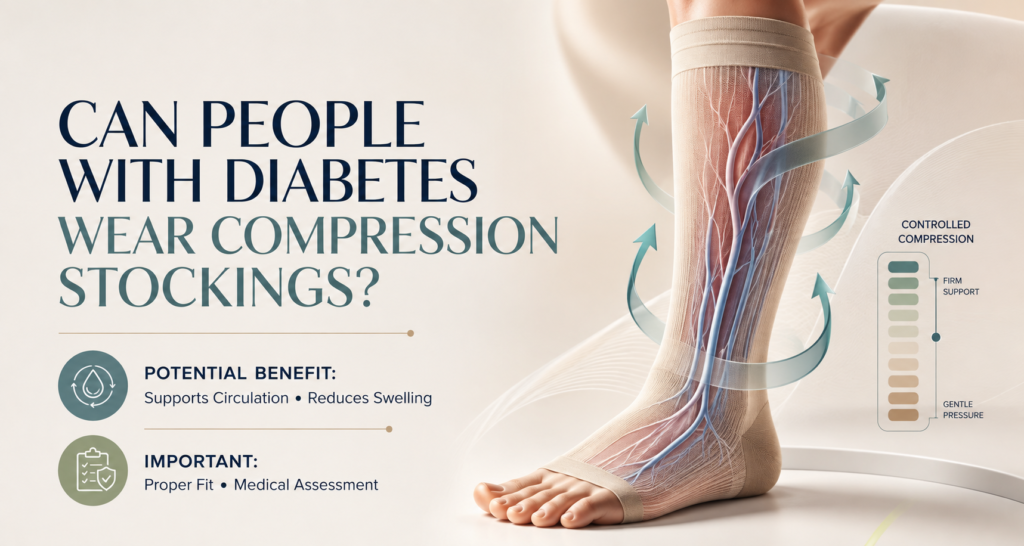
Compression stockings are specially designed garments that apply controlled pressure to the lower legs to help manage swelling and support venous blood return.
They are different from ordinary tight socks.
Medical compression is designed to apply a specific level and distribution of pressure.
Depending on the indication, compression may be used for conditions involving venous insufficiency, certain types of oedema and other circulation-related problems.
But compression needs to be matched to the condition causing the swelling.
That is especially important in diabetes.
Can People With Diabetes Wear Compression Stockings?
Yes, some people with diabetes can safely use compression stockings when there is an appropriate reason and arterial circulation is adequate.
Diabetes alone is not necessarily a contraindication.
The concern is that diabetes can coexist with conditions that influence whether compression is appropriate, particularly:
- peripheral arterial disease,
- diabetic neuropathy,
- fragile skin,
- active wounds,
- infection,
- foot deformity,
- and significant swelling of uncertain cause.
Therefore, the question should not simply be:
“Do I have diabetes?”
A more useful question is:
“Why do I need compression, and is the circulation in my legs adequate for it?”
How Do Compression Stockings Help With Leg Swelling?
Veins carry blood from the legs back toward the heart.
When the venous system does not return blood efficiently, fluid can accumulate in the lower legs.
Graduated compression stockings apply external pressure to support venous return and help control selected forms of swelling.
This can be useful in appropriately diagnosed venous disease.
However, swelling can have many other causes.
Compression stockings should therefore not be viewed as a universal treatment for swollen feet.
Why Do People With Diabetes Develop Swollen Feet?
Diabetes itself is not the only possible explanation for swelling.
Swollen feet or legs can occur for several reasons, including:
- venous insufficiency,
- prolonged sitting or standing,
- kidney problems,
- heart-related conditions,
- certain medications,
- infection,
- injury,
- lymphatic problems,
- and other medical conditions.
Swelling that develops suddenly, affects only one leg, is painful, or occurs with breathlessness requires prompt medical evaluation.
Simply putting on compression stockings without understanding the cause can delay appropriate diagnosis.
What Is the Main Concern With Compression Stockings in Diabetes?
One of the most important concerns is peripheral arterial disease (PAD).
Arteries carry oxygen-rich blood from the heart to the feet.
Diabetes increases the risk of arterial disease in some patients. When the arteries are significantly narrowed, blood supply to the lower leg and foot can become inadequate.
Compression applies external pressure.
For this reason, significant arterial insufficiency needs to be identified before stronger compression therapy is prescribed.
Patients requiring diabetic foot evaluation can learn about EDFC’s nonsurgical diabetic foot investigations, which include assessment of neurological and vascular factors.
What Is Peripheral Arterial Disease?
Peripheral arterial disease occurs when arteries supplying the limbs become narrowed or blocked.
Symptoms can include:
- leg discomfort during walking,
- wounds that heal slowly,
- a colder foot,
- colour changes,
- reduced pulses,
- pain at rest in more severe disease,
- or tissue damage.
However, diabetes and neuropathy can sometimes make symptoms less obvious.
That is why relying only on pain can be misleading.
When arterial disease is suspected, circulation should be evaluated before significant compression is used.
How Is Circulation Checked Before Compression?
Assessment usually begins with a clinical examination.
A clinician may examine:
- foot temperature,
- skin colour,
- pulses,
- capillary refill,
- wounds,
- previous ulcer history,
- and symptoms suggestive of arterial disease.
Additional vascular testing may be appropriate when circulation is uncertain.
EDFC’s diabetic foot assessment includes vascular evaluation as part of its broader diabetic foot care services.
The exact test needed depends on the patient’s condition.
Why Does Diabetic Neuropathy Matter?
Diabetic neuropathy can reduce protective sensation in the feet.
Normally, if a sock becomes painfully tight or a fold creates excessive pressure, you notice the discomfort and adjust it.
Someone with significant neuropathy may not.
A poorly fitted compression stocking could potentially create:
- pressure marks,
- friction,
- blisters,
- skin irritation,
- or unnoticed tissue damage.
This does not mean every person with neuropathy is automatically prohibited from compression.
It means fit, skin monitoring and clinical assessment become especially important.
Are Diabetic Socks and Compression Stockings the Same?
No.
The terms are sometimes confused.
A diabetic sock is generally designed to minimise friction and constriction and to protect sensitive feet.
A medical compression stocking is specifically designed to apply external pressure.
Therefore, buying something labelled “diabetic socks” does not mean it provides therapeutic compression.
Likewise, a compression stocking is not automatically designed for every diabetic foot.
Patients should choose footwear and foot-protection products according to their actual medical needs rather than the product name alone.
Can Compression Stockings Improve Blood Circulation in Diabetes?
This phrase needs careful interpretation.
Compression stockings can support venous return in appropriate patients.
They do not open blocked arteries.
If poor circulation is caused by arterial narrowing, compression stockings are not a substitute for vascular evaluation or treatment.
This distinction between venous circulation and arterial circulation is important.
A stocking that helps venous swelling does not correct significant arterial disease.
Can Compression Stockings Prevent Diabetic Foot Ulcers?
Compression stockings are not a general-purpose diabetic foot ulcer prevention treatment.
Diabetic foot ulcers can develop because of neuropathy, abnormal pressure, deformity, footwear, trauma, circulation problems and other factors.
For pressure-related plantar ulcers, appropriate offloading is usually a different concept from compression therapy.
EDFC provides footwear and pressure-management services for patients who require protection from abnormal foot pressure.
Compression should therefore not be confused with diabetic foot offloading.
What Is the Difference Between Compression and Offloading?
The two treatments solve different mechanical problems.
Compression applies controlled external pressure, usually around the leg, to help manage selected swelling and venous problems.
Offloading reduces pressure from a vulnerable or ulcerated part of the foot during standing and walking.
A patient can potentially require one, the other, both or neither depending on the condition.
For example, someone with a plantar diabetic ulcer may need pressure offloading even if there is no indication for compression stockings.
Can You Wear Compression Stockings With a Diabetic Foot Ulcer?
This requires individual medical assessment.
The answer depends on:
- where the wound is located,
- whether infection is present,
- the condition of the skin,
- arterial circulation,
- degree and cause of swelling,
- neuropathy,
- and the type of compression being considered.
A person with an active diabetic foot ulcer should not simply purchase strong compression stockings and place them over the affected area without professional advice.
The wound itself needs appropriate evaluation.
What If the Foot Is Red and Swollen?
A red, hot or swollen diabetic foot should not automatically be treated with compression.
Possible causes can include infection, injury and other significant diabetic foot complications.
Neuropathy may also reduce pain even when a serious problem is present.
Seek prompt medical assessment if swelling occurs with:
- redness,
- warmth,
- an open wound,
- discharge,
- fever,
- rapid deterioration,
- new deformity,
- or significant colour change.
The priority is determining the cause.
Can Compression Be Used When There Is an Infection?
Active infection requires medical assessment.
Compression decisions depend on the location and severity of infection, circulation, swelling and the patient’s overall condition.
A diabetic foot infection can progress quickly and should not be managed at home simply by wearing a tighter stocking.
Treatment may require wound care, antibiotics when clinically indicated, drainage or debridement in selected cases, and management of other contributing factors.
What Compression Level Is Best for Diabetes?
There is no single compression strength that is best for every person with diabetes.
Compression is available in different pressure levels, and the appropriate choice depends on the indication and vascular status.
Someone with mild swelling and adequate circulation may have different requirements from someone with substantial venous disease.
A patient with possible arterial disease needs particular caution.
Therefore, stronger compression should not be selected simply because it feels more supportive.
More compression is not automatically better.
Why Is Correct Sizing Important?
A medical compression stocking needs to fit properly.
A stocking that is too loose may not provide the intended compression.
One that is too tight or incorrectly fitted can create excessive focal pressure.
Problems can also occur when stockings:
- roll down,
- fold behind the knee,
- bunch around the ankle,
- twist,
- or create a tight band at the top.
These issues are particularly important when neuropathy reduces sensation.
How Should Someone With Diabetes Check Their Skin?
Regular skin inspection is essential when sensation is reduced.
After removing compression stockings, look for:
- persistent redness,
- indentation marks,
- blisters,
- cuts,
- swelling,
- colour changes,
- skin breakdown,
- or new pressure areas.
Also inspect the soles and between the toes.
If you cannot see the bottom of your foot easily, a mirror or help from another person can be useful.
Persistent pressure marks should not simply be ignored because they do not hurt.
When Should You Stop Wearing Compression Stockings?
Seek medical advice if wearing compression is followed by concerning changes such as:
- new foot pain,
- unusual numbness,
- worsening swelling,
- persistent pressure marks,
- skin breakdown,
- significant colour change,
- or a noticeably cold foot.
Patients with neuropathy should be particularly careful because pain may not reliably indicate injury.
Do not simply change to a stronger or tighter stocking when symptoms worsen.
Can Compression Stockings Be Worn All Day?
The recommended duration depends on why compression has been prescribed and the specific product being used.
Some patients are advised to wear stockings during daytime activity and remove them according to their treatment plan.
Others may have different instructions.
A diabetic patient with neuropathy, skin vulnerability or vascular disease may require more individualised guidance.
Follow the prescribing clinician’s instructions rather than applying a universal wearing schedule.
Should Compression Stockings Be Worn While Sleeping?
Do not assume that daytime compression stockings should automatically be worn overnight.
Whether nighttime compression is appropriate depends on the condition being treated and the type of compression system.
Patients should follow specific medical instructions.
This is especially important in diabetes because prolonged unnoticed pressure may be problematic when protective sensation is reduced.
Can You Buy Compression Stockings Without Seeing a Doctor?
Compression products are widely available, but availability does not mean every strength is appropriate for every patient.
For someone with diabetes, professional assessment is particularly useful when there is:
- neuropathy,
- known vascular disease,
- previous foot ulcer,
- active wound,
- unexplained swelling,
- skin colour change,
- or significant foot deformity.
The more complicated the diabetic foot, the less appropriate it is to self-prescribe compression based only on online product descriptions.
Can Compression Stockings Help After Diabetic Foot Surgery?
Sometimes compression may form part of postoperative management, but this depends entirely on the operation and the surgeon’s plan.
After diabetic foot surgery, swelling, wound condition, circulation and permitted weight bearing all need consideration.
Patients should not independently add compression over a recently operated diabetic foot.
EDFC’s diabetic foot surgery services include procedures ranging from wound management to corrective and offloading surgery, so postoperative requirements can vary considerably.
What Else Can Help With Leg Swelling?
Treatment depends on the cause.
Depending on medical assessment, management might involve:
- appropriate movement,
- leg elevation,
- management of venous disease,
- medication review,
- treatment of systemic medical conditions,
- wound management,
- or prescribed compression.
The key point is that swelling is a symptom, not a diagnosis.
Treating swelling effectively requires identifying what is producing it.
Who Should Be Extra Careful With Compression?
Particular caution is appropriate for diabetic patients with:
- suspected or established peripheral arterial disease,
- significant neuropathy,
- active wounds,
- fragile skin,
- previous amputations,
- significant foot deformity,
- infection,
- or unexplained new swelling.
These factors do not always mean compression is impossible.
They mean the decision should be individualised.
When Should a Diabetic Patient See a Foot Specialist?
Consider a diabetic foot assessment if you develop:
- recurrent swelling,
- numbness,
- persistent calluses,
- an open wound,
- skin colour changes,
- a cold foot,
- difficulty finding suitable footwear,
- or a previous diabetic foot ulcer.
Seek more urgent medical attention for rapidly spreading redness, discharge, black or discoloured tissue, fever, sudden major swelling or a rapidly worsening wound.
How Can You Protect Your Feet While Using Compression Stockings?
If compression has been recommended, combine it with good diabetic foot care.
Inspect the feet daily.
Keep the skin clean and appropriately moisturised, but avoid excessive moisture between the toes.
Wear correctly fitted footwear.
Avoid walking barefoot.
Do not cut corns or calluses yourself.
Check the stockings for wrinkles or folds before wearing shoes.
Most importantly, report new skin changes early rather than waiting for them to become painful.
Conclusion
People with diabetes can sometimes wear compression stockings, but they should not be used automatically for every swollen foot or leg.
Compression can be useful for selected venous and swelling-related conditions when arterial blood flow is adequate.
However, diabetes may be associated with peripheral arterial disease, neuropathy and vulnerable skin. These factors can change whether compression is appropriate and how it should be used.
The safest approach is to identify the cause of swelling, assess circulation when necessary, choose the correct compression and monitor the skin carefully.
For a diabetic patient, the right question is not simply “Can I wear compression stockings?”
It is:
“What is causing my swelling, and is compression safe for my circulation and my feet?”
Diabetic Foot & Circulation Assessment at EDFC
At Elegance Diabetic Foot & Ulcers Clinic in Surat, diabetic foot assessment considers circulation, sensation, skin condition, wounds and mechanical pressure before recommending treatment.
Patients who may have circulation or nerve-related concerns can explore the clinic’s diabetic foot investigation services.
Dr. Ashutosh Shah, M.Ch., DNB, has more than 22 years of surgical experience and works in diabetic foot management, reconstruction and limb-preservation care.
You can also learn more about EDFC and its diabetic foot services before arranging an assessment.
Don’t Treat Every Swollen Diabetic Foot With a Tight Stocking
Swelling can come from many different problems, and compression is helpful only when it matches the cause and is safe for the circulation.
If you have diabetes with persistent swelling, numbness, colour changes or a foot wound, use the EDFC contact and consultation service to have the foot assessed in Surat before choosing stronger compression on your own.
Frequently Asked Questions
They can be safe for selected patients, but suitability depends on circulation, sensation, skin condition and the reason compression is needed.
Sometimes. The cause of swelling should first be identified, particularly when swelling is new, persistent or associated with other symptoms.
People with suspected peripheral arterial disease, significant neuropathy, active wounds, infection or fragile skin should seek medical assessment before using significant compression.
Compression can support venous return in appropriate patients, but it does not open narrowed arteries or treat peripheral arterial disease.
They are not a general diabetic foot ulcer prevention treatment. Ulcer prevention often involves pressure offloading, appropriate footwear, daily inspection and management of neuropathy and circulation.
Possibly, but reduced sensation makes proper fit and regular skin inspection especially important. Individual medical guidance is advisable.