Can I Walk on a Foot Ulcer? The Weight Bearing Rules That Decide Healing
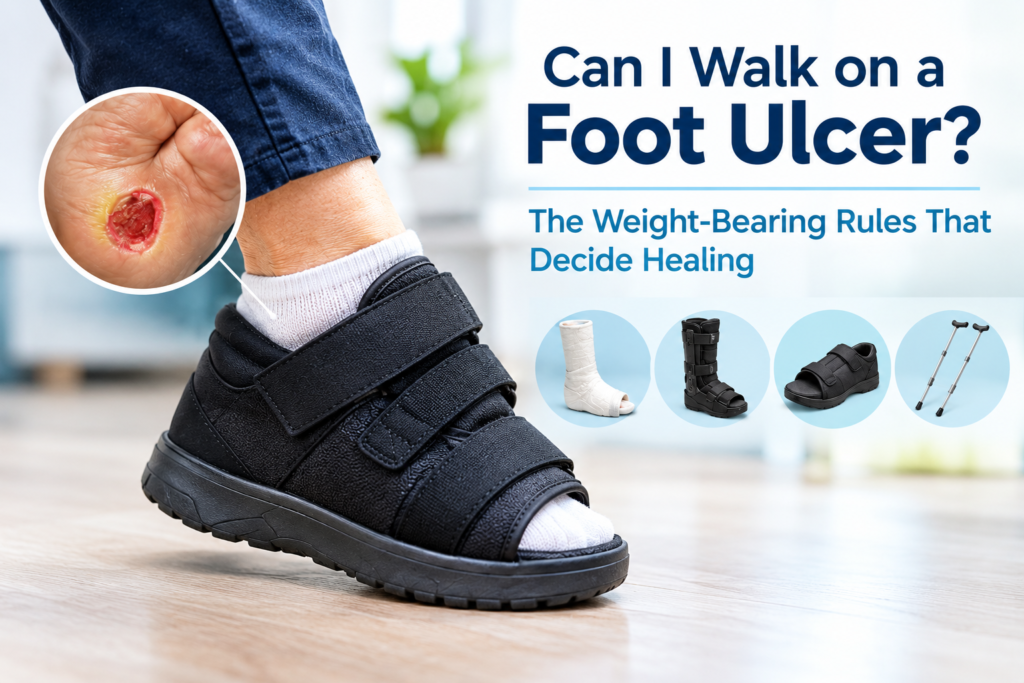
A diabetic foot ulcer does not simply need a dressing. It needs the pressure that keeps reopening the wound to be reduced.
This is especially important with a plantar ulcer, meaning an ulcer on the weight bearing surface of the foot. Repeated loading from standing and walking can increase mechanical stress at the wound and interfere with healing. Current International Working Group on the Diabetic Foot guidance recommends effective offloading as a central part of treatment for plantar diabetic foot ulcers.
So, can you walk on a diabetic foot ulcer? Sometimes, but the answer depends on where the ulcer is, how deep it is, whether infection or poor circulation is present, and whether the wound has been properly offloaded.
For a plantar forefoot or midfoot ulcer, a clinician may prescribe a total contact cast or another appropriate knee high offloading device. These devices redistribute pressure away from the ulcer while allowing necessary mobility.
The goal is not simply to walk less. The goal is to move the load away from the wound.
Why Does Every Step Reopen a Plantar Wound?
A plantar ulcer sits directly under the forces created when you stand and walk. If the same area continues to receive pressure, shear and repeated loading, the wound edges can remain mechanically stressed.
This is why repeatedly walking in an ordinary shoe can work against healing.
The IWGDF describes offloading as reducing mechanical stress at the ulcer, including both plantar pressure and the amount of weight bearing activity. For neuropathic plantar forefoot and midfoot ulcers, a non removable knee high offloading device is recommended as the first choice when clinically appropriate.
NICE similarly recommends offloading as part of standard diabetic foot ulcer care and specifically recommends non removable casting for suitable plantar neuropathic, non ischaemic and uninfected forefoot and midfoot ulcers.
This does not mean every person with a foot ulcer must stay in bed. It means ordinary walking should not continue without a plan for protecting the wound.
Which Ulcer Locations Allow Limited Walking and Which Do Not?
The ulcer location changes the mechanical problem.
A forefoot ulcer may be treated with a device that redistributes pressure across the foot. A heel ulcer creates a different loading problem and may require more substantial heel pressure relief. A toe tip or ulcer between the toes may need local footwear modification or a specific offloading device.
The following is a practical guide, not a substitute for an individual weight bearing prescription.
Weight Bearing Rules by Ulcer Site
| Ulcer site | Permitted activity | Required device | Healing penalty for ignoring it |
|---|---|---|---|
| Forefoot | Limited walking only with prescribed offloading | Total contact cast, non removable walker or appropriate forefoot offloading device | Repeated forefoot pressure can delay closure and keep the wound under mechanical stress |
| Midfoot | Walking should be restricted to essential activity while properly offloaded | Knee high offloading device where appropriate | Continued pressure can prevent effective pressure redistribution and delay healing |
| Heel | Walking depends heavily on ulcer depth and pressure tolerance; minimise heel loading | Heel pressure relief, appropriate offloading device or walking aid as prescribed | Repeated heel loading can delay healing and enlarge the wound |
| Toe tip | Keep walking to necessary activity only and avoid direct toe pressure | Toe specific offloading, suitable footwear or orthotic modification | Direct pressure can repeatedly traumatise the wound |
| Between toes | Walking may be possible if pressure and friction are controlled | Appropriate footwear, toe spacing or other clinician prescribed protection | Moisture, friction and rubbing can delay healing and worsen the wound |
There is no universal number of steps that is automatically safe for every ulcer. The correct amount depends on the wound, sensation, circulation, depth, infection status and the effectiveness of the prescribed offloading device.
For plantar forefoot and midfoot ulcers, evidence supports non removable knee high offloading devices because they reduce the opportunity to remove the device and continue walking without protection.
How Much Walking Is Too Much in a Day?
There is no reliable rule such as “2,000 steps are safe” or “5,000 steps are too many.”
The more useful question is:
How much walking can you do while keeping the ulcer adequately unloaded?
Walking required for essential activities is different from unnecessary walking around the house, shopping, prolonged standing or exercise.
If your prescribed device allows walking, use it for all weight bearing activity, rather than wearing it only when you think you will walk a lot. IWGDF guidance highlights adherence as one reason non removable devices can improve healing compared with removable devices.
If a clinician has specifically instructed you to avoid weight bearing, do not increase walking simply because the wound looks better.
What Are the Practical Options: Cast, Walker, Half Shoe or Crutches?
Cast
A total contact cast is moulded to redistribute pressure across the foot. For suitable plantar forefoot and midfoot ulcers, it is an established offloading option.
Walker
A knee high walker can redistribute pressure while allowing some mobility. Depending on the situation, the device may be removable or made non removable by the clinical team.
Half Shoe
A forefoot offloading shoe can shift loading away from a forefoot wound. It is one of the alternatives considered when a knee high device is not suitable or available.
Crutches
Crutches may reduce weight bearing when a clinician believes that greater unloading is necessary. They are also useful when an offloading device makes walking unstable.
The correct device is not simply the one that feels most comfortable. It needs to match the ulcer location, wound characteristics, circulation, balance and daily activities.
How Do You Manage Bathroom and Stair Trips at Home?
Essential movement still needs planning.
For bathroom trips, keep the prescribed offloading device beside the bed or in the place where you normally start walking. Do not walk barefoot because the distance seems short.
For stairs, follow the instructions given for your specific device. If balance is poor, a walking aid or assistance from another person may be safer.
At home, remove unnecessary walking. Keep frequently used items nearby, sit rather than stand for routine tasks and avoid repeated trips across the house.
If your device makes you unstable, tell your clinical team rather than simply stopping its use. IWGDF guidance specifically notes that a walking aid may be appropriate when an offloading device compromises stability and increases fall risk.
What If I Need to Go to Work With a Plantar Ulcer?
Whether you can work depends on the job.
A desk based role may be possible for some people if the ulcer is appropriately treated and walking is limited. A job involving prolonged standing, walking, ladders or carrying loads can create a very different pressure burden.
Do not judge your ability to work only by how much pain you feel. Diabetic neuropathy can reduce protective sensation, meaning a wound may be under significant mechanical stress without producing much pain.
Your clinician may recommend temporary work modification, reduced walking or time away from weight bearing duties while the ulcer heals.
You can also discuss Custom orthotics when footwear modification is appropriate.
When Is Walking Safe Again?
Walking can usually be increased gradually when the wound is improving and the clinical team confirms that the current level of loading is appropriate.
A wound that appears smaller does not automatically mean it is ready for unrestricted walking.
Healing needs to be assessed alongside:
- Ulcer size and depth
- Pressure exposure
- Foot sensation
- Circulation
- Infection status
- Foot deformity
- The effectiveness and fit of the offloading device
NICE recommends documenting the ulcer’s size, depth and position and using a standardised system to assess severity.
Which New Symptoms While Walking Mean Stop and Be Seen Today?
Stop walking and seek prompt medical assessment if you notice:
| New symptom | What it may indicate | What to do |
|---|---|---|
| Sudden swelling | Trauma, inflammation or possible Charcot process | Stop weight bearing and seek urgent assessment |
| Pop or crack sensation | Possible fracture or structural injury | Stop walking and obtain urgent medical assessment |
| New warmth or redness | Infection or acute Charcot arthropathy | Stop unnecessary walking and seek prompt foot assessment |
| New discharge from the wound | Possible infection | Contact the foot care team promptly |
| Rapidly increasing wound size | Excessive pressure or deterioration | Stop the activity and have the ulcer reviewed |
| New colour change or severe pain | Possible circulation problem, infection or other serious complication | Seek urgent medical assessment |
A hot, swollen foot with or without pain can be a sign of acute Charcot arthropathy in a person with diabetes and should be assessed promptly. NICE recommends non weight bearing while definitive treatment is arranged when acute Charcot is suspected.
Local warmth, swelling, pain and purulent discharge can also be signs of diabetic foot infection.
If there is fever, sepsis, suspected deep infection, limb ischaemia or gangrene, NICE recommends immediate referral to acute services.
Pressure Relief for Wound Healing: What Actually Matters?
The most important principle is consistency.
A person may wear an excellent offloading device for most of the day but still repeatedly load the ulcer when walking barefoot to the bathroom, standing in the kitchen or removing the device for short trips.
That is why pressure relief for wound healing is not simply about reducing long walks. It means controlling the repeated mechanical stress reaching the wound throughout the day.
For appropriate plantar ulcers, professional offloading may include casting, walkers, forefoot offloading footwear or other customised approaches.
If standard offloading is not enough, a specialist may consider Surgical offloading in selected cases.
You can also read Why offloading decides healing for more information about how pressure affects ulcer healing.
For wounds that continue not to close despite appropriate care, see the guide to a Non healing foot ulcer.
Is Bed Rest Necessary?
Usually, not automatically.
Complete bed rest can create other problems, including loss of mobility, weakness and difficulty managing daily activities. The objective is generally effective offloading, not unnecessary immobility.
However, some situations do require much more restricted weight bearing. An acute Charcot foot is one example, where NICE recommends non weight bearing until definitive treatment can begin.
The right balance should therefore be decided from the actual ulcer and foot condition rather than from a fixed rule about bed rest.
FAQs
It may not heal properly if walking repeatedly loads the ulcer. Effective offloading is a core part of treatment.
There is no universal safe step count. Your clinician should determine activity based on the ulcer and offloading device.
Sometimes specialised footwear or padding is appropriate, but a normal shoe may not provide enough offloading for a plantar ulcer.
Not for every ulcer. The goal is appropriate pressure relief, while more serious conditions may require strict non weight bearing.
Possibly, depending on your job and whether walking and standing can be adequately restricted.
Stop weight bearing and seek urgent medical assessment. A sudden pop, new swelling or a hot swollen foot can indicate a significant underlying problem.