
Where Can You Get Wound Care Treatment in Surat?
Dr. Ashutosh Shah, M.Ch., DNB (Plastic Surgery) brings more than 22 years of surgical experience to the assessment of complex wounds and tissue-related problems. His background in plastic and reconstructive surgery is particularly relevant when wound management involves tissue loss, difficult closure, or consideration of reconstructive options.
At Elegance Diabetic Foot And Ulcers Clinic, the objective is to understand what is interfering with healing and build treatment around the individual wound rather than applying the same approach to every patient.
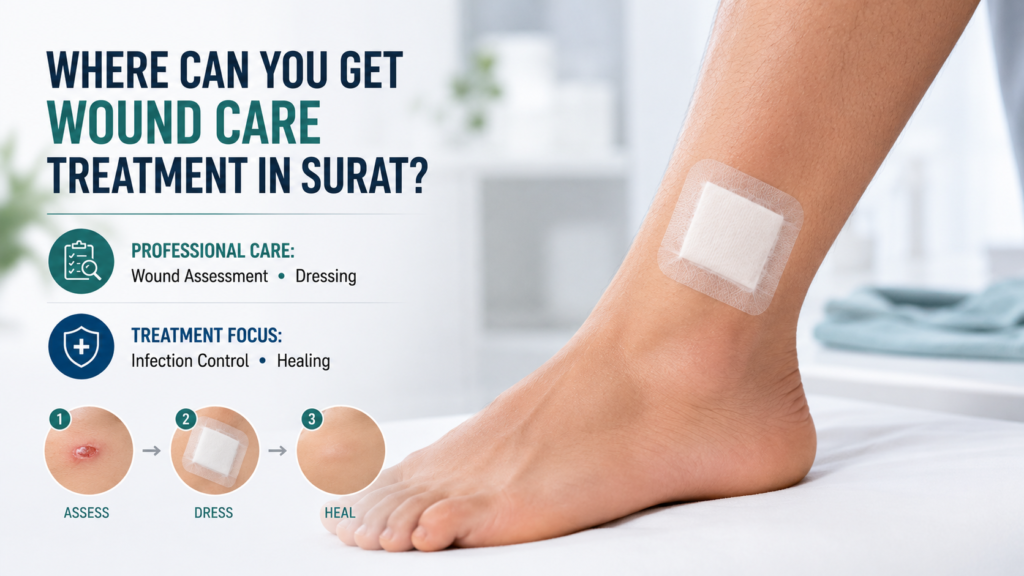
A wound that remains open, repeatedly breaks down, produces persistent discharge, or becomes increasingly painful may need more than routine dressing. Patients looking for wound care treatment in Surat should seek a service that evaluates not only the wound surface but also the factors preventing normal healing.
At Elegance Diabetic Foot And Ulcers Clinic, Surat, wound assessment can focus on the wound’s cause, depth, surrounding tissue, infection risk, pressure, circulation, and relevant medical conditions. This is important because two wounds that appear similar can have completely different reasons for delayed healing.
A non-healing wound may be associated with repeated pressure, inadequate blood circulation, infection, unhealthy tissue, swelling, trauma, diabetes, or other underlying factors. In such situations, repeatedly changing the dressing without identifying the underlying problem may not be enough.
Treatment therefore needs to be individualised. Depending on clinical findings, management may involve wound dressings, debridement, pressure reduction, infection management, assessment of circulation, or reconstructive treatment in selected complex cases.
Not every small cut needs specialist treatment. However, a wound that is worsening, failing to progress, or occurring in a person with diabetes, circulation problems, or reduced sensation deserves appropriate medical assessment.
Key Takeaways
- A non-healing wound often has an underlying factor delaying recovery.
- Infection is important, but it is not the only reason wounds fail to heal.
- Blood circulation, pressure, diabetes, tissue condition, and repeated trauma should also be considered.
- The right dressing depends on the characteristics of the wound.
- Debridement may be considered when unhealthy or dead tissue is interfering with wound management.
- Nondiabetic ulcers can also become chronic and require specialist evaluation.
- Rapid deterioration, significant infection, or tissue colour changes need prompt medical attention.
What Types of Wounds May Need Specialist Care?
Specialist wound care may be appropriate when a wound is not progressing toward healing, repeatedly reopens, becomes deeper, develops unhealthy tissue, or occurs alongside medical factors that increase the risk of delayed healing.
Examples can include chronic ulcers, pressure-related wounds, diabetic foot wounds, difficult surgical wounds, traumatic wounds, infected wounds, and ulcers unrelated to diabetes.
Chronic Wound: A wound in which the normal healing process has been disrupted or delayed.
A wound does not necessarily need to become very large before assessment is worthwhile. Its location, depth, circulation, pressure, sensation, and underlying cause can be as important as its visible size.
Why Is Your Wound Not Healing?
A wound can remain open when one or more factors continue interfering with tissue repair. These may include poor blood supply, infection, repeated pressure, unhealthy tissue, swelling, diabetes, repeated friction, or the nature of the original injury.
Consider a wound over a pressure-bearing part of the foot. Even with an appropriate dressing, repeated pressure during walking may continue disturbing the healing tissue.
Similarly, a leg or foot ulcer associated with inadequate circulation may not respond adequately to surface treatment alone.
This leads to an important principle:
Successful wound care starts by asking why the wound is not healing—not simply which dressing should cover it.
How Is a Non-Healing Wound Evaluated?
A wound assessment considers much more than its appearance.
The clinician may evaluate:
- Wound location, size and depth
- Type and quality of tissue
- Drainage and surrounding skin
- Signs suggesting infection
- Blood circulation
- Pressure on the affected area
- Sensation where relevant
- Previous treatments
- Medical conditions and medications
Additional investigations may be considered when there is concern about deeper infection, bone involvement, circulation, or another underlying problem.
This assessment helps determine whether the wound can be managed locally or whether another medical specialty needs to become involved.
What Does Wound Care Treatment in Surat Involve?
Wound care treatment should be matched to the underlying problem. Depending on the clinical assessment, treatment may involve wound cleaning, appropriate dressings, pressure management, debridement, infection treatment, circulation assessment, or reconstructive care.
The treatment plan can change as the wound changes.
For example, a heavily draining wound may initially require moisture management, while a wound affected by repeated pressure needs the source of pressure addressed as well.
For chronic wounds unrelated to diabetes, patients can also explore [INTERNAL LINK: Nondiabetic Ulcer Treatment → Nondiabetic Ulcers service page] to understand condition-specific evaluation and management available through Elegance Diabetic Foot And Ulcers Clinic.
| Wound Concern | Treatment Focus | Why It Matters |
|---|---|---|
| Excess drainage | Moisture and dressing management | Protects the wound environment |
| Unhealthy tissue | Debridement when appropriate | Helps wound-bed management |
| Repeated pressure | Pressure redistribution | Reduces repeated injury |
| Infection concern | Medical assessment | Determines appropriate management |
| Circulation problem | Vascular evaluation | Healing depends on blood supply |
| Tissue defect | Reconstructive assessment | Coverage may be needed |
Why Is Debridement Sometimes Necessary?
Debridement involves removing dead, damaged, contaminated, or unhealthy tissue when medically appropriate. It can help expose healthier tissue, improve assessment of the wound, and support an appropriate wound-management plan.
Debridement: The medical removal of non-viable or unhealthy tissue from a wound.
There are different approaches to debridement, and not every wound should undergo the same method.
Blood supply, wound characteristics, infection, tissue condition, and the patient’s overall health all influence whether debridement is appropriate.
Patients should never attempt to cut or remove wound tissue themselves.
What Role Does Blood Circulation Play in Healing?
Adequate circulation provides healing tissue with oxygen and nutrients. When blood flow is significantly reduced, even careful dressing and wound cleaning may not be enough to achieve normal healing.
This is particularly important for persistent wounds affecting the feet and lower legs.
If poor circulation is suspected, vascular assessment may become part of the treatment pathway. Addressing the wound surface without recognising a significant blood-flow problem can leave an important cause untreated.
Are All Foot and Leg Ulcers Caused by Diabetes?
No. A patient can develop a chronic ulcer without having diabetes.
Nondiabetic wounds can be associated with pressure, venous problems, reduced arterial circulation, trauma, lymphatic problems, inflammatory conditions, previous surgery, or other causes.
This is why assuming every foot wound is a “diabetic wound” can be misleading.
The underlying cause should guide treatment.
For a patient with diabetes, however, additional factors such as reduced sensation, pressure and circulation may need specific consideration.
Can Complex Wounds Require Reconstructive Treatment?
Some complex wounds may eventually require reconstructive treatment when there is substantial tissue loss, exposed deeper structures, difficult closure, or a defect that cannot heal adequately through simpler methods.
Reconstruction does not automatically mean major surgery.
Depending on the wound, options may range from simpler closure methods to skin grafting or tissue reconstruction. The wound first needs appropriate assessment because infection, poor circulation, dead tissue, or continued pressure can affect reconstructive success.
Skin Graft: A procedure in which skin is transferred from one area of the body to provide coverage for another area.
The most suitable approach depends on the wound rather than using one reconstruction technique for every patient.
How Long Does a Non-Healing Wound Take to Heal?
There is no responsible way to promise one healing time for every wound.
A superficial traumatic wound with healthy circulation is very different from a deep ulcer affected by pressure, infection, diabetes, or reduced blood supply.
Healing can be influenced by wound depth, tissue quality, circulation, infection, nutrition, general health, pressure, and response to treatment.
Instead of focusing only on the number of days or weeks, clinicians can assess whether the wound is progressing in the right direction.
Which Wound Symptoms Should Not Be Ignored?
A wound needs prompt medical assessment when there is rapidly increasing pain, redness or swelling, pus or foul-smelling drainage, fever, significant bleeding, rapidly changing tissue colour, or noticeable deterioration.
Patients with diabetes, reduced sensation, or circulation problems may not always experience symptoms in the same way as someone without these conditions.
Severe infection, major trauma, systemic illness, or uncontrolled bleeding requires urgent medical care rather than waiting for a routine wound appointment.
When Should You Visit a Wound Care Clinic in Surat?
Consider professional evaluation when the wound is not showing expected improvement, repeatedly reopens, becomes larger or deeper, has persistent discharge, develops unhealthy tissue, or is associated with diabetes, pressure, circulation concerns, or previous surgery.
A wound specialist can assess both what the wound looks like and why it continues to exist.
That distinction is particularly important in chronic wound management.
Choosing Appropriate Wound Care in Surat
Effective wound care is not based on one dressing, one medicine, or one procedure. It begins by determining what is preventing the wound from progressing normally.
At Elegance Diabetic Foot And Ulcers Clinic, assessment can consider wound characteristics alongside pressure, circulation, infection, tissue quality, diabetes, and other factors that may influence healing.
Dr. Ashutosh Shah’s background in plastic and reconstructive surgery also provides relevant expertise when wounds involve tissue loss, difficult closure, or potential reconstruction. His 22+ years of surgical experience support a broader assessment of complex wound problems rather than focusing solely on the wound surface.
Individual wounds require individual plans, and results and healing times can vary considerably.
Conclusion
Patients looking for wound care treatment in Surat should consider care that addresses both the visible wound and the reason it is not healing.
Some wounds need suitable dressings and monitoring. Others may require pressure reduction, infection management, debridement, vascular assessment, or reconstructive planning. Nondiabetic ulcers also deserve careful evaluation because diabetes is only one of many reasons a chronic wound may develop.
At Elegance Diabetic Foot And Ulcers Clinic, Surat, the objective is to identify the factors interfering with wound healing and determine an appropriate treatment pathway.
A persistent wound should not simply be covered indefinitely without asking why it remains open. Early professional assessment can be particularly important when the wound is worsening or the patient has additional medical risk factors.
Is a wound taking longer than expected to heal?
Book an assessment with Dr. Ashutosh Shah at Elegance Diabetic Foot And Ulcers Clinic, Surat, for an individual assessment of the wound, surrounding tissues, and factors that may be delaying healing.
Frequently Asked Questions
There is no single timeline for every wound. A wound that stops progressing, repeatedly opens, or deteriorates should be professionally assessed.
No. Treatment depends on the extent and depth of infection, tissue condition, and other clinical findings.
Debridement removes unhealthy or dead tissue when medically appropriate.
Yes. Diabetes can affect sensation, infection risk, circulation, and other factors relevant to healing.
Some complex wounds may require skin grafting or another reconstructive technique, but many do not.
Repeated pressure, friction, infection, poor tissue quality, circulation problems, or another underlying cause may contribute.