
When Is Tendon Transfer Surgery Needed for the Foot?
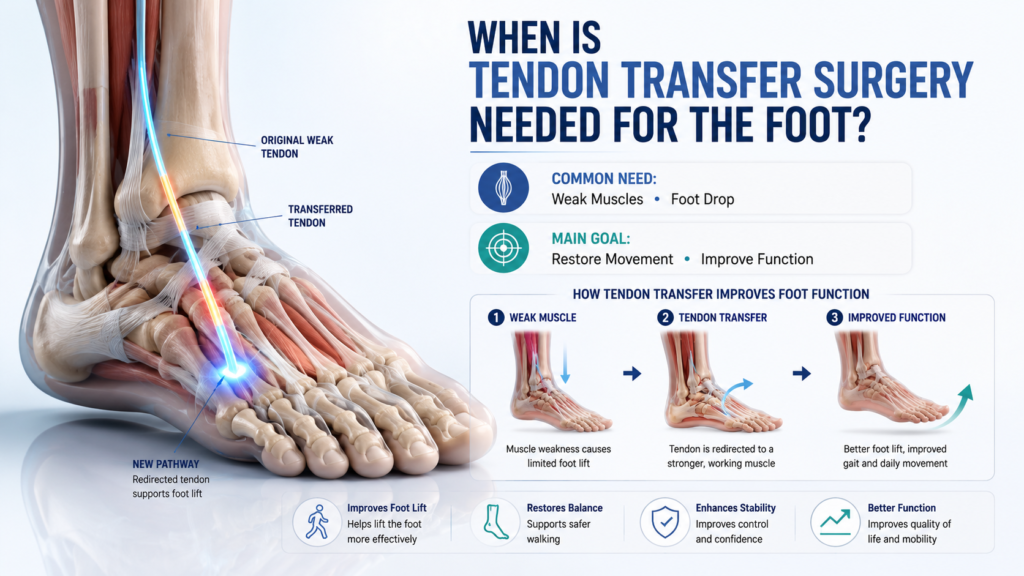
When a diabetic wound repeatedly develops at the same pressure point, treating only the skin may not address the mechanical force responsible for the problem.
Dr. Ashutosh Shah, M.Ch., DNB (Plastic Surgery) has more than 22 years of surgical experience, with reconstructive and microvascular training relevant to complex diabetic-foot wounds, tissue preservation and limb reconstruction. At EDFC, surgical planning can consider both the wound and the underlying mechanics contributing to repeated tissue stress.
Tendon transfer surgery may be considered when muscle or tendon imbalance causes abnormal foot position, deformity, weakness, or repeated pressure that cannot be adequately controlled with nonsurgical treatment. In selected people with diabetes, correcting this imbalance may help redistribute pressure, improve foot positioning, and support the management or prevention of recurrent pressure-related wounds.
A tendon transfer is not simply the removal or replacement of a damaged tendon. During the procedure, a functioning tendon is redirected so that its pull can support a different movement or help rebalance forces across the foot. The exact operation depends on the deformity, which muscles still function, joint flexibility, and the purpose of reconstruction.
This can be particularly relevant in diabetic feet affected by neuropathy. When protective sensation is reduced, abnormal pressure may repeatedly act on the same part of the foot without producing enough pain to warn the patient. Research on neuropathic foot ulcers has described tendon imbalance and biomechanical deformity as contributors to increased plantar pressure and recurrent ulceration.
However, tendon transfer is not appropriate for every diabetic foot problem. Circulation, infection, wound condition, joint mobility, nerve and muscle function, overall health, and the patient’s ability to follow postoperative restrictions all need consideration.
At Elegance Diabetic Foot And Ulcers Clinic (EDFC), Surat, tendon procedures can be considered within a broader plan focused on creating a safer, more functional and better pressure-balanced foot.
Key Takeaways
- Tendon transfer redirects a functioning tendon to improve or rebalance foot mechanics.
- It may be considered for selected flexible deformities, muscle imbalance, weakness or recurrent pressure problems.
- In diabetic feet, abnormal mechanics can contribute to recurrent ulcers.
- Tendon transfer is not required for every diabetic foot wound.
- Circulation, infection, tissue condition and joint flexibility need assessment before reconstruction.
- Recovery usually requires protection of the surgical repair and gradual rehabilitation.
- Surgery cannot guarantee that a diabetic foot ulcer will never return.
What Does Tendon Transfer Surgery Actually Do?
Tendon transfer surgery redirects a functioning tendon from its usual attachment to another location so its muscle force can perform or support a different mechanical role.
A tendon connects muscle to bone. When muscle forces around the foot become unbalanced, the foot or toes may gradually be pulled into an abnormal position.
The purpose of transferring a tendon can therefore be to rebalance these forces.
The objective is not always to create a perfectly shaped foot. In diabetic-foot reconstruction, a practical goal may be a foot that is more stable, functional and less exposed to damaging focal pressure.
Why Can Tendon Imbalance Become a Problem in Diabetes?
Tendon and muscle imbalance can change foot position and concentrate pressure on particular areas. When diabetic neuropathy reduces protective sensation, the patient may continue loading these pressure points without recognising the developing tissue damage.
Repeated mechanical stress can contribute to callus formation and, in vulnerable feet, ulceration.
This explains why a wound can sometimes return even after it has apparently healed.
If the biomechanical force responsible for the wound remains unchanged, the same area may continue experiencing excessive stress. A review of neuropathic foot ulcer surgery highlights the importance of correcting underlying biomechanical deformity when it is driving increased plantar pressure.
When Is Tendon Transfer Surgery Considered?
Tendon transfer may be considered when a correctable muscle or tendon imbalance is contributing to deformity, weakness, abnormal foot positioning or recurrent pressure and conservative treatment has not adequately addressed the problem.
The indication is highly individual.
Before recommending surgery, clinicians may consider whether the deformity is flexible or rigid, which muscles and tendons still function, where excessive pressure occurs, and whether footwear, orthoses, offloading or other nonsurgical measures can adequately control it.
When abnormal mechanics require surgical correction, Diabetic Foot Surgery may form part of a broader reconstruction plan.
Can Tendon Transfer Help With Recurrent Diabetic Foot Ulcers?
In carefully selected patients, tendon-balancing procedures may help reduce the abnormal mechanical pressure contributing to certain recurrent neuropathic ulcers. They should not, however, be viewed as a universal treatment for diabetic foot ulcers.
Published clinical studies have reported tendon-balancing procedures for specific chronic diabetic foot ulcers. For example, one prospective cohort evaluated staged tendon balancing for chronic ulcers beneath the first metatarsal head that had persisted despite conservative care.
More recent long-term research has also examined EHL Jones tenosuspension, with or without peroneus longus-to-brevis transfer, for selected first-metatarsal-head ulcers in patients with diabetes.
These findings support the concept of mechanical correction in carefully selected cases, but they do not mean every diabetic ulcer requires tendon surgery.
Why Isn’t Wound Dressing Alone Always Enough?
A dressing protects and manages a wound, but it does not necessarily remove the mechanical force that caused the wound.
Imagine a wound repeatedly developing under the same part of the forefoot. Even good wound care may struggle to produce a lasting solution if abnormal foot position continues concentrating body weight at that exact point.
Treatment may therefore require two different questions:
How do we heal the wound?
and
How do we reduce the force that keeps damaging this location?
Offloading, footwear and orthotic measures may address the second question without surgery in many patients. Tendon or structural surgery becomes relevant only in selected situations.
How Is a Tendon Transfer Planned?
Planning begins by identifying the mechanical problem and determining whether an available functioning tendon can safely help correct it.
Assessment may include foot position, walking pattern, muscle strength, tendon function, joint flexibility, sensation, pressure points, wounds and previous surgery.
For a person with diabetes, circulation and tissue condition are especially important.
An active infection or inadequately perfused foot may require treatment before elective reconstruction can be considered. A wound may also need debridement, infection management or other treatment as part of a staged plan.
The exact tendon selected depends on the deformity and desired mechanical effect. There is no standard tendon transfer suitable for every diabetic foot.
What Happens During Tendon Transfer Surgery?
The exact surgical steps vary considerably according to the tendon and deformity being treated.
In general, the selected functioning tendon is accessed surgically, redirected, and attached in a planned position so its muscle pull can contribute differently to foot movement or balance.
Other procedures may sometimes be performed at the same time when additional structural problems are present.
Because this is reconstructive surgery, the result depends not only on transferring the tendon but also on appropriate tension, foot alignment, tissue quality, postoperative protection and rehabilitation.
Can You Walk Normally After Tendon Transfer?
The goal may include improving useful foot function and pressure distribution, but walking recovery varies according to the procedure, pre-existing deformity, nerve function, muscle strength and overall condition of the foot.
Immediately returning to unrestricted walking is generally not the objective.
The transferred tendon and surgical tissues need protection while healing occurs. Depending on the operation, temporary immobilisation, restricted weight bearing, protective footwear or another form of postoperative support may be required.
Rehabilitation may later help the patient adapt to the changed mechanics.
What Is Recovery Like?
Recovery is individual and depends on the tendon transferred, associated procedures, wound condition, circulation, diabetes management and tissue healing.
Early recovery may involve swelling, tenderness, dressings and protection of the operated foot.
Weight-bearing instructions are particularly important. Loading the reconstruction too early can interfere with healing, while prolonged inactivity also has potential consequences. The treating surgical team should therefore determine the appropriate progression.
Longer-term care may include footwear modification, pressure management and monitoring for new pressure points.
Can a New Pressure Point Develop After Surgery?
Yes.
Changing foot mechanics can reduce pressure in one area while increasing it elsewhere. This is sometimes called a transfer lesion.
Studies of surgical offloading procedures in neuropathic diabetic feet have reported recurrence and transfer lesions, reinforcing why long-term surveillance remains necessary even after mechanical correction.
Surgery should therefore be viewed as one part of continuing diabetic foot care rather than the end of foot monitoring.
What Are the Risks of Tendon Transfer Surgery?
Possible risks include infection, wound-healing problems, bleeding, scarring, tendon failure, incomplete correction, overcorrection, weakness, stiffness, recurrent deformity and development of new pressure points.
Patients with diabetes may have additional concerns related to neuropathy, circulation and wound healing.
The risk profile also changes when surgery is being performed in a foot that has previously had ulcers, infection, amputation or other reconstructive procedures.
Individual risks should be discussed after examination rather than estimated from the procedure name alone.
Who May Not Be Suitable for Tendon Transfer?
Not every patient with diabetic foot deformity is a candidate for tendon transfer.
Suitability can be affected by inadequate circulation, uncontrolled or active infection, extensive tissue loss, rigid deformity, inadequate functioning muscle-tendon units, poor tissue quality, medical conditions affecting surgical safety, or inability to protect the reconstruction during recovery.
Some of these problems may need treatment first. Others may make a different reconstructive or nonsurgical approach more appropriate.
How Can Tendon Transfer Support Limb Preservation?
Tendon transfer can form one component of limb-preservation treatment when abnormal mechanics are placing viable tissue at repeated risk and the deformity can be meaningfully corrected.
Limb salvage is broader than tendon surgery. It can involve infection control, circulation management, debridement, pressure relief, wound reconstruction, bone or joint procedures and appropriate footwear.
Patients with complex diabetic-foot problems can explore Limb Salvage Treatment when multiple factors threaten the foot.
The objective is not preservation at any cost. It is to achieve a safe, functional and sustainable foot when medically possible.
Mechanical Reconstruction at EDFC
At Elegance Diabetic Foot And Ulcers Clinic, Surat, a recurring wound can be assessed beyond its surface appearance.
When pressure continues because of tendon imbalance or deformity, treatment planning may consider whether the underlying mechanics can be changed rather than repeatedly managing the same pressure injury.
Dr. Ashutosh Shah’s more than 22 years of surgical experience, along with his reconstructive and microvascular background, is relevant when diabetic-foot problems require tissue preservation and reconstructive planning.
The appropriate strategy depends on the patient’s circulation, sensation, wound condition, infection status, foot mechanics and realistic functional goals.
Conclusion
Tendon transfer surgery can be useful for selected foot problems where muscle or tendon imbalance causes deformity, weakness, abnormal positioning or repeated harmful pressure.
In diabetic-foot care, its value is particularly relevant when abnormal mechanics contribute to recurrent pressure-related wounds and cannot be adequately managed with conservative measures.
However, surgery is not appropriate for every diabetic ulcer or deformity. Circulation, infection, joint flexibility, functioning tendons, tissue condition and overall medical health must be assessed first.
For patients in Surat, evaluation at Elegance Diabetic Foot And Ulcers Clinic can help determine whether nonsurgical pressure management, tendon balancing, another reconstructive procedure or a broader limb-preservation plan is appropriate.
Dealing with a recurrent diabetic foot wound or deformity caused by abnormal pressure?
Consult Dr. Ashutosh Shah at Elegance Diabetic Foot And Ulcers Clinic, Surat, for an assessment of foot mechanics and suitable reconstructive or limb-preservation options.
Frequently Asked Questions
It is a reconstructive procedure that redirects a functioning tendon so its muscle force can support a different movement or improve mechanical balance.
In selected patients, it may help correct muscle imbalance, deformity or abnormal pressure that contributes to recurrent tissue damage.
Tendon balancing may support healing or reduce recurrence in selected mechanically driven neuropathic ulcers, but it is not appropriate for every ulcer.
No. Footwear, orthoses, offloading and other conservative treatments may be sufficient for many patients.
Yes. Recurrence and new pressure points remain possible, so long-term diabetic foot monitoring is important.