
How Is an Osteoma in the Foot Treated?
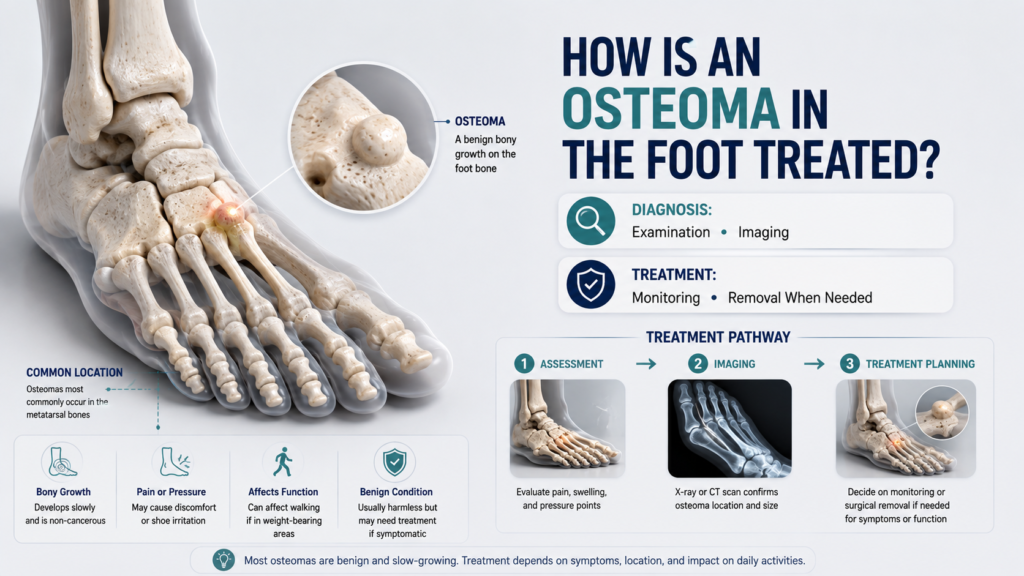
A hard lump can affect more than the underlying bone. Its position may change footwear pressure, walking comfort, and the condition of the skin covering it.
Dr. Ashutosh Shah, M.Ch., DNB (Plastic Surgery) has more than 22 years of surgical experience, with reconstructive expertise relevant to tissue protection, complex foot wounds, and surgical reconstruction. At EDFC, the aim is to understand both the diagnosis and the functional effect of a foot lesion before deciding on treatment.
A suspected osteoma in the foot does not always need surgery. The appropriate osteoma foot treatment depends first on confirming what the lump or bone lesion actually is. Its location, size, symptoms, imaging appearance, effect on walking or footwear, and whether it is changing over time can all influence treatment.
An osteoma is a benign, meaning non-cancerous, bone-forming lesion. However, osteomas are much more commonly described in the skull and facial bones than in the foot. Therefore, a hard lump in the foot should not automatically be labelled an osteoma. Other benign bone lesions, bony prominences, joint-related changes, previous injuries, and some soft-tissue masses can produce a similar appearance.
A small, stable lesion that has been appropriately diagnosed and causes no symptoms may sometimes be monitored. If a bone prominence causes persistent pain, repeated shoe pressure, difficulty walking, skin irritation, or uncertainty about the diagnosis, further investigation and sometimes surgical treatment may be considered.
For people with diabetes, a prominent area deserves particular attention. Neuropathy can reduce protective sensation, allowing repeated footwear pressure to damage the skin without significant pain.
Patients in Surat who notice a persistent hard foot lump can therefore benefit from examination rather than trying to determine its nature from appearance alone. At Elegance Diabetic Foot And Ulcers Clinic (EDFC), evaluation can consider the bone lesion together with pressure, skin condition, sensation, circulation, and overall foot function.
Key Takeaways
- A hard foot lump should not automatically be diagnosed as an osteoma.
- Imaging may be required to identify the origin and characteristics of a bone lesion.
- Small, appropriately diagnosed and symptom-free benign lesions may sometimes be observed.
- Surgery may be considered when a lesion causes significant symptoms, pressure problems, functional difficulty, or diagnostic concern.
- Removed tissue may require histopathological examination to confirm the diagnosis.
- In diabetes, a bony prominence can create pressure even when neuropathy reduces pain.
- Treatment should be based on diagnosis, symptoms, foot mechanics, and individual health factors.
What Is an Osteoma in the Foot?
An osteoma is a benign bone-forming lesion composed predominantly of mature bone. True osteomas are uncommon in the foot, so confirming the diagnosis is important before deciding on treatment.
The word “benign” means that the lesion is not cancerous. It does not, however, mean that every benign lesion should be ignored.
Its location can matter.
Even a relatively small bony prominence can become troublesome when it lies in an area repeatedly compressed by footwear or exposed to pressure during walking.
Is Every Hard Lump on the Foot an Osteoma?
No. Several conditions can cause a hard lump or an apparent bone growth in the foot, so examination and imaging may be necessary.
A lump may arise from bone, a joint, or surrounding soft tissue. Previous injury can also alter bone shape.
This distinction is important because treatment should address the actual diagnosis rather than simply remove any visible prominence.
An enlarging, unusual, painful, or unexplained mass deserves additional assessment. When imaging characteristics are atypical, further investigation or referral may be appropriate.
What Symptoms Can a Foot Bone Lesion Cause?
Some benign bone lesions cause no symptoms and are discovered incidentally. Others can cause pain, footwear irritation, pressure, swelling, or difficulty with normal activity depending on their location.
A superficial prominence may repeatedly rub against footwear.
Patients may notice:
- A firm or hard lump
- Local pressure or discomfort
- Difficulty wearing certain shoes
- Skin irritation over the prominence
- Callus formation
- Changes in walking because of discomfort
For someone with diabetic neuropathy, visible pressure changes may sometimes be more noticeable than pain.
How Is a Suspected Foot Osteoma Diagnosed?
Diagnosis usually begins with clinical examination and appropriate imaging. The objective is to determine whether the lesion arises from bone, understand its characteristics, and distinguish it from other conditions.
A clinician may ask when the lump was first noticed, whether it has changed, whether there was previous trauma, and whether it causes pain or footwear problems.
Plain X-rays may provide useful information about many bone abnormalities. Depending on the findings, additional imaging such as CT or MRI may sometimes be required.
If the diagnosis remains uncertain, additional specialist assessment or tissue examination may be necessary.
This is particularly important because unusual bone lesions should not be assumed to be harmless based only on how they feel through the skin.
Does Every Osteoma Need to Be Removed?
No. A small, stable and appropriately diagnosed benign lesion that is not causing symptoms may sometimes be monitored rather than immediately removed.
Observation may include clinical follow-up and, when appropriate, repeat imaging.
The decision changes when the lesion causes persistent symptoms or creates a mechanical problem.
Nonsurgical measures can sometimes include footwear modification or pressure management when the primary problem is rubbing rather than significant structural impairment.
Patients with diabetes who also have pressure or skin concerns may benefit from Nonsurgical Diabetic Foot Management.
When Is Osteoma Removal Surgery Considered?
Surgery may be considered when a confirmed benign bone lesion causes persistent symptoms, repeated pressure, functional difficulty, or another clinically significant problem, or when removal is appropriate as part of establishing or managing the diagnosis.
The exact procedure depends on where the lesion is located and its relationship to surrounding structures.
For a superficial bony lesion, surgery may involve exposing the affected area and removing or contouring the abnormal bone while protecting nearby tissues.
This should not be viewed as a standard procedure that is identical for every foot lump.
Patients requiring operative treatment may be directed to Diabetic Foot Surgery where appropriate.
Is the Removed Bone Tested?
When tissue is surgically removed from an uncertain or clinically relevant lesion, it may be sent for histopathological examination.
Histopathology means examining tissue microscopically to help establish or confirm its diagnosis.
This can be important because several bone lesions can have overlapping appearances.
A surgical procedure should therefore not focus only on making the lump disappear. Obtaining diagnostic certainty may also be part of appropriate management.
What Is Recovery Like After Foot Bone Surgery?
Recovery depends on the size and location of the lesion, the extent of surgery, surrounding tissue condition, wound healing, circulation, and whether other procedures were required.
Early recovery can involve swelling, tenderness, dressings, and temporary activity modification.
Some patients may need to reduce pressure on the operated area or use protective footwear while tissues heal. The appropriate weight-bearing plan depends on the operation performed.
Return to normal footwear and activity should therefore be based on healing rather than a fixed timeline applied to every patient.
For people with diabetes, wound monitoring can be particularly important during recovery.
Can an Osteoma Grow Back?
Recurrence depends on the actual diagnosis and completeness of treatment.
This is another reason it is important to distinguish a true osteoma from other bone lesions before discussing the likelihood of recurrence.
Patients should not be promised that removal of an unexplained bone lump will provide a permanent cure before the diagnosis is established.
Follow-up may be advised according to pathology and clinical findings.
Why Does a Bone Prominence Matter More in a Diabetic Foot?
A bony prominence can concentrate pressure against footwear or the ground. In someone with diabetic neuropathy, reduced protective sensation may allow this pressure to continue without producing an adequate pain warning.
Over time, repeated pressure can contribute to callus or skin breakdown in a vulnerable foot.
A diabetic-foot assessment may therefore consider:
Bone prominence → pressure → skin condition → sensation → circulation → footwear.
The aim is not simply to remove every prominence. The clinician needs to determine whether it is actually creating a meaningful risk and whether nonsurgical or surgical correction is appropriate.
What Are the Risks of Surgical Removal?
Surgery around the foot can involve risks such as infection, bleeding, scarring, delayed wound healing, pain, numbness, injury to nearby structures, recurrence, or continued symptoms.
The specific risk depends on the lesion’s location and procedure performed.
Diabetes, neuropathy, circulation problems, previous wounds, and overall health may influence healing and surgical planning.
An individual examination is therefore required before estimating surgical risk.
When Should You See a Foot Specialist?
A persistent, enlarging, painful, or unexplained hard foot lump should be assessed rather than self-diagnosed.
Evaluation is also appropriate when a prominence repeatedly rubs inside footwear, creates callus or skin damage, affects walking, or changes noticeably.
People with diabetes should seek earlier assessment if the skin over the lump becomes red, swollen, wounded, discoloured, or begins producing discharge.
A rapidly changing or otherwise concerning mass may require additional investigation rather than routine removal.
oot Bone and Pressure Assessment at EDFC
At Elegance Diabetic Foot And Ulcers Clinic, Surat, evaluation of a hard foot lump can extend beyond deciding whether it should be removed.
For a person with diabetes, the relationship between the prominence and footwear pressure, sensation, circulation, skin integrity, and walking mechanics may be equally important.
With more than 22 years of surgical experience, Dr. Ashutosh Shah brings reconstructive expertise relevant when foot conditions involve tissue protection, wounds, or surgical reconstruction.
The objective is to identify the problem correctly and choose an approach that protects both foot structure and surrounding tissue.
Conclusion
Appropriate osteoma foot treatment begins with confirming the diagnosis.
A hard lump on the foot is not automatically an osteoma, and true osteomas are uncommon at this location. Clinical examination and imaging can help determine what the lesion is and whether treatment is necessary.
A small, stable, symptom-free benign lesion may sometimes be monitored. Surgical removal may be considered when a confirmed lesion causes persistent pain, repeated pressure, difficulty with footwear or function, or when diagnostic considerations make removal appropriate.
For patients with diabetes in Surat, assessment is particularly useful when a bony prominence creates pressure, callus, skin irritation, or a wound.
Noticed a persistent hard or bony lump on your foot?
Consult Dr. Ashutosh Shah at Elegance Diabetic Foot And Ulcers Clinic, Surat, for an assessment of the lesion, foot pressure, skin condition, and suitable treatment options.
Frequently Asked Questions
A true osteoma is benign. However, a foot lump should first be correctly diagnosed because not every bone lesion is an osteoma.
No. An appropriately diagnosed lesion without symptoms may sometimes be observed.
It can cause discomfort if its location creates pressure or interferes with footwear or normal foot mechanics.
Clinical examination and X-rays are commonly useful. Additional imaging or tissue assessment may be needed depending on the findings.
Selected symptomatic lesions can be surgically removed, but the procedure depends on the location and diagnosis.