Varicose Vein Treatment When You Have Diabetes: Sugar Limits, Laser, Injection or Surgery?
Can People With Diabetes Have Varicose Vein Treatment?
Yes. Varicose vein treatment for diabetic patients is usually possible, but diabetes changes the pre-procedure assessment.
The important questions are not simply “What is your sugar today?” The doctor needs to consider leg circulation, skin condition, infection risk, HbA1c, medications, neuropathy and the pattern of venous reflux.
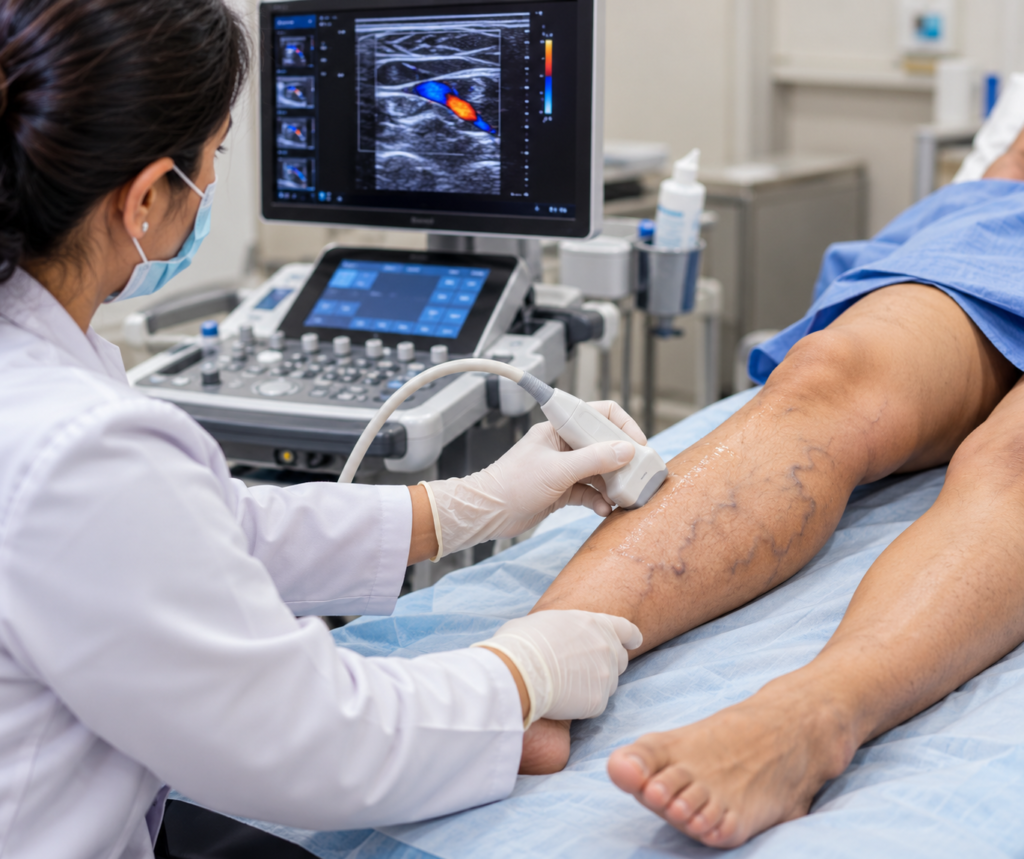
A duplex ultrasound is used to map the abnormal veins and reflux. In a person with diabetes, assessment of arterial circulation may also be important before procedures or compression. HbA1c helps show longer-term glucose control.
For elective surgery, the American Diabetes Association recommends an individualized preoperative approach, with an HbA1c goal of less than 8% whenever possible. This is a risk-reduction target, not a universal rule saying that every person above 8% must be refused treatment.
Does Diabetes Change Whether Varicose Veins Should Be Treated?
Diabetes does not automatically mean that varicose veins should be left untreated.
Treatment may be considered when varicose veins cause persistent aching, heaviness, swelling, itching, skin changes, bleeding or venous ulceration. Chronic venous disease can cause progressive skin changes and ulcers in some patients.
However, a diabetic leg needs a more careful assessment before an intervention. Poor arterial circulation, an active ulcer, cellulitis, uncontrolled infection or significantly uncontrolled glucose may change the timing or treatment choice.
The goal is to treat the underlying venous problem without creating an avoidable wound or healing problem.
If the leg already has a venous ulcer, understanding the relationship between varicose veins and ulceration is important; the clinic’s information on varicose vein ulcers explains why persistent venous pressure matters.
Which Checks Must Come Before Any Vein Procedure?
A diabetic patient should not choose laser, injections or surgery simply because one technique sounds less invasive.
A practical pre-procedure assessment includes:
| Check | Why it matters |
|---|---|
| Duplex ultrasound | Maps reflux, vein anatomy and the veins suitable for treatment |
| ABI or ankle-pulse assessment | Helps assess arterial circulation, particularly when compression is being considered |
| HbA1c | Shows longer-term glucose control and helps assess elective-procedure risk |
| Skin examination | Looks for ulcers, infection, dermatitis, wounds or fragile skin |
| Foot/neuropathy assessment | Important when reduced sensation may affect wound awareness |
| Medication review | Diabetes medicines and blood thinners may need procedure-specific planning |
The duplex scan is particularly important because treatment should be based on the anatomy and source of reflux rather than simply the appearance of surface veins.
If arterial disease is suspected, the clinician may need additional vascular testing before compression or intervention.
A vascular Doppler assessment can help investigate blood flow and is different from simply looking at visible veins; the clinic’s vascular Doppler test information explains this type of evaluation.
Laser, Radiofrequency, Glue, Foam or Surgery: Which Suits a Diabetic Leg?
There is no single “best” treatment for every diabetic patient.
For suitable truncal reflux, endovenous thermal ablation-including laser and radiofrequency treatment-is generally preferred over traditional stripping because it is less invasive and usually allows faster recovery. NICE places endothermal ablation first when suitable, followed by ultrasound-guided foam sclerotherapy and then surgery when the preceding options are unsuitable.
EVLA – Endovenous Laser Ablation
EVLA uses laser energy delivered through a catheter to close the abnormal vein.
For a diabetic patient with suitable anatomy, good circulation and acceptable skin condition, this can be an attractive option because there is no large surgical incision.
The diabetes-specific question is whether the patient’s overall risk profile makes an elective procedure appropriate—not whether diabetes itself prohibits laser.
RFA – Radiofrequency Ablation
RFA uses heat generated by radiofrequency energy to close the treated vein.
Like EVLA, it is an endovenous procedure and is generally performed through a small access point under ultrasound guidance. NICE recognises both laser and radiofrequency as forms of endothermal ablation.
Cyanoacrylate Glue
Medical adhesive can close a selected superficial vein without thermal energy.
This can be useful in appropriately selected patients, but the anatomy, vein diameter, treatment objective and individual risks still need assessment. “No heat” does not mean “no risk,” and diabetes does not make glue automatically safer than every other method.
Foam Sclerotherapy
Foam sclerotherapy involves injecting a sclerosant into the vein, generally under ultrasound guidance.
It can be particularly useful for selected veins or when thermal ablation is unsuitable. The injection causes the treated vein to close and gradually become less prominent. NICE describes ultrasound-guided foam sclerotherapy as a minimally invasive option that can be performed using local anaesthesia.
For diabetic patients, the injection site and surrounding skin still need appropriate monitoring.
Open Ligation and Stripping
Traditional surgery involves tying off and removing the affected vein.
It remains useful in selected situations, but it is no longer automatically the first option when a suitable endovenous treatment is available. Modern guidelines favour less invasive approaches where clinically appropriate.
Comparison: Varicose Vein Treatments in Diabetes
| Method | Anaesthesia | Back to walking | Stocking period | Extra caution with diabetes |
|---|---|---|---|---|
| EVLA | Local/tumescent usually | Usually same day | As advised | Check circulation, skin and glucose control |
| RFA | Local/tumescent usually | Usually same day | As advised | Assess arterial status and wound risk |
| Cyanoacrylate glue | Usually local anaesthesia | Usually same day | May be less dependent on prolonged compression | Check skin, infection risk and treatment suitability |
| Foam sclerotherapy | Usually local/no major anaesthesia | Usually same day | Often used for a period after treatment, depending on protocol | Monitor injection site and skin carefully |
| Open ligation & stripping | Regional/general depending on case | Usually slower than endovenous treatment | Individualised | Greater wound/healing considerations |
Actual recovery varies according to the veins treated, procedure, general health, occupation and complications. The ESVS guidelines support modern endovenous approaches for appropriate patients, while treatment selection remains individual.
How Do Healing and Recovery Differ With Diabetes?
Diabetes can make recovery more complicated when glucose is poorly controlled, circulation is impaired or the skin is already damaged.
That does not mean that every diabetic patient heals poorly.
After treatment, the important factors include:
- keeping glucose within the range advised by the treating team
- following wound-care instructions
- checking the puncture or incision sites
- watching for increasing redness, discharge or skin breakdown
- walking as advised rather than remaining inactive for prolonged periods
- using compression only when medically appropriate and correctly fitted
The American Diabetes Association notes that perioperative hyperglycaemia is associated with postoperative complications, which is why glucose management forms part of elective-procedure planning.
Compression also needs individual assessment. A person with significant arterial disease should not simply buy tight compression stockings without appropriate vascular evaluation.
The clinic’s information about compression stockings can be useful when discussing whether compression is appropriate after treatment.
When Should Treatment Be Postponed?
A planned vein procedure may need to be delayed when the risks of proceeding are temporarily higher than the benefits.
Examples include:
- active cellulitis or another leg infection
- an open or infected wound at the treatment site
- significantly impaired arterial circulation
- poorly controlled glucose requiring optimisation
- an unstable medical condition
- an unresolved acute vascular problem
- inability to follow essential aftercare instructions
There is no single blood-sugar reading that automatically determines whether treatment can proceed.
For elective surgery, an HbA1c below 8% is a commonly recommended target when possible, but the final decision should consider the procedure, urgency and the patient’s overall risk profile.
What Are the Side Effects of Vein Treatment?
Possible side effects of vein treatment depend on the technique.
After endovenous treatment, patients may experience bruising, tenderness, tightness or temporary numbness. Foam sclerotherapy can cause bruising, inflammation or temporary skin changes. Rare but more serious complications can include thrombosis, infection, nerve injury or skin injury.
Open surgery generally involves more tissue disruption and therefore may have a longer recovery.
A diabetic patient should report increasing pain, spreading redness, discharge, skin colour changes, fever or a wound that is not healing as expected.
The objective of vein surgery safety is therefore not simply selecting the newest procedure. It is selecting the right procedure after checking venous anatomy, arterial circulation, skin condition and metabolic control.
How Long Is Recovery After Varicose Vein Treatment?
Veins surgery recovery time varies substantially by technique.
Most endovenous procedures allow walking soon after treatment and many patients resume ordinary activities relatively quickly. Foam treatment may also be performed as an outpatient procedure. Traditional stripping generally involves a more substantial recovery.
A diabetic patient may require closer wound and skin monitoring even when the procedure itself is minimally invasive.
Your clinician should give specific instructions about walking, exercise, driving, work, bathing and compression rather than relying on a generic recovery timeline.
Will the Veins Come Back After Treatment?
Treatment closes or removes the veins responsible for the current problem, but it cannot guarantee that no new varicose veins will ever develop.
New reflux can develop in untreated veins, and previously treated veins can occasionally reopen or require additional treatment.
This is why follow-up matters. In the clinic pathway described in the sheet, procedures are supervised by Dr. Ashutosh Shah, with reviews planned around day 7 and week 6.
The follow-up is an opportunity to assess healing, symptoms, residual veins and whether further treatment is needed.
Pre-Procedure Checklist for a Diabetic Patient
Before scheduling treatment, ask whether these have been reviewed:
☐ Duplex ultrasound – confirms the venous anatomy and reflux pattern.
☐ ABI or ankle-pulse assessment – checks arterial circulation when indicated.
☐ HbA1c – assesses longer-term glucose control.
☐ Skin check – looks for ulcers, infection, dermatitis or fragile skin.
☐ Medication review – particularly anticoagulants and diabetes medicines.
☐ Neuropathy assessment – reduced sensation can affect wound awareness.
☐ Procedure-specific plan – confirms why laser, RFA, glue, foam or surgery is being selected.
Is Laser Vein Treatment Safe for Diabetics?
For an appropriately selected patient, laser vein treatment can be safe despite diabetes.
The decision should follow a duplex scan and assessment of circulation, skin condition and glucose control. Diabetes by itself should not be treated as either an automatic contraindication or a guarantee of safety.
If you are looking for a varicose vein doctor in bardoli, the important step is to have the leg assessed before choosing a procedure.
FAQs
Yes, it can be appropriate for selected diabetic patients. Safety depends on venous anatomy, arterial circulation, skin condition, infection status and glucose control. A duplex scan and clinical examination should guide the decision rather than choosing laser solely because it is minimally invasive.
There is no universal HbA1c cutoff for every vein procedure. For elective surgery, the ADA recommends aiming for an HbA1c below 8% when possible, while individual risk and the type of procedure must be considered.
A skin injury or ulcer is possible but uncommon. Diabetes may increase concern when circulation is poor or skin is already damaged. The injection site should therefore be examined beforehand and monitored afterwards, particularly if the patient has neuropathy or existing skin problems.
Many endovenous treatments allow walking soon afterwards and have relatively short recovery periods. Foam sclerotherapy can also be performed as an outpatient treatment. Recovery after open surgery is generally longer. Your individual timeline depends on the technique and your health.
New varicose veins can develop even after successful treatment, and some treated veins can recanalise. Follow-up helps identify persistent or new reflux and determine whether additional treatment is necessary.
Not everyone needs the same duration of compression. The decision depends on the procedure, symptoms, circulation and clinician’s protocol. Compression should not be used without appropriate assessment when significant arterial disease is suspected.
Featured Questions
- I have diabetes and varicose veins, is laser treatment safe for me?
- What sugar level is needed before varicose vein surgery?
- Laser vs injection for varicose veins in a diabetic patient, which is better?
Medical Review
Medically reviewed by Dr. Ashutosh Shah
Treatment decisions should be based on the patient’s duplex findings, arterial circulation, skin condition, HbA1c and overall medical status. The ESVS 2022 guidelines support endovenous approaches for appropriate chronic venous disease, while NICE recommends endothermal ablation before foam sclerotherapy or surgery when clinically suitable.