
Can Limb Salvage Help a Chronic Wound?
Dr. Ashutosh Shah, M.Ch., DNB (Plastic Surgery) has more than 22 years of surgical experience, with a background in plastic, reconstructive and microvascular surgery. In chronic wound cases, this experience is relevant when assessment extends beyond wound dressing to tissue viability, difficult defects, wound coverage, and reconstructive possibilities.
At Elegance Diabetic Foot And Ulcers Clinic, limb-salvage decisions are based on the individual wound and patient rather than assuming that one procedure is appropriate for every difficult ulcer.
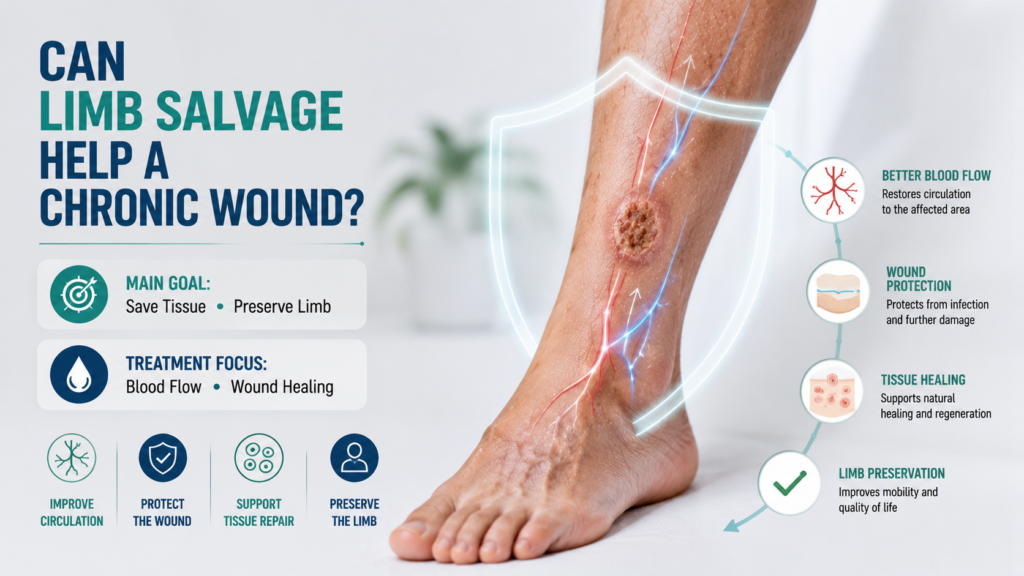
A chronic wound on the foot or lower leg can sometimes progress beyond a local skin problem. When infection, poor blood circulation, tissue loss, repeated pressure, or deeper structures are involved, the priority may shift toward limb salvage—a coordinated approach that aims to control the disease, heal the wound where possible, preserve useful tissue, and maintain a functional limb.
For patients seeking limb salvage and chronic wound care in Surat, early assessment is particularly important when a wound is becoming deeper, repeatedly infected, exposing deeper tissues, or failing to improve despite ongoing treatment. Limb salvage is not a single operation, and it does not mean that every threatened limb can or should be preserved. Modern limb-salvage planning is patient- and defect-centred, with functional restoration as an important goal.
At Elegance Diabetic Foot And Ulcers Clinic, Surat, assessment can focus on what is threatening the wound and limb. Depending on the individual problem, management may involve infection control, debridement, pressure reduction, evaluation of circulation, wound care, management of underlying conditions, and reconstructive treatment in selected cases.
The important principle is to look beyond the wound surface. A dressing may protect a wound, but it cannot by itself correct severely reduced circulation, remove deep infected tissue, or eliminate repeated pressure.
Key Takeaways
- Limb salvage is a treatment strategy, not one specific operation.
- The aim is not merely to close a wound but, where medically appropriate, to preserve a useful and functional limb.
- Infection, inadequate circulation, neuropathy, pressure, and tissue loss can interact in complex chronic wounds.
- Debridement may be necessary when dead or infected tissue needs removal.
- Reduced blood supply may require vascular assessment and, in selected patients, revascularisation.
- Reconstruction can be considered when a wound leaves a significant tissue defect after underlying problems are controlled.
- Limb salvage is not appropriate or achievable in every case; sometimes amputation remains the safer or more functional option.
What Does Limb Salvage Mean?
Limb salvage describes a coordinated treatment approach intended to preserve as much of a threatened arm or leg as medically and functionally appropriate. In chronic lower-limb wounds, this may require treatment of infection, blood-flow problems, pressure, unhealthy tissue and structural defects rather than wound dressing alone.
Limb Salvage: A patient-specific strategy intended to preserve a threatened limb and, importantly, maintain or restore useful function when clinically achievable.
Current reconstructive literature emphasises functional limb restoration, meaning that keeping the limb is not the only objective; its eventual usefulness also matters.
This distinction is important when discussing realistic expectations with patients and families.
When Can a Chronic Wound Put the Limb at Risk?
A chronic wound becomes more concerning when it is associated with spreading infection, significant tissue loss, inadequate blood circulation, bone involvement, progressive tissue death, or repeated breakdown. Diabetes, neuropathy and peripheral arterial disease can further complicate some lower-limb wounds.
A wound that has been present for a long time is not automatically limb-threatening. Conversely, a relatively small foot wound can sometimes become serious when infection extends deeper or circulation is severely compromised.
The severity therefore cannot be judged from surface size alone.
Neuropathy: Nerve damage that can reduce sensation, making pressure or injury harder to detect.
How Is a Limb-Threatening Wound Assessed?
Assessment needs to identify both the wound and the factors threatening the limb. Clinicians may evaluate wound depth, viable and non-viable tissue, infection, circulation, sensation, pressure, structural changes, previous procedures, medical conditions, and the patient’s ability to use the limb.
If deeper infection or bone involvement is suspected, additional investigations may be required.
Circulation deserves particular attention. A wound cannot be expected to heal normally if the tissues are receiving inadequate blood flow.
The 2024 ACC/AHA guideline recommends coordinated multidisciplinary care for patients with chronic limb-threatening ischaemia and non-healing wounds, combining evidence-based wound care with revascularisation when appropriate.
How Does Limb Salvage for a Chronic Wound Work?
Limb salvage is built around the specific problems found during assessment. Treatment may involve controlling infection, removing unhealthy tissue, relieving pressure, improving circulation when possible, managing the wound environment, treating underlying medical factors, and reconstructing tissue defects when appropriate.
The order of treatment matters.
For example, immediately closing a complex wound may not solve the problem if significant infection remains underneath. Likewise, repeated debridement and dressings may have limited success when severe arterial disease is preventing adequate tissue perfusion.
Current diabetes-related foot-care standards identify core ulcer-management principles that include pressure relief, removal of non-viable tissue when appropriate, revascularisation of ischaemic wounds when necessary, infection management and wound-appropriate dressings.
Patients can learn more about Diabetic Foot Surgery when a diabetic foot wound requires evaluation for surgical treatment as part of a broader limb-preservation strategy.
Why Is Blood Circulation Important for Limb Salvage?
Blood circulation determines whether damaged tissue receives enough oxygen and nutrients to support healing. When a chronic wound is associated with significant arterial disease, improving the wound surface alone may not address the underlying lack of blood flow.
Revascularisation: A procedure intended to restore or improve blood flow to tissue when circulation has become significantly impaired.
Not every chronic wound needs revascularisation. Vascular testing and treatment are considered when clinical assessment suggests inadequate arterial circulation.
When significant ischaemia is present, collaboration with an appropriate vascular specialist may become an essential part of limb-salvage planning.
How Are Infection and Unhealthy Tissue Managed?
Infection can rapidly increase the seriousness of a chronic foot wound. Management depends on its severity and depth and may involve medical treatment together with surgical removal of infected or non-viable tissue when indicated.
Debridement: The medical removal of dead, infected, contaminated or otherwise non-viable tissue when clinically appropriate.
Deep infection may extend beyond what can be seen from the surface. Bone infection, known as osteomyelitis, can also complicate some chronic foot wounds.
Severe diabetic foot infection requires timely assessment because delaying appropriate treatment can allow further tissue destruction.
Why Is Pressure Relief Part of Limb Preservation?
Pressure can repeatedly injure the same tissue, particularly when neuropathy reduces protective sensation.
This creates a frustrating cycle: treatment begins healing the wound, but walking or mechanical pressure damages the fragile tissue again.
Offloading: Reducing or redistributing mechanical pressure away from a wound so that affected tissue has a better opportunity to heal.
Offloading may involve specialised footwear, devices, activity modification, or other strategies depending on the wound.
The appropriate method needs to be individualised. Simply telling every patient not to walk is not a complete limb-salvage plan.
Can Reconstructive Surgery Help Save a Limb?
Reconstructive surgery can be considered for selected patients when a chronic wound leaves a significant tissue defect or exposes structures that require durable coverage. Reconstruction is generally planned after factors such as infection, circulation, unhealthy tissue and mechanical pressure have been appropriately evaluated.
The reconstructive approach depends on the defect.
Some wounds may heal with simpler methods. Others can require skin grafting, local tissue rearrangement, or more advanced tissue-transfer techniques.
A recent plastic and reconstructive surgery review describes modern lower-extremity limb salvage as a multidisciplinary and patient-centred process in which reconstruction is planned around both the defect and eventual limb function.
Can Every Limb Be Saved?
No. Limb salvage is not medically appropriate, technically possible, or functionally beneficial in every situation. The decision must consider infection severity, blood supply, extent of tissue destruction, medical condition, expected function, treatment burden and the risks of repeated procedures.
This is one of the most important realistic expectations in limb-salvage care.
“Saving the limb at any cost” is not a responsible medical objective. In some situations, amputation may provide better infection control, safety, rehabilitation potential, or eventual function.
The decision should therefore be individualised and discussed carefully with the patient and family when appropriate. Modern reconstructive literature similarly frames the decision around functional salvage versus functional amputation, rather than limb preservation alone.
How Long Does Limb Salvage Treatment Take?
There is no standard timeline.
Some patients require relatively limited wound treatment, while complex cases can involve several stages of infection control, circulation management, debridement, wound preparation, reconstruction and rehabilitation.
Healing also depends on the extent of tissue damage, blood supply, pressure, infection, medical conditions and response to treatment.
For this reason, a promise that every chronic wound can be healed or every limb saved within a particular period would be medically inappropriate.
When Should You Seek Specialist Care?
A chronic foot or lower-leg wound should be professionally evaluated when it is deteriorating, becoming deeper, repeatedly infected, failing to progress, associated with tissue colour changes, or occurring in a patient with diabetes, neuropathy or known circulation problems.
Urgent assessment is particularly important with rapidly spreading redness or swelling, severe or increasing pain, fever or systemic illness, foul or significant drainage, rapidly changing tissue colour, or signs of severe infection.
A patient with neuropathy may have a serious wound without experiencing proportionate pain. Lack of pain should therefore not automatically be interpreted as a reassuring sign.
Limb-Focused Wound Care at Elegance Diabetic Foot And Ulcers Clinic
At Elegance Diabetic Foot And Ulcers Clinic, Surat, the focus in a difficult chronic wound is not simply whether the wound can be dressed—it is whether the factors threatening tissue survival and limb function can be identified and appropriately managed.
Dr. Ashutosh Shah, M.Ch., DNB (Plastic Surgery) brings more than 22 years of surgical experience, including a background in reconstructive and microvascular surgery relevant to complex tissue defects and limb-preservation planning. When vascular, infectious, metabolic, or other specialist input is required, chronic wound care may also involve multidisciplinary evaluation.
This approach keeps the treatment goal realistic: preserve a healthy, functional limb when medically achievable while recognising when another strategy is safer.
Conclusion
Limb salvage for chronic wounds involves much more than keeping an ulcer covered. The treatment strategy may need to address infection, dead tissue, pressure, blood circulation, deeper tissue involvement, and the patient’s overall medical condition.
For patients in Surat, early specialist evaluation is particularly important when a chronic foot or lower-leg wound is deteriorating or showing features that could threaten tissue or limb viability.
At Elegance Diabetic Foot And Ulcers Clinic, the treatment pathway can be planned according to the individual wound and the factors preventing healing. Some patients may need wound care alone, while complex cases may require debridement, vascular evaluation, reconstruction, or multidisciplinary management.
Most importantly, limb salvage should never be presented as a guarantee. The appropriate goal is to achieve the safest and most functional outcome possible for the individual patient.
Concerned that a chronic wound may be putting your foot or limb at risk?
Consult Dr. Ashutosh Shah at Elegance Diabetic Foot And Ulcers Clinic, Surat, for an individual assessment of the wound, tissue condition and factors affecting limb preservation.
Frequently Asked Questions
It is a coordinated approach that aims to control the factors threatening the limb and preserve useful function when medically appropriate.
No. Treatment depends on the underlying problem. Some patients require wound care and pressure management, while others need surgical or vascular intervention.
Yes. Significant reduction in arterial blood flow can interfere with tissue healing and may require vascular assessment.
Severe or uncontrolled infection can destroy tissue and increase the risk of limb loss, particularly when combined with poor circulation or other complications.
No. Many diabetic foot wounds do not require major surgery. Treatment is selected according to wound severity and underlying factors.