
How Is Chronic Wound Care Done?
Dr. Ashutosh Shah, M.Ch., DNB (Plastic Surgery) has more than 22 years of surgical experience, with a professional background spanning plastic and reconstructive surgery. This expertise is relevant when chronic wounds involve unhealthy tissue, tissue loss, difficult closure, or a potential need for reconstruction.
At Elegance Diabetic Foot And Ulcers Clinic, Surat, chronic wound evaluation considers both the wound and the factors that may be preventing normal tissue repair.
A wound that remains open, repeatedly breaks down, or shows little healing progress may need a more detailed approach than routine cleaning and dressing. Chronic wound care focuses on understanding why healing has slowed and then managing the factors responsible for that delay.
For patients seeking chronic wound care in Surat, this can involve assessment of the wound itself as well as blood circulation, pressure, infection, tissue condition, sensation, diabetes, swelling, and other health factors. A wound may look small on the surface but still require careful evaluation, particularly when it affects the foot or lower leg.
At Elegance Diabetic Foot And Ulcers Clinic, wound management is planned according to the individual wound rather than following one standard treatment for every patient. Depending on clinical findings, care may involve appropriate dressings, pressure reduction, removal of unhealthy tissue when necessary, infection management, circulation assessment, and reconstructive planning for selected complex wounds.
Chronic wounds should not be treated only as a skin problem. Healing depends on the condition of the surrounding tissues and the patient’s overall health. This is why identifying the barrier to healing is often as important as treating the wound itself.
Wounds that rapidly worsen, develop significant redness or swelling, produce unusual discharge, become severely painful, or are accompanied by fever or tissue colour changes need prompt medical evaluation.
Key Takeaways
- Chronic wound care begins by identifying why normal healing has slowed.
- Infection is only one possible reason for delayed wound healing.
- Pressure, poor circulation, diabetes, swelling, tissue damage, and repeated trauma can interfere with recovery.
- Dressings should be selected according to the wound rather than used as a one-size-fits-all treatment.
- Debridement may be considered when dead or unhealthy tissue affects wound management.
- Both diabetic and nondiabetic wounds can become chronic.
- A worsening wound or signs of serious infection require prompt medical attention.
What Makes a Wound Chronic?
A wound becomes a chronic concern when its normal healing process is delayed, interrupted, or repeatedly disrupted. Rather than improving steadily, the wound may remain open, change very slowly, repeatedly reopen, or deteriorate because an underlying problem continues to interfere with tissue repair.
Chronic Wound: A wound in which normal healing has been delayed or disrupted and which requires assessment of factors preventing recovery.
Chronic wounds can occur in people with or without diabetes. Examples include pressure ulcers, difficult foot and leg ulcers, persistent traumatic wounds, and wounds that have not healed normally after surgery.
The label alone does not explain why the wound remains open. Finding that reason is the next step.
Why Do Chronic Wounds Heal Slowly?
Chronic wounds may heal slowly because of inadequate circulation, infection, repeated pressure, unhealthy tissue, swelling, repeated injury, diabetes, or other medical factors. More than one problem can be present at the same time.
Consider a wound on the bottom of the foot. Appropriate dressing may protect the wound, but repeated pressure during walking can continue damaging newly forming tissue.
In another patient, the main problem may be inadequate blood supply.
This is why chronic wound management should answer a fundamental question:
What is continuing to prevent this wound from healing?
Treating that factor can be as important as treating the visible wound.
How Is a Chronic Wound Assessed? {#wound-assessment}
Chronic wound assessment examines the wound’s size, depth, tissue quality, drainage and surrounding skin while also considering circulation, pressure, sensation, infection risk, medical history and previous treatment. Further investigations may be appropriate when a deeper problem is suspected.
A clinician may look for healthy tissue as well as dead or unhealthy tissue. The amount and nature of wound fluid can also provide useful clinical information.
For foot wounds, pressure and sensation may need particular attention. For lower-leg wounds, circulation and swelling can be important considerations.
If deeper infection, bone involvement, or significant circulation problems are suspected, additional evaluation may be necessary.
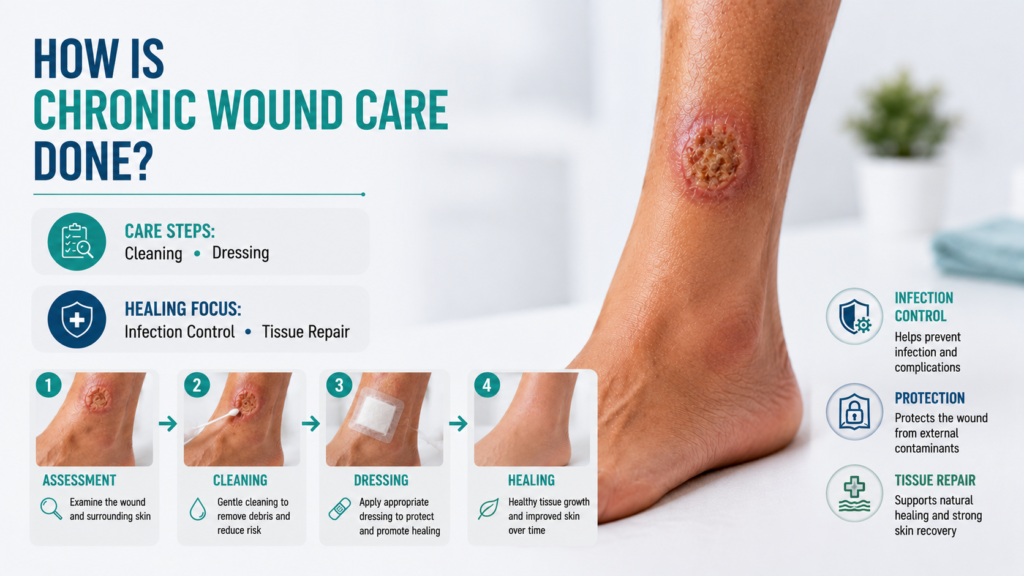
How Is Chronic Wound Care Done?
Chronic wound care is individualised according to the cause and characteristics of the wound. Management can include wound cleaning, suitable dressings, moisture control, pressure reduction, debridement when indicated, infection management, circulation assessment, and treatment of underlying factors affecting healing.
A wound-care plan may also change over time.
A dressing that is appropriate when a wound is producing significant fluid may no longer be the right choice after the wound environment changes. Similarly, reducing infection without addressing continued pressure may leave another major barrier to healing untreated.
At Elegance Diabetic Foot And Ulcers Clinic, the aim is therefore not simply to keep changing dressings. Chronic wound management considers how the wound is progressing and whether the underlying causes are being adequately addressed.
Patients with ulcers not caused by diabetes can also learn about Nondiabetic Ulcer Treatment , where evaluation can be directed toward the specific cause of the ulcer.
Why Is Pressure Management Important?
Repeated pressure can prevent fragile healing tissue from recovering, particularly when a wound is located on a weight-bearing area of the foot. Reducing or redistributing pressure may therefore form an important part of treatment for selected chronic wounds.
Offloading: Reducing or redistributing pressure away from a wound or vulnerable area.
The method used depends on wound location, mobility, foot structure, sensation, and other clinical factors.
Simply telling every patient to stop walking is not an appropriate universal solution. Pressure management needs to be practical and matched to the individual’s condition.
Why Does Blood Circulation Matter?
Healing tissue requires oxygen and nutrients delivered through the bloodstream.
When arterial circulation is significantly reduced, the wound may struggle to repair itself even when surface wound care is appropriate. A clinician may therefore assess circulation when the wound’s appearance, location, symptoms, or medical history raises concern.
A circulation problem may require assessment or treatment beyond the wound clinic itself.
This demonstrates why chronic wound care often involves more than what is visible on the skin.
When Is Debridement Considered?
Debridement may be considered when dead, damaged, contaminated, or unhealthy tissue is interfering with wound assessment or management. The decision depends on the wound, circulation, infection status, tissue condition, and the patient’s overall health.
Debridement: A medical process used to remove non-viable or unhealthy tissue from a wound when clinically appropriate.
Not every chronic wound requires the same form of debridement, and some wounds may not be suitable for immediate debridement.
It should therefore be performed as part of an appropriate medical wound-care plan rather than attempted at home.
How Are Infection and Chronic Wounds Connected?
A chronic wound can become infected, but not every chronic wound is infected.
This distinction matters because delayed healing alone does not automatically mean antibiotics are required.
Increasing pain, redness, warmth, swelling, pus-like drainage, unpleasant odour, fever, or deterioration may raise concern and should be medically assessed. The appropriate response depends on the extent and nature of the suspected infection.
Treatment should address infection when present without assuming infection is the only reason the wound has remained open.
Can Chronic Wounds Need Reconstruction?
Some chronic wounds with substantial tissue loss, exposed deeper structures, or difficult closure may require reconstructive assessment. Reconstruction is generally considered within the wider wound-care plan rather than as a replacement for managing infection, circulation, pressure, or unhealthy tissue.
Depending on the defect, reconstructive options may include wound closure, skin grafting, or movement of suitable tissue.
The appropriate approach varies considerably between patients.
Dr. Ashutosh Shah’s plastic and reconstructive surgery background is particularly relevant when wound treatment progresses from controlling the underlying problem to considering how a complex tissue defect can be covered or reconstructed.
How Long Can Chronic Wound Healing Take?
There is no single healing timeline for chronic wounds. Healing depends on wound depth, blood supply, infection, pressure, tissue condition, medical conditions, nutrition, mobility, and response to treatment.
For this reason, promising that a chronic wound will close within a particular number of days would be inappropriate without examining the patient.
Progress can instead be assessed through changes in wound dimensions, tissue quality, drainage, surrounding skin, and other clinical findings.
A wound that stops improving or begins deteriorating may need the treatment plan reassessed.
When Should You See a Chronic Wound Specialist?
Professional assessment should be considered when a wound is not progressing as expected, repeatedly reopens, becomes deeper or larger, develops persistent drainage, or occurs alongside diabetes, poor circulation, reduced sensation, significant pressure, or other healing concerns.
Seek prompt medical attention if there is rapidly worsening redness or swelling, severe or increasing pain, significant bleeding, fever, rapidly changing tissue colour, spreading infection, or a marked deterioration in general health.
Patients with reduced sensation may not always experience significant pain even when a foot wound is becoming more serious.
A Focused Approach to Difficult Wound Healing
At Elegance Diabetic Foot And Ulcers Clinic in Surat, chronic wound care is centred on identifying the specific obstacles to healing rather than treating every wound in the same way.
Dr. Ashutosh Shah, M.Ch., DNB (Plastic Surgery) contributes more than 22 years of surgical experience, with reconstructive expertise that can become relevant when a chronic wound involves tissue loss, difficult closure, or the need for more advanced reconstruction.
The appropriate pathway can therefore range from wound management and pressure control to investigation of circulation or reconstructive planning, depending entirely on the clinical findings.
Conclusion
Chronic wound care is not simply about keeping an open wound covered. Effective management requires understanding why the normal healing process has slowed and addressing those factors wherever possible.
For patients in Surat, chronic wounds may require assessment of infection, circulation, pressure, sensation, tissue health, diabetes, swelling, and previous treatment. Some wounds can be managed with appropriate local care, while complex cases may need debridement, additional investigations, multidisciplinary treatment, or reconstructive assessment.
At Elegance Diabetic Foot And Ulcers Clinic, treatment is planned around the characteristics and underlying cause of each wound. Individual healing times and outcomes vary, so professional examination remains important when a wound is persistent or worsening.
Is a wound remaining open or repeatedly returning?
Consult Dr. Ashutosh Shah at Elegance Diabetic Foot And Ulcers Clinic, Surat, for an individual assessment of the wound and the factors that may be interfering with healing.
Frequently Asked Questions
Many chronic wounds can improve when the factors delaying healing are identified and appropriately managed. Outcomes vary between patients.
No. Pressure, circulation problems, trauma, venous disease and other conditions can also contribute to chronic wounds.
No. Surgical or reconstructive treatment is considered only for selected wounds when clinically appropriate.
Debridement is the removal of unhealthy or non-viable tissue when appropriate for the wound.
Reduced blood supply can significantly interfere with tissue repair because healing tissues require adequate oxygen and nutrients.
Repeated pressure, friction, poor circulation, tissue weakness, infection, or another unresolved factor may contribute.
Consider assessment when a wound is persistent, worsening, repeatedly reopening, or associated with factors that can interfere with healing.