
How Is a Pincer Nail Corrected?
Reviewed & Prepared Under the Guidance of Dr. Ashutosh Shah
Dr. Ashutosh Shah, M.S., M.Ch. (Plastic Surgery)
Experience: 22+ Years
Focus: Plastic, Reconstructive & Diabetic Foot Care
Founder: Elegance Diabetic Foot & Ulcer Clinic (EDFC)
With more than 22 years of surgical experience, Dr. Ashutosh Shah’s work includes diabetic-foot care, wound management, reconstruction, and limb preservation. At EDFC, nail deformities are evaluated not only for appearance but also for the pressure they create on the skin and nail bed.
Last Updated: August 2026
Introduction
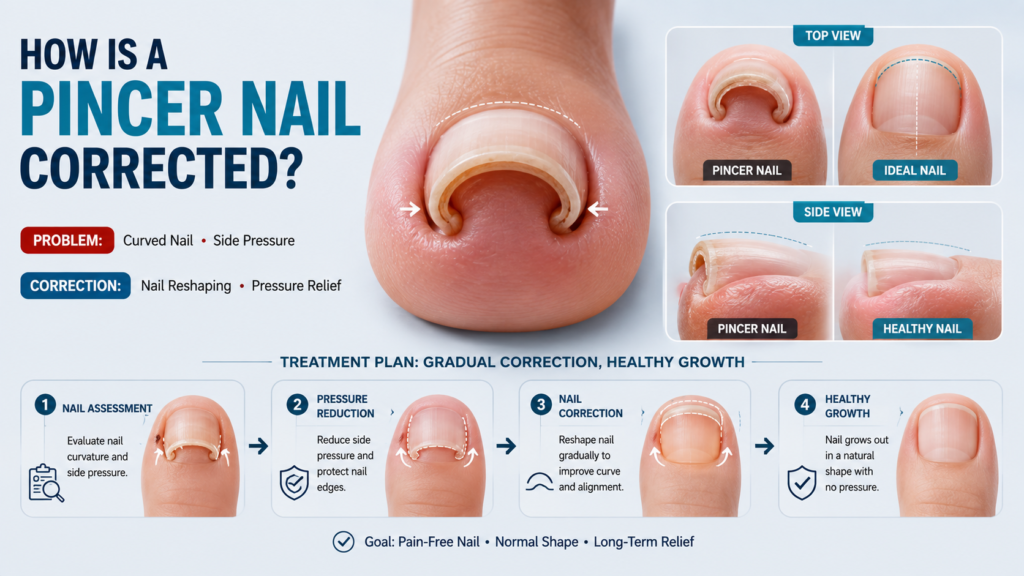
A toenail should normally grow relatively flat across the nail bed. A pincer nail behaves differently. Its sides become excessively curved inward, sometimes creating a tube-like shape that squeezes the skin and tissue underneath.
This pressure can cause pain, tenderness, difficulty wearing shoes, and repeated irritation around the nail. For someone with diabetes, the problem deserves additional attention because pressure beneath a deformed nail can contribute to hidden skin breakdown.
Pincer nail correction does not always mean surgery. Depending on the severity and cause, treatment may involve professional thinning and reduction of the nail, nail bracing, management of contributing conditions, or a procedure designed to stop a repeatedly problematic nail edge from growing back.
For patients looking for pincer nail treatment in Surat, the first step is determining whether the nail is simply curved or whether it has already created pressure-related skin damage.
Key Takeaways
- A pincer nail curves excessively inward across its width.
- The nail can squeeze the nail bed and surrounding tissue.
- Cutting the nail repeatedly may provide only temporary relief.
- Professional nail reduction can decrease pressure in selected cases.
- Nail bracing may gradually improve curvature without surgery.
- Recurrent painful cases may require a more definitive nail procedure.
- Diabetes, neuropathy, circulation, and skin condition can affect treatment planning.
- Correcting the pressure is more important than simply making the nail look flatter.
What Is a Pincer Nail?
A pincer nail is a nail deformity in which the nail plate develops excessive side-to-side curvature and begins pinching the tissue underneath.
When viewed from the front, a significantly affected nail may appear more like a curved tube than a flat nail plate.
The curvature often becomes more noticeable toward the end of the nail. As both edges turn downward, pressure becomes concentrated beneath the nail and along its sides.
EDFC’s information on pincer nail problems and available correction options explains that this pressure can become particularly important in a diabetic foot because damaged skin may develop beneath the nail.
Why Do Pincer Nails Develop?
There is not always one identifiable cause.
Some people naturally develop strongly curved nails because of their nail shape. Narrow footwear can worsen pressure around an already curved nail.
Fungal infection can also thicken or distort the nail plate, while changes involving the bone beneath the nail can influence its shape. Certain medications may affect nail growth as well.
This means treatment should ideally identify whether the curvature itself is the main problem or whether another condition is contributing to it.
Is a Pincer Nail the Same as an Ingrown Toenail?
No. Although both conditions can cause pain along the sides of a toenail, they are not exactly the same problem.
An ingrown nail typically involves an edge of the nail entering or irritating the surrounding skin.
With a pincer nail, the entire nail plate can become excessively curved across its width, squeezing the nail bed between the two inward-turning sides.
A severely curved pincer nail can eventually cause problems similar to an ingrown nail, but recognising the underlying deformity is important because repeatedly cutting one painful corner may not correct the overall curvature.
Patients with other unusual nail shapes can also read about how EDFC evaluates different toenail deformities, where treatment is based partly on where the nail creates pressure.
Which Pincer Nail Correction May Be Considered?
The appropriate option depends on the degree of curvature, symptoms, recurrence, surrounding skin, circulation, and whether diabetes or neuropathy is present.
| Pincer Nail Problem | Possible Approach | Main Consideration |
|---|---|---|
| Mild thick curved nail | Professional nail reduction | May need repeated maintenance |
| Pressure from excessive thickness | Clinical thinning | Reduces pressure but may not permanently change growth |
| Flexible/moderate curvature | Nail bracing | Correction develops gradually |
| Fungal-related distortion | Treat confirmed fungal problem | Nail shape improves only as healthier nail grows |
| Recurrent painful edge | More definitive nail-edge procedure | Suitability depends on examination |
| Repeated skin breakdown | Specialist diabetic-foot assessment | Pressure, circulation and infection must be checked |
| Severe recurrent deformity | Surgical correction may be considered | Procedure depends on anatomy and tissue condition |
The goal is not automatically to remove the entire toenail. Treatment should address the part of the nail that is creating the problem.
Can a Pincer Nail Be Corrected Without Surgery?
Yes. Some pincer nails can be managed conservatively, particularly when there is no significant wound or recurrent infection.
Professional reduction can thin an excessively thick nail and reduce pressure on the nail bed.
Another option for selected patients is nail bracing. A brace applies controlled outward tension across the nail plate. Over time, this can encourage the excessively curved nail to become flatter. EDFC describes bracing as a gradual nonsurgical option that may work over several months.
The advantage is that the nail can potentially be corrected without an operation.
The limitation is that it is not an immediate solution and may not be appropriate for every severe or recurrent deformity.
Why Doesn’t Repeated Nail Cutting Permanently Fix It?
Cutting the curved nail shorter can reduce pressure temporarily, but it does not necessarily change how the nail grows from its base.
As new nail grows forward, the same excessive curvature may return.
Digging deeply into the sides can also create sharp edges or accidentally injure surrounding skin.
This is particularly concerning for someone with diabetes and reduced protective sensation.
Patients who cannot safely manage thick or distorted nails themselves may benefit from clinical diabetic nail care and medical pedicure, where nails are reduced using sterile instruments and the foot can also be checked for early warning signs.
When Might a Procedure Be Needed?
A more definitive procedure may be considered when pain, pressure, wounds, or inflammation repeatedly return despite appropriate conservative treatment.
One approach may involve removing the problematic nail edge and treating its growth area so that the same curved section does not continue growing.
The exact procedure should be determined after examining the nail and toe.
For a person with diabetes, circulation deserves particular attention before an elective nail procedure because the treated area needs adequate blood supply for healing. EDFC specifically notes circulation assessment as part of planning pincer nail surgery.
Why Is a Pincer Nail More Important in Diabetes?
A curved nail can continuously press on the tissue underneath it.
In a person with normal sensation, pain may encourage early treatment. Diabetic neuropathy can reduce this warning mechanism.
A patient may therefore continue walking with pressure beneath the nail without realising that the skin is being injured.
EDFC’s broader preventive diabetic-foot care programme includes screening, nail and skin education, and other measures designed to identify foot risks before they progress to wounds.
For diabetic patients in Surat, a painful or markedly curved nail should therefore be treated as a foot-pressure issue rather than only a cosmetic nail concern.
Can a Pincer Nail Cause a Wound?
Yes. Severe curvature can compress the skin and nail bed enough to contribute to tissue breakdown.
The wound may also be difficult to see because part of it can remain hidden beneath the nail.
Warning signs can include increasing redness, swelling, discharge, bleeding, unusual colour change, or new tissue appearing around the nail edge.
A diabetic patient with reduced sensation should not wait for severe pain before seeking assessment.
What Happens After Pincer Nail Correction?
Recovery depends on the treatment.
Professional reduction may provide relatively quick pressure relief but may require periodic maintenance as the nail continues growing.
Bracing works gradually and requires follow-up as the nail changes shape.
After a nail procedure, patients may need dressings, temporary footwear modification, activity precautions, and wound monitoring according to the treatment performed.
The important outcome is not simply whether the nail looks straighter immediately. The treated toe should remain comfortable, the skin should heal appropriately, and recurrent pressure should be reduced.
Can Pincer Nails Return?
Recurrence depends partly on the cause and treatment used.
Simple thinning or trimming does not permanently alter the nail’s growth pattern, so repeated maintenance may be needed.
Bracing aims to progressively change curvature but takes time.
When a repeatedly problematic edge is treated more definitively, recurrence from that particular portion may be reduced. However, no procedure should be presented as universally appropriate or guaranteed for every patient.
Conclusion
Pincer nail correction should be matched to the severity and cause of the nail deformity.
Mild or moderate problems may sometimes be managed through professional nail reduction or bracing. When the nail repeatedly causes pain, inflammation, wounds, or significant pressure, a more definitive procedure may be considered.
For people with diabetes, the decision requires additional attention to sensation, circulation, surrounding skin, and healing ability.
Patients seeking treatment in Surat should consider assessment before repeatedly cutting a deeply curved nail at home, particularly when the nail has already become painful or damaged the surrounding skin.
From Nail Shape to Foot Protection: The EDFC Approach
At Elegance Diabetic Foot & Ulcer Clinic, nail deformities are considered part of overall diabetic-foot health. EDFC’s clinical approach includes nail care, preventive screening, wound management, pressure assessment, and surgical treatment when required.
The clinic was founded by Dr. Ashutosh Shah, a plastic and reconstructive surgeon with more than 22 years of experience. His limb-preservation approach is particularly relevant when deciding whether a nail problem can be managed conservatively or requires a procedure to prevent repeated tissue injury. Patients can learn more about EDFC’s limb-preservation philosophy when considering specialist diabetic-foot care.
When the Nail Keeps Curving Back, Look Beyond the Clippers
If the same toenail keeps becoming tightly curved, painful, or difficult to manage, repeated cutting may only restart the cycle. Patients in Surat can contact the EDFC foot-care team through the clinic website to determine whether reduction, bracing, treatment of an underlying cause, or a more definitive correction is appropriate.
Frequently Asked Questions
Some recurrent cases may be treated more definitively by addressing the problematic nail edge and its growth area. The appropriate approach depends on the individual nail.
Yes. Professional reduction and nail bracing may be options for selected patients.
A pincer nail has excessive curvature across the nail plate, while an ingrown nail typically involves an edge pressing into surrounding skin.
Bracing is intended to apply gradual corrective tension. Individual comfort and suitability should be assessed professionally.
Diabetes-related neuropathy can reduce warning pain, allowing pressure-related skin damage to go unnoticed.