
How Does an AFO Help Your Foot and Ankle?
Diabetic Foot Mobility Guidance by Dr. Ashutosh Shah
Written By: Dr. Ashutosh Shah
Qualifications: M.Ch., DNB (Plastic Surgery)
Specialty: Plastic, Reconstructive Surgery & Diabetic Foot Management
Experience: 22+ Years
Clinic: Elegance Diabetic Foot & Ulcers Clinic, Surat
Dr. Ashutosh Shah has more than 22 years of surgical experience and works in diabetic foot management, reconstructive surgery and chronic wound care. At EDFC, treatment planning considers not only an existing wound but also pressure, gait, muscle weakness and foot mechanics that may contribute to future problems.
Last Updated: August 2026
Introduction
Walking depends on the foot and ankle working together to provide balance, stability and controlled movement. When muscle weakness, nerve problems, foot drop or deformity affects this system, walking may become difficult or unsafe.
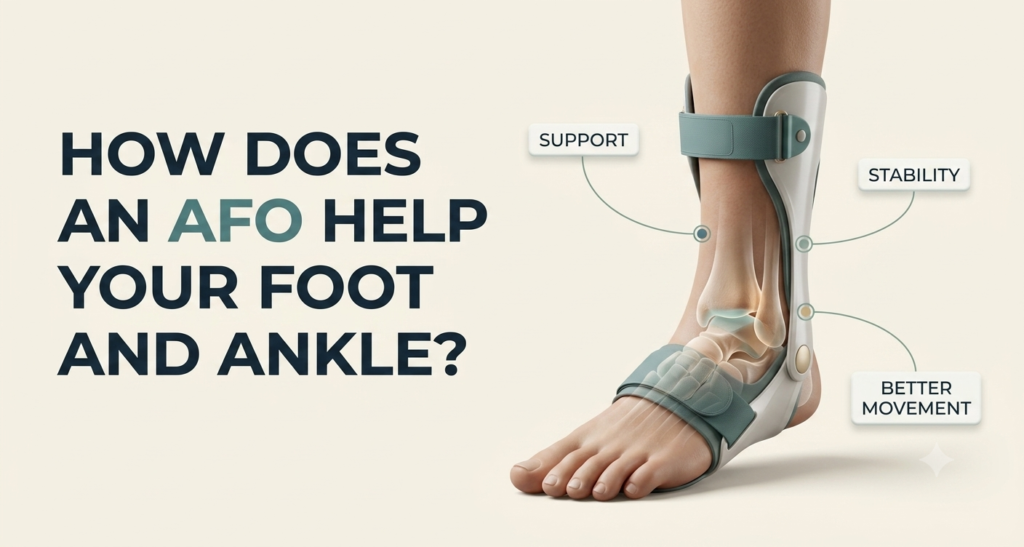
An ankle foot orthosis, commonly called an AFO, is a supportive brace designed to help control the position and movement of the ankle and foot.
For people with diabetes, selecting an AFO requires particular care. Neuropathy may reduce sensation, meaning pressure or rubbing from an unsuitable brace can sometimes go unnoticed. The objective is therefore not simply to support the ankle, but to improve mobility while protecting vulnerable skin and pressure points.
At Elegance Diabetic Foot & Ulcers Clinic in Surat, diabetic foot management includes orthotic devices and customised footwear as part of broader preventive and rehabilitative care.
Key Takeaways
- An AFO supports and stabilises the ankle and foot.
- It may help people with foot drop, ankle weakness, instability or certain deformities.
- Different AFO designs provide different degrees of movement and support.
- AFOs can improve foot positioning during walking.
- People with diabetic neuropathy require careful fitting because reduced sensation increases the risk of unnoticed pressure or rubbing.
- An AFO does not treat every underlying cause of foot drop or muscle weakness.
- Footwear needs to accommodate the orthosis properly.
- Regular skin inspection remains important for people with diabetes using an AFO.
- Persistent weakness, wounds or progressive deformity requires medical assessment.
What Is an Ankle Foot Orthosis (AFO)?
An ankle foot orthosis is a brace designed to support the foot and ankle, improve alignment and assist lower-limb function during standing and walking.
An AFO usually extends around the foot and upward across part of the lower leg.
Depending on its design, it may restrict unwanted ankle movement, hold the foot in a safer position or allow controlled movement while providing support.
EDFC’s dedicated ankle foot orthotics service describes custom-fitted AFOs for problems including foot drop, ankle instability, weakness and deformity.
What Problems Can an AFO Help With?
| Foot or Ankle Problem | How an AFO May Help | Important Consideration |
|---|---|---|
| Foot drop | Helps maintain foot position during walking | Underlying nerve or muscle cause should be assessed |
| Ankle weakness | Provides external support | Support level depends on remaining muscle function |
| Ankle instability | Helps control unwanted movement | Correct fit is essential |
| Muscle paralysis | Holds the foot in a more functional position | Long-term treatment depends on the cause |
| Foot deformity | May improve alignment or accommodate the foot | Rigid deformities may need different management |
| Balance difficulty | May improve stability during walking | Other causes of poor balance should also be checked |
| Diabetic neuropathy | May support gait when weakness is present | Skin and pressure points require close monitoring |
An AFO should be selected according to the individual problem rather than simply choosing a brace based on shoe size.
How Does an AFO Help With Foot Drop?
Foot drop occurs when a person has difficulty lifting the front of the foot appropriately during walking.
This can cause the toes to drag along the ground. Some people compensate by lifting the knee higher than usual while walking.
An AFO can hold the foot at a more functional angle and help reduce dragging during the swing phase of walking.
EDFC lists AFOs among the orthotic approaches used for foot drop management, alongside options such as physical therapy and nerve stimulation depending on the underlying problem.
The brace provides external support. It does not necessarily restore the nerve or muscle function that originally caused the foot drop.
Can an AFO Improve Walking?
Yes, in appropriately selected patients.
By controlling the ankle and keeping the foot in a more useful position, an AFO may help make steps more stable and reduce compensatory movements.
For example, someone with foot drop may otherwise need to lift the leg unusually high to prevent the toes from catching the floor.
Supporting the foot can make walking more controlled.
However, walking difficulty can have several causes. An AFO is most useful when the mechanical problem it is designed to address has been correctly identified.
Can an AFO Help With Ankle Instability?
Yes.
Weak muscles or neurological problems can make the ankle unstable during standing and walking.
An AFO can provide external support that limits unwanted movement and helps maintain alignment.
The amount of restriction required differs between patients.
Some people require considerable stability, while others benefit from a design that allows selected ankle movement.
This is one reason customised assessment is preferable to choosing a generic brace without evaluating gait and muscle function.
What Are the Different Types of AFO?
AFOs are available in different designs.
A solid AFO provides relatively greater control by limiting ankle movement.
A hinged AFO allows selected ankle motion while still providing support.
More dynamic designs can provide flexibility or assistance during movement.
EDFC identifies solid, hinged and dynamic AFOs among the types that may be used according to the required level of support.
No one design is automatically the “best AFO.” The appropriate device depends on the person’s muscle strength, deformity, gait, balance, skin condition and treatment objective.
Why Is Custom Fitting Important?
A brace that is too loose may fail to provide adequate control.
A brace that is too tight can create excessive pressure.
Custom fitting allows the device to be planned according to the shape and size of the patient’s foot and ankle. EDFC describes its AFO approach as using custom fitting, stabilising designs and adjustable features.
This becomes particularly important in diabetic foot care because the objective includes both mobility and tissue protection.
Why Do People With Diabetes Need Extra Care With an AFO?
Diabetes can be associated with peripheral neuropathy, which may reduce sensation in the feet.
A person may therefore not immediately feel excessive pressure, friction or an early skin injury caused by footwear or an orthotic device.
This means comfort alone cannot be used to judge whether an AFO fits safely.
Regular skin inspection is important.
Areas around the ankle, heel, sides of the foot and other contact points should be checked for persistent redness, blistering, skin breakdown or wounds.
A new pressure area in a person with neuropathy deserves attention before it develops into a larger problem.
Can an AFO Prevent Diabetic Foot Ulcers?
An AFO should not be described as a universal ulcer-prevention device.
However, when abnormal movement, instability or weakness contributes to inappropriate loading, improving foot position may form part of a broader pressure-management strategy.
Diabetic foot ulcer prevention can also involve suitable footwear, pressure redistribution, regular foot checks, wound care when needed and management of underlying medical risks.
EDFC provides custom orthotics and preventive foot-care services as part of its broader diabetic foot programme.
Can You Wear an AFO With Normal Shoes?
The shoe needs sufficient space and an appropriate shape to accommodate the orthosis without creating excessive pressure.
A shoe that becomes too tight after inserting an AFO can create new friction or pressure points.
For patients with diabetes, footwear selection becomes particularly important because an unnoticed pressure area may eventually damage the skin.
The brace and shoe should therefore be considered together rather than as completely separate products.
Should You Check Your Skin After Wearing an AFO?
Yes, particularly if you have diabetes or reduced foot sensation.
Inspect the skin after using the brace, especially when it is new or has recently been adjusted.
Look for persistent redness, blisters, abrasions, swelling or skin breakdown.
If a suspicious area appears, do not simply continue wearing the device until the skin “gets used to it.”
The fit may need reassessment.
Patients with reduced sensation should be particularly cautious because pain may not provide an early warning.
Does an AFO Cure Foot Drop?
No.
An AFO supports the foot mechanically.
Whether the underlying foot drop improves depends on its cause and the potential for nerve or muscle recovery.
Some patients may need physiotherapy, neurological assessment or other treatment in addition to bracing.
In selected cases where paralysis persists, surgical options such as tendon transfer may be considered. EDFC notes that tendon transfer requires appropriate circulation, a functioning donor tendon and suitable patient selection.
Therefore, the brace may be one part of treatment rather than the entire treatment plan.
Is Physiotherapy Needed With an AFO?
It may be recommended depending on the condition.
Physiotherapy can address strength, mobility, balance and gait where appropriate.
The AFO provides external mechanical support, while rehabilitation may focus on how the patient uses the limb.
The two approaches can therefore complement each other.
The rehabilitation plan should be based on the underlying cause rather than assuming that every person wearing an AFO requires the same exercises.
When Might an AFO Not Be Enough?
An AFO may not solve the entire problem when there is:
- progressive neurological weakness,
- severe fixed deformity,
- significant skin breakdown,
- an active diabetic foot ulcer,
- poor circulation,
- uncontrolled infection,
- or a mechanical problem requiring corrective surgery.
A person whose walking continues to deteriorate despite appropriate bracing should be reassessed.
Likewise, a patient who develops a wound beneath or around the brace needs prompt review.
When Should You See a Diabetic Foot Specialist?
Professional assessment is particularly important when diabetes is accompanied by:
- new foot weakness,
- foot drop,
- repeated tripping,
- ankle instability,
- numbness,
- abnormal walking,
- recurrent pressure areas,
- foot deformity,
- blisters or wounds,
- or changes in skin colour or temperature.
Sudden foot drop should also be medically evaluated rather than treated only by purchasing a brace.
The cause may involve nerves, muscles or another neurological or structural problem.
How Is the Right AFO Selected?
Choosing an AFO begins with understanding why support is needed.
The assessment may consider muscle strength, ankle movement, deformity, walking pattern, balance, sensation and skin condition.
In diabetic foot care, pressure distribution and existing wounds also matter.
The objective is to provide enough control to improve function without unnecessarily restricting movement or creating new pressure.
This is why a personalised orthotic plan can be more appropriate than selecting an off-the-shelf brace without assessment.
Conclusion
An ankle foot orthosis (AFO) can help support and stabilise the foot and ankle when weakness, foot drop, instability or certain deformities interfere with walking.
For people with diabetes, however, successful AFO use involves more than simply putting on a brace.
The device needs to fit correctly, work with appropriate footwear and avoid creating harmful pressure. Skin should be inspected regularly, particularly when neuropathy reduces sensation.
Most importantly, an AFO provides mechanical support but does not automatically treat the underlying cause of weakness or paralysis.
A proper assessment helps determine whether the patient needs an AFO alone or a combination of orthotic support, physiotherapy, footwear modification, medical treatment or corrective surgery.
Mobility and Foot Protection at EDFC
At Elegance Diabetic Foot & Ulcers Clinic, diabetic foot care includes preventive, nonsurgical and surgical management as well as customised footwear and orthotic support. The clinic’s AFO service for foot and ankle support is designed for concerns such as instability, foot drop, deformity and muscle weakness.
Dr. Ashutosh Shah, M.Ch., DNB (Plastic Surgery), has more than 22 years of surgical experience and works in reconstructive and diabetic foot management. His work at EDFC includes chronic wounds, limb-preservation strategies and correction of biomechanical problems affecting the diabetic foot.
Patients can also learn more about EDFC’s diabetic foot approach, including its surgical, nonsurgical, corrective and footwear-related services.
Support the Foot Before Abnormal Walking Creates Another Problem
If foot drop, ankle weakness or instability is changing the way you walk, simply buying a generic brace may not address your individual mechanics. Patients in Surat can book an assessment with EDFC to determine whether a custom AFO, footwear modification, rehabilitation or another treatment is appropriate.
Frequently Asked Questions
An AFO is a brace that supports and controls the position of the ankle and foot to improve stability, alignment or walking function.
Yes, when appropriately prescribed and fitted. Patients with neuropathy require careful pressure management and regular skin checks.
Common categories include solid, hinged and dynamic AFO designs. The appropriate type depends on the level and type of support required.
Generic braces are available, but patients with diabetes, deformity, neuropathy, foot drop or skin problems benefit from assessment because an unsuitable device can create pressure or fail to control the underlying problem.
Wear time should follow the clinician’s or orthotist’s instructions. New devices may require a gradual adaptation period and careful monitoring of the skin.