
Flexor Tenotomy in Ankleshwar: A Small Procedure for Toe-Tip Ulcers and Claw Toes
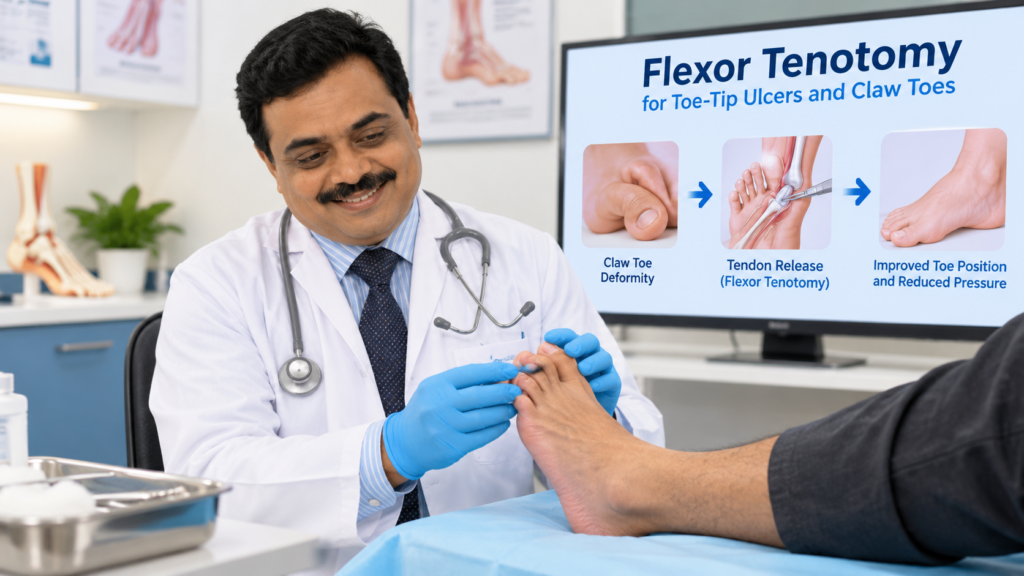
Flexor tenotomy in Ankleshwar may help selected patients with diabetic toe-tip ulcers caused by curled or clawed toes. This small surgical procedure releases a tight tendon beneath the toe to reduce excessive pressure. As a result, the toe may rest in a better position, allowing a pressure-related wound to heal.
However, flexor tenotomy does not treat every diabetic foot ulcer. A doctor must first examine the toe deformity, wound condition, blood circulation and infection risk.
People with diabetes may develop toe-tip wounds without feeling significant pain. Therefore, even a small ulcer deserves medical attention.
This guide explains how flexor tenotomy works, who may benefit, what happens during the procedure, possible complications and recovery.
What Is Flexor Tenotomy?
Flexor tenotomy is a minor surgical procedure that releases a tight tendon responsible for bending a toe.
The flexor tendons run along the underside of the toes. They help control toe movement.
However, a tight tendon may pull a toe into a curled position. This can concentrate pressure on the toe tip.
How Does Tendon Release Reduce Pressure?
During the procedure, a surgeon releases the selected tendon through a small opening.
The release reduces the pulling force that bends the toe downward.
Consequently, pressure at the toe tip may decrease.
Doctors call this approach surgical offloading because it addresses the mechanical pressure contributing to tissue damage.
Learn more about the clinic’s Flexor Tenotomy procedure.
Why Do Claw Toes Cause Diabetic Toe-Tip Ulcers?
Claw toes and hammertoes change the normal alignment of the toes.
As a result, certain areas may press against the ground or footwear more than usual.
Claw Toe Deformity
A claw toe bends abnormally at multiple joints.
The toe tip may point downward and experience repeated pressure.
Over time, this pressure can damage the skin.
Hammertoe Deformity
A hammertoe typically bends at the middle toe joint.
This position may create friction against footwear or increase pressure on part of the toe.
However, not every hammertoe requires surgery.
Diabetic Neuropathy
Diabetes can damage the nerves responsible for protective sensation.
Therefore, patients may not notice rubbing, pressure or small injuries.
Repeated pressure can cause calluses, blisters, skin breakdown and ulcers.
Importantly, a painless wound can still become infected or worsen.
Who May Benefit From Flexor Tenotomy in Ankleshwar?
A diabetic foot specialist may consider flexor tenotomy for selected patients with flexible toe deformities and repeated pressure at the toe tip.
A flexible deformity means the clinician can still straighten the toe to some extent.
Patients With Recurrent Toe-Tip Ulcers
Some patients develop an ulcer that heals and later returns.
This may happen because the same curled toe continues pressing against footwear or the floor.
If the tendon contributes to that pressure, flexor tenotomy may help.
Patients With Repeated Callus Formation
Thick calluses can indicate excessive pressure.
In patients with diabetic neuropathy, calluses may develop into wounds.
Therefore, a specialist may investigate the underlying toe position.
Patients With Flexible Claw Toes
A flexible claw toe may respond to tendon release.
However, a rigid deformity may require another treatment approach.
Patients Who Need a Full Foot Assessment
Not every toe-tip ulcer results from a tight tendon.
Poor circulation, infection or other pressure problems may contribute.
For local consultation information, visit Diabetic Foot Ulcer Treatment in Ankleshwar.
How Do Doctors Decide Whether Flexor Tenotomy Is Suitable?
The surgeon must identify the cause of the ulcer before recommending tendon release.
Toe Flexibility Examination
First, the doctor examines the toe joints.
They check whether the toe can straighten and whether a tight flexor tendon contributes to the deformity.
Wound Examination
Next, the clinician checks the ulcer’s size, depth and surrounding tissue.
They also look for calluses, drainage and signs of infection.
Blood Circulation Assessment
Adequate blood supply supports healing after surgery.
Therefore, the doctor may assess pulses and recommend vascular tests when necessary.
Nerve Function Testing
The clinician may test protective sensation.
Reduced sensation increases the risk of unnoticed pressure injuries.
Medical History Review
Finally, the team reviews diabetes management, medicines and other medical conditions.
These factors help determine procedural risk and postoperative care.
Flexor Tenotomy Procedure: Step-by-Step
Flexor tenotomy is usually less extensive than major reconstructive foot surgery.
However, only a qualified clinician should perform it.
Step 1: Preparing the Toe
The clinical team cleans the area and prepares a sterile field.
The surgeon confirms the affected toe and tendon.
Step 2: Giving Local Anaesthesia
The surgeon commonly uses local anaesthesia to reduce discomfort.
However, the exact anaesthesia plan depends on the patient’s condition.
Step 3: Releasing the Tendon
The surgeon makes a small opening and releases the selected flexor tendon.
This reduces the force pulling the toe downward.
The surgeon then checks the change in toe position.
Step 4: Applying a Dressing
The team covers the procedure site with an appropriate dressing.
They also provide instructions about keeping the area protected.
Step 5: Planning Follow-Up
The surgeon reviews the procedure site and any existing ulcer.
The patient may need protective footwear or another offloading device during recovery.
For an overview of related operations, explore Diabetic Foot Surgery.
Can Flexor Tenotomy Help an Existing Toe-Tip Ulcer Heal?
In selected cases, yes.
If a tight tendon causes repeated pressure on the toe tip, releasing that tendon may support ulcer healing.
However, the wound may still need other treatment.
Pressure Relief
Reducing abnormal pressure helps protect the healing area.
Nevertheless, patients may still require appropriate footwear and activity restrictions.
Wound Cleaning and Dressings
Clinicians choose dressings according to the wound’s condition.
Some wounds also require professional removal of unhealthy tissue.
Infection Treatment
An infected ulcer may require antibiotics or another intervention.
Flexor tenotomy does not replace infection treatment.
Diabetes and Circulation Management
Blood glucose management and adequate circulation remain important.
Therefore, the surgeon should address these issues alongside pressure reduction.
Flexor Tenotomy vs Other Diabetic Foot Treatments
| Treatment | Main purpose | When doctors may consider it |
|---|---|---|
| Flexor tenotomy | Releases a tight toe tendon | Selected flexible claw or hammertoe with toe-tip pressure |
| Protective footwear | Reduces rubbing and pressure | Pressure-prone feet and ulcers |
| Wound dressings | Protects the wound | Existing ulcers |
| Callus management | Removes excessive thickened skin | Recurrent pressure-related calluses |
| Claw toe correction | Addresses selected toe deformities | Deformities needing more extensive correction |
| Debridement | Removes unhealthy tissue | Selected wounds with dead or damaged tissue |
| Vascular treatment | Addresses inadequate blood flow | Significant circulation problems |
The most suitable approach depends on the wound and its underlying cause.
For more information, read about Ulcer-Healing and Preventive Surgeries.
What Is Recovery Like After Flexor Tenotomy?
Recovery varies according to the patient’s circulation, diabetes management and wound condition.
The small surgical opening may heal before an existing toe ulcer.
Therefore, patients should not assume that a healed incision means the original ulcer has completely recovered.
The First Few Days
The clinician may recommend a dressing and protective footwear.
Patients should follow specific instructions about walking and activity.
During Wound Healing
The surgical team monitors the incision and any existing ulcer.
They also check whether pressure has shifted to another toe.
Returning to Normal Activities
Some patients return to limited routine activities relatively quickly.
However, recovery may take longer when an ulcer, infection or circulation problem is present.
The surgeon should determine when walking and footwear changes are safe.
Long-Term Foot Care
Patients should continue daily foot inspections.
In addition, appropriate footwear and regular diabetic foot assessments remain important.
What Are the Risks of Flexor Tenotomy?
Although flexor tenotomy is a small procedure, complications can occur.
Infection or Bleeding
The surgical site may develop infection or bleeding.
Therefore, patients should follow dressing and wound care instructions.
Delayed Healing
Poor circulation, infection or uncontrolled medical conditions can delay recovery.
Incomplete Pressure Relief
Sometimes, tendon release does not sufficiently reduce pressure.
The patient may require further assessment or another treatment.
Changes in Toe Position
The toe may not settle into the expected position.
Some patients may also notice changes in toe movement.
Transfer Lesions
Pressure can shift to another toe or area of the foot.
As a result, a new callus or ulcer may develop.
Regular follow-up helps clinicians identify these problems.
Can Flexor Tenotomy Prevent Future Toe Ulcers?
Flexor tenotomy may reduce recurrent pressure at a particular toe tip.
However, it cannot guarantee that another ulcer will never develop.
Why Can Ulcers Return?
Diabetic neuropathy may continue after surgery.
In addition, unsuitable footwear, other toe deformities and poor circulation can create new problems.
How Can Patients Lower Their Risk?
Daily foot inspection helps identify changes early.
Patients should also wear appropriate footwear and attend recommended follow-up visits.
Most importantly, they should seek medical advice when a new callus, blister or wound appears.
When Is More Extensive Diabetic Foot Surgery Necessary?
A simple tendon release cannot correct every foot problem.
For example, rigid toe deformities may require another procedure.
Similarly, deep infection, bone involvement or significant tissue damage may need more extensive treatment.
Rigid Toe Deformities
A rigid claw toe may not straighten sufficiently after tendon release.
Therefore, the surgeon may consider another corrective procedure.
Deep or Complicated Ulcers
An ulcer involving deeper tissues may need additional investigation.
The treatment plan may include debridement, infection management or reconstructive care.
Significant Circulation Problems
Severely reduced blood flow can threaten wound healing.
A vascular specialist may need to assess whether treatment to improve circulation is appropriate.
Learn more about the clinic’s Diabetic Foot Surgery services and Surgical Offloading.
When Should You Seek Urgent Medical Care?
A diabetic toe ulcer can worsen even when it causes little pain.
Therefore, arrange prompt assessment if a wound becomes deeper, develops discharge or fails to improve.
Warning Signs
Contact a healthcare professional promptly for increasing redness, swelling, warmth or an unpleasant odour.
Also, seek assessment for new skin breakdown or a rapidly enlarging callus.
Emergency Warning Signs
Seek emergency care for rapidly spreading infection, fever with severe illness, blackened tissue or a suddenly cold and pale foot.
Do not delay urgent treatment while waiting for a routine surgical consultation.
Frequently Asked Questions
Flexor tenotomy is a small surgical procedure that releases a tight tendon beneath a toe. In selected patients, it reduces pressure at the tip of a curled toe and may support healing of a diabetic ulcer.
No. Doctors generally consider it for selected flexible deformities. A rigid claw toe or an ulcer caused by another problem may require different treatment.
Surgeons commonly use local anaesthesia to reduce discomfort during the procedure. Some soreness may occur afterward. However, diabetic neuropathy can reduce pain sensation, so follow-up remains essential.
It may help selected ulcers by reducing the pressure that causes repeated injury. However, wound dressings, infection management, circulation assessment and appropriate footwear may also be necessary.
Recovery varies according to circulation, diabetes management and whether an ulcer is present. The small incision may heal before the original ulcer. Your surgeon will advise you about walking, dressings and follow-up.
It may reduce the risk of repeated injury at a particular toe tip. However, it cannot prevent every diabetic foot ulcer. Daily foot checks, protective footwear and regular care remain important.
Some flexor tenotomy procedures can take place in an outpatient setting. However, the appropriate location depends on the patient’s condition, wound and available facilities.
Possible complications include infection, bleeding, delayed healing, incomplete pressure relief and pressure shifting to another toe. A surgeon should explain individual risks before treatment.
Walking recommendations depend on the procedure, wound and surgeon’s instructions. Some patients need protective footwear or temporary activity restrictions. Do not resume normal walking until your treating team confirms it is appropriate.
Patients considering flexor tenotomy in ankleshwar can begin with a diabetic foot assessment. Visit Diabetic Foot Ulcer Treatment in Ankleshwar for local consultation information. Confirm where any recommended procedure would take place.
Conclusion
Flexor tenotomy in Ankleshwar may help selected patients with diabetic toe-tip ulcers and flexible claw toe deformities.
The procedure releases a tight tendon to reduce excessive pressure at the toe tip.
However, it cannot replace infection treatment, adequate circulation, wound care or appropriate footwear.
A diabetic foot specialist should examine the toe and identify the cause of repeated pressure before recommending surgery.
For further information, explore Flexor Tenotomy, Diabetic Foot Surgery and Diabetic Foot Ulcer Treatment in Ankleshwar.