
PRP Therapy for Wound in Bharuch: Benefits, Risks and Limitations
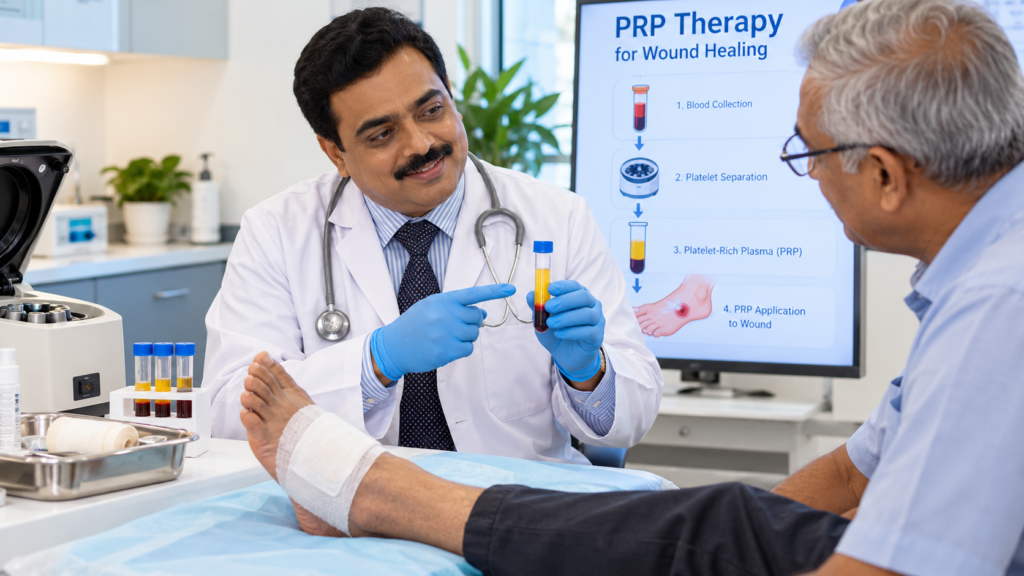
PRP therapy for wound in Bharuch may help selected patients who have stubborn diabetic wounds. Platelet-rich plasma (PRP) uses concentrated platelets from a patient’s blood to support natural tissue repair. However, PRP cannot replace infection treatment, good blood circulation, wound cleaning or pressure relief.
Some diabetic foot wounds heal slowly despite regular dressings. Therefore, doctors must identify the reasons before recommending advanced treatment. For example, poor circulation, infection and repeated pressure can prevent healing.
This guide explains how PRP works, who may benefit, what the procedure involves and what it cannot achieve. It also covers possible side effects, alternative treatments and warning signs.
What Is PRP Therapy for Wound Healing?
PRP stands for platelet-rich plasma. It contains a higher concentration of platelets than ordinary blood plasma.
Platelets help the body control bleeding. They also release growth factors involved in tissue repair.
Doctors may use PRP as an additional treatment for selected chronic wounds. However, PRP does not guarantee faster or complete healing.
How Does PRP Support Tissue Repair?
Growth factors help regulate processes involved in wound healing.
For example, they influence cell activity, tissue formation and blood vessel development.
Researchers have studied whether concentrated platelets can improve the healing environment in chronic wounds.
Some studies suggest possible benefits. However, results vary because researchers use different PRP preparations and treatment methods.
Is PRP a Replacement for Regular Dressings?
No. PRP supports selected wound care plans rather than replacing them.
Doctors still need to manage infection, circulation, pressure and blood glucose.
Therefore, patients should continue the wound care plan their clinician recommends.
Why Do Some Diabetic Wounds Heal Slowly?
Diabetes can affect nerves, circulation and the body’s ability to recover from injury.
However, different patients experience different problems.
Poor Blood Circulation
Healthy tissue needs oxygen and nutrients.
Peripheral arterial disease can reduce blood flow to the feet.
As a result, wounds may heal slowly or worsen.
PRP cannot reopen a severely blocked artery. Therefore, a doctor may recommend vascular assessment.
Infection
Bacteria can enter a wound and cause infection.
Warning signs include increasing redness, swelling, discharge and unpleasant odour.
Some patients also develop fever or feel unwell.
Doctors must assess and treat infection promptly.
Repeated Pressure
Walking can repeatedly injure a diabetic foot ulcer.
For this reason, doctors may recommend special footwear or an offloading device.
Without pressure relief, even advanced treatments may have limited benefit.
High Blood Glucose
Poor blood glucose control can interfere with healing.
It can also increase infection risk.
Therefore, diabetes management remains an important part of wound treatment.
PRP Therapy for Wound in Bharuch: Who May Benefit?
Doctors may consider PRP when a wound shows limited improvement despite appropriate standard care.
However, the decision depends on the patient’s condition and wound assessment.
Patients With Stubborn Diabetic Foot Ulcers
Some diabetic foot ulcers remain open for several weeks.
In these cases, a clinician may assess whether PRP could provide additional support.
First, the doctor checks circulation, infection and pressure on the affected foot.
Next, the team reviews the wound’s depth and tissue condition.
Patients With Selected Chronic Wounds
Doctors also study PRP for certain non-diabetic chronic wounds.
However, treatment suitability depends on the underlying cause.
PRP is not appropriate for every wound type.
Patients Who Need Further Treatment First
Some wounds require infection treatment, debridement or vascular care before clinicians consider PRP.
Therefore, a proper examination should always come first.
For local wound assessment information, visit Diabetic Foot Ulcer Treatment in Bharuch.
How Does the PRP Wound Treatment Procedure Work?
The exact procedure depends on the wound and the clinician’s treatment protocol.
However, the process commonly involves the following steps.
Step 1: Wound Examination
The clinician measures the wound and checks its depth.
They also assess circulation, infection and surrounding skin.
This assessment helps determine whether PRP is suitable.
Step 2: Blood Collection
A healthcare professional collects a small blood sample from the patient.
The amount depends on the PRP preparation system.
Step 3: Platelet Separation
A centrifuge separates the blood into different components.
The clinician then prepares the platelet-rich portion for treatment.
Step 4: Wound Preparation
The clinician cleans and examines the wound.
If necessary, they remove unhealthy tissue through appropriate debridement.
However, not every wound requires the same preparation.
Step 5: PRP Application
The clinician applies PRP according to the selected treatment protocol.
Some methods involve surface application, while others use injections around selected areas.
Afterward, the team applies a suitable dressing.
Step 6: Follow-Up Assessment
The clinician reviews wound size and tissue changes during follow-up visits.
They may consider further sessions if appropriate.
However, no single treatment schedule suits every patient.
Learn more about the clinic’s PRP and PRF Therapy.
What Can PRP Therapy Do for a Stubborn Wound?
PRP may provide additional support during wound treatment.
However, its effectiveness varies between patients.
Support Natural Tissue Repair
Platelets contain growth factors involved in healing.
These factors may support cellular processes that help repair damaged tissue.
Improve Healing in Selected Cases
Some clinical studies suggest that adding PRP to standard care may improve healing outcomes in selected diabetic foot ulcers.
However, researchers have not established one universally effective PRP method.
Therefore, patients should discuss the expected benefits and uncertainties with their clinician.
Complement Other Wound Treatments
PRP may form part of a wider treatment plan.
For example, a patient may still need dressings, pressure relief and diabetes management.
PRP does not replace these essential measures.
What PRP Therapy Cannot Do for Diabetic Wounds
Understanding PRP’s limitations helps patients set realistic expectations.
PRP Cannot Cure an Active Infection
PRP is not an antibiotic.
A bacterial infection may require antibiotics, drainage or another medical procedure.
Therefore, patients should never delay infection treatment while waiting for PRP.
PRP Cannot Restore Severely Reduced Blood Flow
Poor circulation can prevent a wound from receiving enough oxygen.
PRP cannot reliably correct blocked arteries.
A vascular specialist may need to assess significant circulation problems.
PRP Cannot Remove Dead Tissue
Dead tissue can interfere with healing.
A trained clinician may need to remove it through debridement.
PRP cannot replace that procedure.
PRP Cannot Replace Pressure Relief
Repeated pressure can damage the wound every time a patient walks.
Therefore, suitable offloading remains essential for many diabetic foot ulcers.
PRP Cannot Guarantee Complete Healing
Some wounds remain difficult to treat despite advanced therapies.
The outcome depends on circulation, infection, wound depth and overall health.
Consequently, patients should avoid treatments that promise guaranteed healing.
PRP Therapy vs Other Wound Treatments
Different wound treatments address different problems.
| Treatment | Main purpose | Limitation |
|---|---|---|
| PRP therapy | May support tissue repair in selected wounds | Results vary; no guaranteed cure |
| Specialised dressings | Protect tissue and manage moisture | Cannot correct blocked arteries |
| Debridement | Removes unhealthy tissue when needed | May require repeat procedures |
| Antibiotics | Treat bacterial infections | Do not correct pressure or circulation |
| Offloading | Reduces pressure on foot ulcers | Requires consistent use |
| VAC/NPWT | Manages wound fluid in selected wounds | Not suitable for every wound |
| Vascular treatment | Addresses significant blood flow problems | Requires specialist assessment |
A clinician may combine several approaches.
For more information, explore Nonsurgical Management.
What Are the Risks and Side Effects of PRP Therapy?
PRP uses the patient’s blood, but the procedure still carries some risks.
Temporary Pain
Blood collection or PRP application may cause mild discomfort.
The level of pain varies between patients.
Bruising and Bleeding
Needle insertion may cause temporary bruising or minor bleeding.
Patients with certain blood disorders may require additional assessment.
Infection
Any procedure involving needles or wound handling carries an infection risk.
Therefore, clinicians must follow appropriate sterile techniques.
Limited or No Improvement
Some patients may not experience a meaningful healing benefit.
For this reason, the clinician should measure progress rather than continue treatment automatically.
When Should Doctors Delay or Avoid PRP?
PRP may not suit every patient.
Untreated Infection
Doctors must assess and manage active infection.
PRP should never delay necessary antibiotics or other infection treatment.
Severe Circulation Problems
A wound with poor blood supply may require vascular treatment first.
Without adequate circulation, tissue repair becomes difficult.
Platelet or Blood Disorders
Certain conditions affect platelet numbers or function.
Therefore, the doctor may recommend blood tests before considering PRP.
Uncontrolled Medical Conditions
A patient may need better management of diabetes or another illness before an elective procedure.
The clinician should assess these factors individually.
How Do Doctors Measure PRP Treatment Results?
Doctors should monitor objective signs of wound healing.
Changes in Wound Size
The clinician measures the wound during follow-up appointments.
A reduction in size may indicate progress.
Healthy Tissue Formation
The team examines the wound bed for signs of appropriate tissue development.
Changes in Drainage
Doctors assess wound fluid, odour and surrounding skin.
These observations can help identify healing problems.
Overall Treatment Response
If the wound does not improve, the team reassesses circulation, infection and pressure relief.
Simply repeating PRP without investigating the cause may delay more suitable care.
What Other Nonsurgical Wound Treatments Can Help?
PRP represents only one possible part of diabetic wound care.
Specialised Wound Dressings
Clinicians choose dressings according to the wound’s condition.
Some dressings help manage excess fluid. Others protect tissue and maintain a suitable healing environment.
Wound Culture and Sensitivity Testing
When clinicians suspect infection, they may collect an appropriate sample to guide treatment.
Read more about Wound Culture and Sensitivity Testing.
Negative Pressure Wound Therapy
VAC or NPWT uses controlled suction and a sealed dressing.
It may help manage fluid in selected wounds.
Explore VAC/NPWT Wound Therapy.
Pressure Relief and Footwear
Special footwear and offloading devices can reduce repeated pressure on a foot ulcer.
The clinician selects an approach based on wound location, circulation and infection status.
Diabetes Management
Managing blood glucose supports overall health and wound recovery.
Patients should follow their treating clinician’s advice.
For additional educational guidance, read the CDC’s information about diabetes and foot health.
When Should You Seek Medical Attention?
A diabetic foot wound needs timely assessment, especially when healing slows.
Contact a healthcare professional promptly if you notice increasing redness, swelling, discharge or an unpleasant odour.
Also, seek assessment if the wound becomes deeper or the surrounding skin changes colour.
Warning Signs That Need Emergency Care
Seek emergency care if you experience:
- Rapidly spreading redness or swelling.
- Fever with a worsening wound or severe illness.
- Blackened or rapidly deteriorating tissue.
- A suddenly cold, pale or discoloured foot.
- Severe pain or other signs of an acute circulation problem.
Do not wait for a scheduled PRP appointment if serious symptoms develop.
Frequently Asked Questions
PRP therapy uses concentrated platelets prepared from the patient’s blood. These platelets contain growth factors involved in tissue repair. PRP may be considered as an additional treatment for selected chronic wounds.
PRP may support healing in some patients, but complete healing cannot be guaranteed. Results depend on wound condition, circulation, infection control, pressure relief and overall health.
Not necessarily. PRP and dressings have different roles. Standard wound care remains essential, while PRP may be considered as an additional treatment in selected cases.
Patients may feel mild discomfort during blood collection or treatment. The level of discomfort varies according to the technique and wound condition.
There is no fixed number suitable for everyone. The treatment plan depends on the wound’s response and the clinician’s protocol. Some patients may not be suitable for repeated sessions.
PRP does not replace antibiotics, drainage or other infection treatment. A suspected infected wound requires medical assessment before an adjunctive treatment is considered.
There is no guaranteed timeline. Clinicians usually assess wound size and tissue changes during follow-up visits. Some wounds may not respond meaningfully.
PRP may be appropriate for selected patients with diabetes after clinical assessment. However, blood disorders, infection, poor circulation and other health factors can affect suitability.
The clinician should reassess the reasons for delayed healing. Additional treatment may involve pressure relief, infection management, vascular care, specialised dressings or surgery when necessary.
If you are searching for prp therapy for wound in bharuch, start with a specialist diabetic wound assessment. Visit the Bharuch diabetic foot ulcer treatment page for local consultation information. Confirm PRP availability and the treatment location directly before booking.
Conclusion
PRP therapy for wound in Bharuch may offer additional support for selected patients with slow-healing wounds.
However, PRP cannot replace infection treatment, adequate circulation, debridement or pressure relief.
A clinician must first identify why the wound is not healing. Next, they can decide whether PRP or another treatment fits the patient’s needs.
For further information, explore Nonsurgical Management and PRP and PRF Therapy.