
PRP Therapy for Wound in Ankleshwar: Benefits, Limitations and Treatment
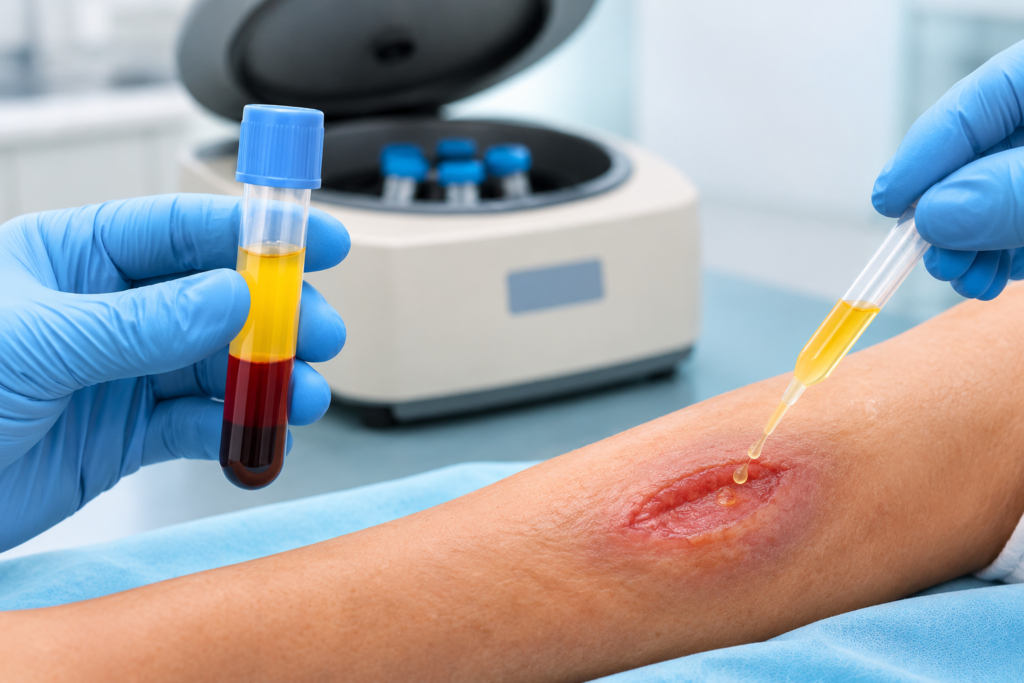
PRP therapy for wound in ankleshwar may be considered for selected chronic wounds that are not healing as expected despite appropriate care. Platelet-rich plasma (PRP) is prepared from a patient’s own blood and contains concentrated platelets. However, PRP is not a guaranteed cure. It cannot replace infection treatment, adequate circulation, pressure relief or essential diabetic foot wound management.
What Is PRP Therapy for Wound Healing?
Platelet-rich plasma therapy is a treatment that uses a concentrated preparation of platelets obtained from the patient’s blood.
Platelets contain growth factors involved in normal tissue repair. Therefore, researchers have investigated whether applying PRP to selected chronic wounds may support healing.
However, evidence varies according to wound type, PRP preparation method and treatment protocol.
How does PRP work?
The process generally involves collecting a blood sample and processing it to separate platelet-rich plasma from other blood components.
Depending on the clinical protocol, the preparation may be applied to the wound or used in another medically appropriate way.
The intended goal is to support the wound-healing environment.
Nevertheless, PRP cannot correct every underlying reason a wound remains open.
Why do diabetic wounds heal slowly?
Diabetes can affect wound healing through several mechanisms, including:
- Reduced protective sensation in the feet.
- Poor blood circulation.
- Repeated pressure on an injured area.
- Infection.
- Inadequate blood glucose management.
- Nutritional problems.
- Delayed identification of tissue damage.
For this reason, the underlying causes must be assessed before considering additional treatments.
Who May Benefit From PRP Therapy for Non-Healing Wounds?
PRP therapy for wound in ankleshwar may be discussed when a patient has a persistent wound that has not responded adequately to appropriate standard treatment.
However, treatment suitability depends on individual clinical findings.
Patients who may be evaluated
A specialist may assess PRP as an additional treatment for:
- Selected chronic diabetic foot ulcers.
- Certain non-healing wounds after standard care.
- Some wounds requiring advanced wound-management assessment.
- Patients whose wound progress has stalled despite appropriate treatment.
Importantly, a wound that is not healing should not automatically be treated with PRP.
The specialist must first identify why healing has slowed.
When might PRP be unsuitable?
PRP may not be appropriate when urgent treatment of infection, severe circulation problems or extensive tissue damage is needed.
For example, a patient with rapidly spreading infection may require urgent antibiotics, drainage or surgery rather than an elective PRP procedure.
Similarly, a wound with inadequate blood supply may require vascular assessment.
A patient’s blood-related conditions and medications may also influence treatment decisions.
How Is PRP Therapy Performed?
The procedure varies depending on the preparation system and the wound being treated.
Therefore, patients should ask which technique is proposed and what evidence supports its use for their particular wound.
Step 1: Specialist wound assessment
The doctor examines wound size, depth, surrounding skin, infection and circulation.
Protective sensation and pressure-related factors may also be assessed.
Additional tests may be advised if deeper infection or vascular disease is suspected.
Step 2: Blood sample collection
If PRP is considered appropriate, a blood sample is collected using sterile medical techniques.
The amount collected depends on the preparation system.
Step 3: PRP preparation
The collected blood is processed using a specialised system, often involving centrifugation.
This separates components and produces a platelet-rich preparation.
However, platelet concentration and final composition vary between systems.
Step 4: Application to the wound
The prepared PRP may be applied according to the clinician’s selected wound-treatment protocol.
The wound is then managed with appropriate dressings.
Step 5: Follow-up and wound monitoring
After treatment, the specialist monitors wound size, tissue condition, drainage and signs of infection.
Some patients may require additional sessions, while others may be advised to continue standard care without further PRP.
What Can PRP Therapy Do for a Stubborn Wound?
PRP is being studied as an adjunctive treatment for selected chronic wounds.
Some research suggests that certain PRP preparations may improve healing outcomes when combined with appropriate standard wound care.
However, study methods and treatment protocols differ. Therefore, benefits cannot be assumed for every patient.
Potential benefits being investigated
- Supporting tissue-repair processes.
- Improving healing in selected chronic wounds.
- Providing an additional option when standard care has been optimised.
- Supporting wound management as part of a broader treatment plan.
Importantly, these are potential benefits rather than guaranteed results.
What does successful wound treatment involve?
Successful diabetic foot wound management generally requires several coordinated measures.
These may include wound assessment, appropriate dressings, infection management, pressure reduction and evaluation of circulation.
Blood glucose management and regular follow-up are also important.
For patients considering PRP therapy for wound in ankleshwar, understanding these essential treatments is more important than focusing on PRP alone.
What Can PRP Therapy Not Do?
PRP has important limitations, particularly in complicated diabetic foot wounds.
It should not be presented as a substitute for established medical treatment.
PRP cannot replace antibiotics when required
A clinically infected wound may require appropriate antimicrobial treatment.
In some cases, drainage or surgical removal of infected tissue is also necessary.
PRP cannot restore blocked blood circulation
Poor circulation can prevent oxygen and nutrients from reaching the wound.
If significant vascular disease is present, specialist assessment and possible restoration of blood flow may be necessary.
PRP cannot replace offloading
Repeated pressure on a diabetic foot ulcer can delay healing.
Appropriate offloading devices or footwear may be needed to protect the affected area.
PRP cannot guarantee complete healing.
Even with advanced treatment, some wounds remain difficult to heal.
Factors such as infection, circulation, wound depth, and general health influence outcomes.
PRP cannot replace debridement when indicated.
Dead or infected tissue may require professional removal.
The treating specialist determines whether debridement is appropriate.
PRP versus standard wound care
| Treatment component | What it does | Can PRP replace it? |
|---|---|---|
| Wound assessment | Identifies wound severity and causes | No |
| Infection management | Treats clinically significant infection | No |
| Debridement | Removes unhealthy tissue when indicated | No |
| Offloading | Reduces pressure on the wound | No |
| Circulation assessment | Identifies reduced blood supply | No |
| Appropriate dressings | Protects and manages the wound | No |
| PRP therapy | May support healing in selected cases | Additional treatment only |
For patients exploring conservative treatment options, the clinic’s Nonsurgical Management services should be discussed with the treating team.
When Is Specialist Wound Care Necessary?
A stubborn diabetic foot wound requires timely assessment, especially when healing has stopped or the wound is becoming worse.
Patients should not wait for multiple advanced-treatment sessions if signs of infection or tissue damage appear.
Warning signs requiring urgent attention
Seek prompt medical assessment if you notice:
- Increasing redness or swelling.
- Pus or unpleasant wound odour.
- Fever or feeling unwell.
- Rapidly spreading skin changes.
- Blackening tissue.
- A newly cold or pale foot.
- Sudden deterioration of an existing ulcer.
Rapidly spreading infection, significant bleeding or signs of severe circulation loss require emergency assessment.
What happens during consultation?
Dr. Ashutosh Shah can assess the wound and discuss whether additional treatment is appropriate based on the clinical findings.
The consultation may involve reviewing previous wound care, diabetes control, circulation, and infection.
Patients should bring previous reports, prescriptions, and wound-treatment records.
Frequently Asked Questions
PRP may support healing in selected chronic diabetic foot wounds when used alongside appropriate standard care. However, results vary depending on infection, circulation, wound depth and the PRP preparation method. It cannot guarantee complete healing. A specialist should first identify and address the underlying causes of delayed wound recovery.
PRP is generally prepared by collecting a blood sample and processing it to concentrate platelets. The resulting preparation may then be applied using a suitable clinical protocol. However, equipment, platelet concentration and application methods vary. Patients should ask their specialist which technique is proposed and why it is appropriate.
There is no single number of PRP sessions suitable for every chronic wound. Treatment frequency depends on wound condition, the chosen protocol and the response to care. Some patients may not be suitable for PRP at all.
No. PRP cannot replace debridement when removal of unhealthy tissue is clinically necessary. Similarly, infected wounds may require antibiotics, drainage or other medical treatment. PRP should only be considered as part of a broader wound-management plan after the specialist has assessed infection, circulation and other healing barriers.
A diabetic foot wound should be assessed promptly, particularly if it is not improving or shows redness, swelling, discharge or tissue discoloration. Fever, spreading infection or blackening tissue requires urgent attention. Early specialist evaluation helps identify complications and determine whether standard care, surgery or additional treatment is needed.
Conclusion
PRP therapy for wound in ankleshwar may be considered as an additional treatment for selected persistent wounds, but it is not suitable for everyone.
The most important step is identifying why the wound has not healed. Infection, poor circulation, repeated pressure and unhealthy tissue must be addressed through appropriate medical care.
Dr. Ashutosh Shah can evaluate diabetic foot complications and discuss suitable wound-management options.