
When Is Toe Amputation Necessary in a Diabetic Foot?
Written & Medically Guided By
Dr. Ashutosh Shah, M.Ch. (Plastic Surgery)
Plastic, Reconstructive & Diabetic Foot Surgeon
22+ Years of Surgical Experience
Founder, Elegance Diabetic Foot & Ulcer Clinic (EDFC)
Dr. Ashutosh Shah’s reconstructive and diabetic-foot work focuses on preserving viable tissue and maintaining as much useful foot function as safely possible. At EDFC, toe amputation is considered within a broader limb-salvage plan rather than automatically being the first response to a difficult diabetic wound. EDFC’s surgical program specifically describes amputation as an option used when salvage is no longer possible.
Hearing that a diabetic toe may need to be amputated can make a patient assume that losing the entire foot or leg is inevitable. That is not necessarily the case.
Toe amputation is a minor amputation in which one or more toes are removed when the affected tissue cannot be safely preserved. In diabetic-foot care, the aim should generally be to save viable tissue whenever possible while controlling infection, removing dead tissue, and protecting the rest of the foot.
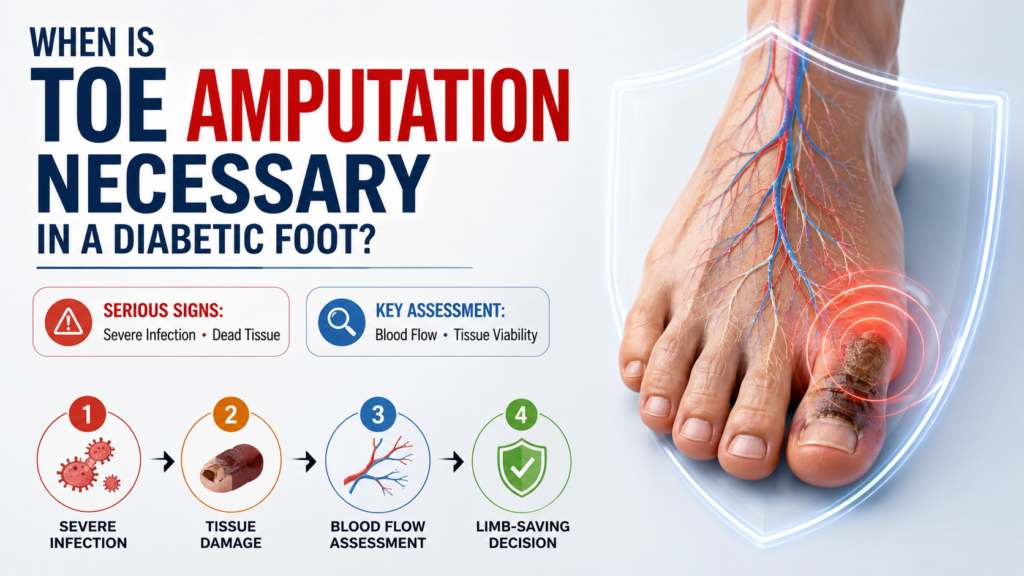
A toe may become threatened by severe infection, gangrene, poor circulation, a non-healing wound, or infection that has reached the bone. However, the presence of an ulcer or infected toe does not automatically mean amputation is required. Current diabetic-foot guidance recommends urgent surgical assessment for severe infections and for moderate infections complicated by extensive gangrene, deep abscess, necrotising infection, or severe lower-limb ischaemia.
For patients seeking diabetic-foot treatment in Surat, early evaluation is particularly important because the possibility of preserving a toe can change as infection, circulation, and tissue damage progress.
Key Takeaways
- A diabetic toe does not automatically need amputation because it has an ulcer.
- Treatment should first determine which tissue is still viable and whether the toe can safely be preserved.
- Severe infection, extensive dead tissue, gangrene, or destructive bone infection can make amputation necessary.
- Blood circulation should be considered because poor blood supply can affect wound healing.
- A small toe-level amputation can sometimes help prevent infection or tissue loss from progressing further.
- Limb salvage can involve infection control, debridement, circulation management, reconstruction, and offloading.
- Delaying necessary surgery can be dangerous when infection is rapidly spreading.
- Protecting the remaining foot is an important part of recovery.
Can a Diabetic Toe Be Saved Without Amputation?
Sometimes, yes. Whether a toe can be saved depends on the amount of viable tissue, severity of infection, blood supply, bone involvement, wound condition, and overall health of the foot.
A superficial wound with manageable infection may require wound care, pressure relief, appropriate infection treatment, glucose management, and close observation rather than amputation.
Even some cases of diabetic-foot osteomyelitis can potentially be managed without removing bone in carefully selected circumstances. The IWGDF notes that antibiotic treatment without surgery may be considered in selected cases of forefoot osteomyelitis when there is no immediate need for drainage, no peripheral arterial disease, and no exposed bone.
This is why the decision should not be made simply because a wound “looks bad.”
At EDFC, limb-salvage treatment can combine removal of infected or dead tissue with wound reconstruction and other measures intended to preserve as much functional foot as possible.
When Can Toe Amputation Become Necessary?
Toe amputation may become necessary when tissue is no longer viable or when retaining the affected toe would allow serious infection or tissue damage to threaten the rest of the foot or the patient’s health.
Possible situations include severe gangrene, uncontrolled or spreading infection, extensive tissue destruction, and selected cases of bone infection that cannot be adequately controlled while preserving the toe.
The goal is not simply to “remove the infected toe.”
The surgeon needs to determine how much tissue must be removed and how much can safely remain.
EDFC describes this as choosing the lowest function-preserving amputation level when amputation is unavoidable.
What Problems Can Lead to Toe Amputation?
| Diabetic Foot Problem | What Needs Assessment | Possible Direction |
|---|---|---|
| Superficial toe wound | Depth, infection, pressure | Wound care and offloading may be sufficient |
| Local infection | Severity and tissue involvement | Antibiotics, wound treatment or drainage |
| Deep infection | Abscess and tissue viability | Surgical treatment may be required |
| Bone infection | Extent of osteomyelitis | Medical treatment or bone/toe surgery depending on the case |
| Dry gangrene | Blood supply and extent of dead tissue | Vascular and surgical assessment |
| Spreading wet/infected gangrene | Infection severity and viable tissue | Urgent surgical management may be required |
| Poor circulation | Ability of tissue to heal | Vascular assessment and possible revascularisation |
| Non-salvageable toe | Remaining viable tissue | Limited amputation may be considered |
The purpose of this assessment is to avoid two extremes: removing viable tissue unnecessarily and waiting too long when dangerous tissue needs to be removed.
Why Is Circulation Important Before Toe Amputation?
Adequate blood supply is important because the remaining surgical wound needs enough circulation to heal.
Diabetes can coexist with peripheral artery disease, which reduces blood flow to the foot.
When a diabetic patient has a foot ulcer or gangrene together with peripheral artery disease and infection, current guidelines recommend urgent surgical and vascular specialist consultation to determine the timing of drainage and/or revascularisation.
Depending on the clinical situation, circulation testing can therefore be an important part of planning treatment.
Restoring blood flow, when feasible and indicated, may improve the conditions for healing and can sometimes influence how much tissue can be preserved.
Does Gangrene Always Mean the Toe Must Be Removed?
Not every colour change or area labelled “gangrene” should lead directly to an amputation decision without assessing circulation, infection, and tissue viability.
Gangrene means tissue has died because its blood supply has been lost, sometimes with infection.
Dead tissue itself cannot be restored to normal living tissue. The important question is how far the damage extends and whether the surrounding foot remains viable.
If gangrene is limited to a toe, treatment may sometimes be limited to that area rather than requiring a larger amputation.
However, infected or rapidly spreading gangrene can become an emergency.
Patients with blackening of a toe accompanied by swelling, discharge, foul odour, spreading redness, fever, or worsening illness should seek urgent medical care.
What If Infection Has Reached the Bone?
Bone infection in a diabetic foot is known as osteomyelitis.
It does not automatically mean the whole foot needs to be amputated.
Treatment depends on which bone is involved, infection severity, wound depth, circulation, exposed bone, soft-tissue condition, and whether infection can be controlled.
Some cases can be treated medically. Others require removal of infected bone, and in selected situations removing a toe or part of the forefoot may provide better infection control while preserving the remainder of the limb.
EDFC’s diabetic-foot surgery program includes bone debridement, osteomyelitis surgery, limb-salvage procedures, and minor amputations when required.
When Can Waiting Become Dangerous?
Wanting to avoid amputation is understandable, but saving a toe should never mean allowing a dangerous infection to spread unchecked.
Urgent surgical evaluation is particularly important with severe infection, extensive gangrene, suspected deep abscess, necrotising infection, compartment syndrome, or severe lower-limb ischaemia. The IWGDF also recommends considering early surgery with antibiotics for moderate and severe diabetic-foot infections when infected and necrotic tissue needs removal.
The safest goal is therefore not “avoid amputation at any cost.”
It is preserve everything that can safely be preserved while treating what cannot be saved before it threatens more tissue.
What Happens During Toe Amputation?
The exact operation depends on the location and extent of disease.
Only the affected toe may need removal in some cases. When infection extends farther into the associated foot bone, a different level of minor amputation may be necessary.
The surgeon also evaluates whether remaining tissue appears viable and whether the wound can be closed safely or requires additional wound management.
This is why two people who both have an infected big toe may not receive identical operations.
Can You Walk After Losing a Toe?
Many people can walk after a toe amputation, but the effect on walking depends on which toe is removed, how much tissue is lost, the condition of the remaining foot, and rehabilitation.
The big toe contributes more to push-off and balance than a smaller toe, so its loss may have a greater mechanical effect.
After healing, footwear modification, insoles, offloading, physiotherapy, or other rehabilitation measures may sometimes help redistribute pressure.
This is important because removing one pressure problem can change where forces fall elsewhere on the foot.
How Can Another Wound Be Prevented?
Recovery does not end when the amputation wound closes.
A person who has already developed a serious diabetic-foot problem remains at increased risk of future problems. Regular foot inspection, appropriate footwear, pressure management, glucose control, and early attention to new wounds remain important.
EDFC’s preventive diabetic-foot care is intended for people with diabetes, including those with previous ulcers, infections, or amputations.
A new blister, callus, colour change, crack, or wound should not be ignored simply because it is painless.
Conclusion
Toe amputation in a diabetic foot is not automatically the first treatment for an ulcer, infection, or discoloured toe.
The decision depends on infection severity, gangrene, tissue viability, circulation, bone involvement, wound depth, and whether the affected area can realistically heal.
When salvage is possible, treatment may include wound care, infection management, debridement, improved circulation, offloading, or reconstructive procedures.
When a toe cannot safely be preserved, a limited amputation can sometimes be part of a limb-preservation strategy, removing non-viable or dangerous tissue while protecting as much of the remaining foot as possible.
For diabetic-foot patients in Surat, early assessment matters because treatment options can narrow as infection and tissue damage progress.
A Preserve-What-Is-Viable Approach at EDFC
At Elegance Diabetic Foot & Ulcer Clinic, the treatment philosophy is centred on reducing avoidable amputations while recognising that limited amputation can sometimes be necessary to protect the rest of the limb. EDFC’s published surgical pathway includes wound care, infection control, limb salvage, reconstructive procedures, and function-preserving amputation when required.
Dr. Ashutosh Shah has more than 22 years of surgical experience and works in plastic, reconstructive, and diabetic-foot surgery. His reconstructive background is particularly relevant when treatment requires deciding what tissue can be preserved, what must be removed, and how the remaining foot can be protected for healing and mobility.
Before Accepting or Delaying a Toe Amputation
If you have been told that a diabetic toe may need removal, the important question is not simply whether you want to avoid surgery. It is whether the toe remains safely salvageable. A timely assessment at EDFC in Surat can evaluate infection, tissue viability, circulation, and possible limb-salvage options before determining the most appropriate level of treatment.
Frequently Asked Questions
No. Treatment depends on infection severity, wound depth, circulation, bone involvement, and tissue viability.
It depends on the cause and extent of tissue death. Dead tissue cannot recover, but surrounding viable foot tissue may sometimes be preserved.
Selected cases of forefoot osteomyelitis may be treated without bone removal, but not every patient is suitable.
Yes. Toe and limited forefoot amputations are generally classified as minor amputations because they remain below the ankle.
Many patients regain walking ability, although the effect varies according to which toe was removed and the condition of the remaining foot.
The remaining wound requires adequate blood flow to heal, so significant arterial disease can change treatment planning.
In selected cases, removing non-viable or severely infected tissue at a limited level can help control the problem while preserving the rest of the foot.
Rapidly spreading redness or swelling, extensive gangrene, deep infection, systemic illness, or suspected necrotising infection requires urgent medical assessment.