
How Can Peripheral Angioplasty Improve Blood Flow to the Foot?
Written With Vascular & Diabetic Foot Focus: Dr. Ashutosh Shah, M.Ch., DNB (Plastic Surgery)
Experience: 22+ Years
Clinic: Elegance Diabetic Foot & Ulcers Clinic, Surat
A diabetic foot wound cannot heal well if it does not receive enough blood.
Diabetes increases the risk of peripheral artery disease, or PAD, in which arteries supplying the legs and feet become narrowed or blocked. When reduced circulation threatens wound healing or tissue survival, restoring blood flow may become an important part of treatment.
Peripheral angioplasty is a minimally invasive procedure used to open selected narrowed or blocked arteries. But opening an artery is not the finish line. The ulcer may still need infection control, debridement, pressure relief and specialised wound care.
At Elegance Diabetic Foot & Ulcers Clinic in Surat, vascular assessment forms part of comprehensive diabetic-foot management.
Key Takeaways
- Peripheral angioplasty treats selected narrowed or blocked arteries.
- Diabetes increases the risk of peripheral artery disease.
- Poor blood flow can contribute to delayed wound healing.
- Not every diabetic foot ulcer requires angioplasty.
- Circulation needs to be assessed before deciding on revascularisation.
- Balloon angioplasty is one method used to reopen an artery.
- A stent may be used in selected cases.
- Restoring blood flow does not directly remove infection or foot pressure.
- Wound care and offloading remain important after revascularisation.
- New colour changes, rest pain or non-healing wounds require medical assessment.
What Is Peripheral Angioplasty?
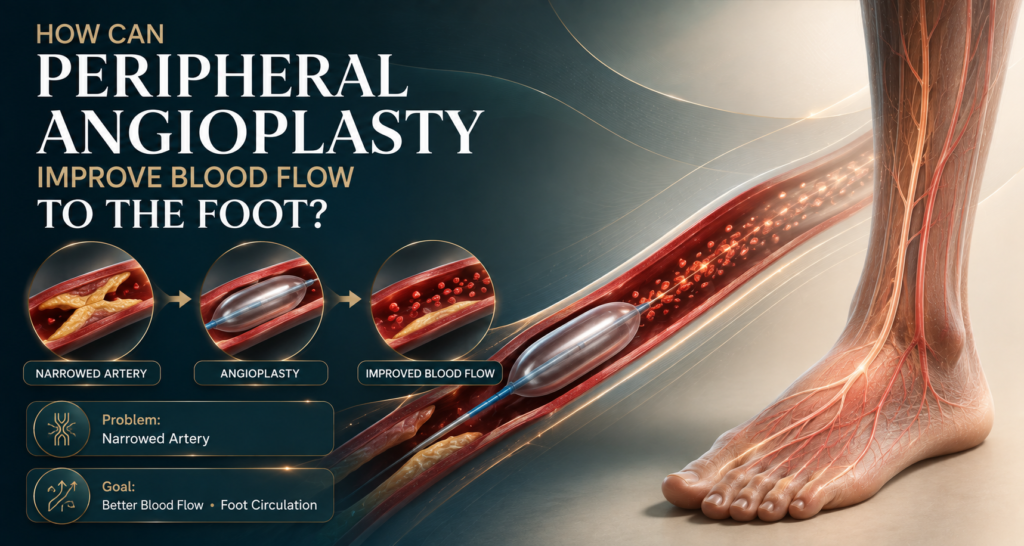
Peripheral angioplasty is a minimally invasive procedure used to improve blood flow through selected narrowed or blocked arteries outside the heart, commonly in the legs.
EDFC’s dedicated peripheral angioplasty service describes balloon angioplasty and stent placement among techniques used to restore blood flow.
The procedure is part of vascular treatment rather than a direct treatment for every diabetic ulcer.
Why Is Poor Circulation Dangerous in Diabetes?
A wound needs oxygen and nutrients delivered through the bloodstream to repair damaged tissue.
If arterial blood supply is severely reduced, the foot may struggle to heal even when dressings are performed correctly.
Poor circulation can contribute to:
- delayed wound healing,
- tissue breakdown,
- infection complications,
- pain,
- tissue necrosis,
- and gangrene.
Diabetic neuropathy can make the situation harder because significant foot damage may sometimes occur with less pain than expected.
What Is Peripheral Artery Disease?
Peripheral artery disease occurs when arteries supplying the limbs become narrowed, commonly because of atherosclerosis.
Possible signs include:
- calf or leg discomfort during walking,
- rest pain,
- a cold foot,
- colour changes,
- weak pulses,
- slow-healing wounds,
- and tissue loss.
Some patients may have significant PAD without obvious symptoms, especially when neuropathy is also present.
When Might Angioplasty Be Considered?
Angioplasty may be considered when clinically important arterial narrowing or blockage is reducing blood supply and a vascular specialist believes revascularisation is appropriate.
This can become particularly important when there is:
- a non-healing ulcer,
- tissue loss,
- gangrene,
- significant ischaemia,
- rest pain,
- or another sign that circulation is inadequate.
The decision depends on vascular anatomy, disease severity and the patient’s overall condition.
Does Every Diabetic Foot Ulcer Need Angioplasty?
No.
A diabetic ulcer may develop because of:
- pressure,
- neuropathy,
- deformity,
- trauma,
- infection,
- poor circulation,
- or several factors together.
Angioplasty only addresses the circulation component.
If blood supply is adequate, another treatment may be more important.
How Is Blood Circulation Checked?
A vascular assessment may include examination of:
- pulses,
- skin temperature,
- colour,
- wound characteristics,
- and other signs of perfusion.
Depending on the situation, vascular testing can include Doppler-based assessment and additional imaging.
EDFC includes vascular investigations among its nonsurgical diabetic-foot assessment services.
What Happens During Peripheral Angioplasty?
A thin catheter is guided through the blood vessel system to the narrowed or blocked artery.
A small balloon can then be expanded at the narrowed segment to improve the channel for blood flow.
In selected cases, a stent may be placed to help maintain the opening.
The exact technique depends on the location and nature of the arterial disease.
What Is the Difference Between Angiography and Angioplasty?
Angiography helps visualise blood vessels and identify narrowing or blockage.
Angioplasty is the treatment used to open an appropriate narrowed or blocked vessel.
The two may form part of the same treatment pathway, but they have different purposes.
Will an Ulcer Heal Immediately After Angioplasty?
No.
Improving blood supply creates a better environment for healing, but the wound itself still requires treatment.
A diabetic foot ulcer may also need:
- infection control,
- debridement,
- specialised dressing,
- pressure offloading,
- glucose management,
- and appropriate footwear.
This is why vascular treatment should be integrated into comprehensive diabetic-foot care rather than viewed as a standalone cure.
Why Is Offloading Still Important?
Imagine restoring water supply to a damaged field while continuing to drive a heavy vehicle over the same spot.
Blood flow has improved, but mechanical damage continues.
The same principle applies to diabetic ulcers.
If abnormal pressure caused or maintains the wound, restoring circulation alone will not remove that pressure.
EDFC’s insole and footwear selection service can be used to address pressure distribution when appropriate.
Can Angioplasty Prevent Amputation?
Restoring circulation can be an important part of limb-preservation treatment when poor blood flow threatens tissue.
But angioplasty cannot guarantee that an amputation will be avoided.
Outcome depends on factors such as:
- severity of arterial disease,
- infection,
- tissue already lost,
- wound depth,
- pressure,
- kidney and cardiovascular health,
- and overall diabetes management.
The earlier a threatened foot is evaluated, the more treatment options may remain available.
What Are the Risks?
Potential risks can include:
- bleeding or bruising at the catheter site,
- artery injury,
- blood clot,
- contrast-related problems,
- kidney complications in susceptible patients,
- re-narrowing,
- and need for additional vascular treatment.
Individual risks should be discussed with the treating vascular team.
What Happens After Angioplasty?
Follow-up is important.
The team may monitor:
- blood flow,
- the wound,
- infection,
- tissue viability,
- glucose control,
- walking and pressure pattern,
- and footwear.
Vascular risk factors also need long-term medical management.
Peripheral Angioplasty and Diabetic Foot Care at EDFC
EDFC in Surat provides diabetic-foot management that includes vascular assessment, wound care, surgical treatment and pressure management.
Patients can read more about Dr. Ashutosh Shah and EDFC’s diabetic-foot services before arranging an evaluation.
An Open Artery Is the Beginning of Healing, Not the End
Peripheral angioplasty can restore blood flow when a significant arterial blockage is contributing to a threatened diabetic foot.
But the wound still needs its own treatment.
The strongest plan asks two questions together:
Does enough blood reach the foot?
And what is preventing the wound from healing once it gets there?
For a non-healing diabetic foot wound or suspected circulation problem, contact EDFC for assessment in Surat.
Frequently Asked Questions
It opens selected narrowed or blocked arteries to improve blood flow.
No. It is considered when poor arterial circulation is clinically important.
Not by itself. Wound care, infection treatment and offloading may still be required.
No. Whether a stent is appropriate depends on the arterial problem.
Yes. Re-narrowing can occur, so vascular follow-up remains important.