
Choosing the Right Footwear After Foot Surgery
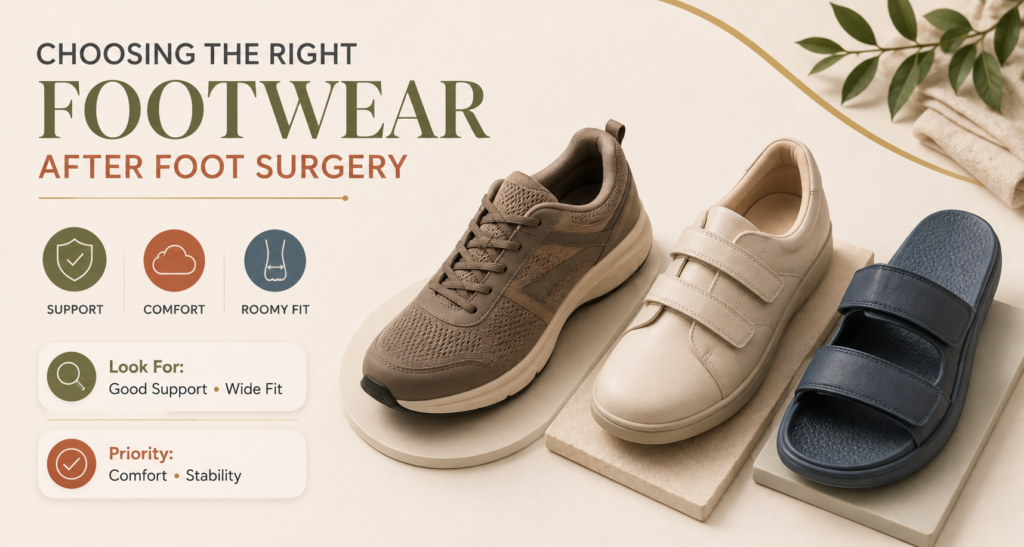
Post-Surgery Foot Protection Guide
Clinical Experience Behind This Guide
Dr. Ashutosh Shah
M.Ch., DNB (Plastic Surgery)
22+ Years in Plastic, Reconstructive & Diabetic Foot Surgery
Elegance Diabetic Foot Care (EDFC)
The operation may be over, but protecting the foot does not stop when you leave the operating room.
After diabetic foot surgery, footwear becomes an important part of recovery.
A shoe that creates rubbing or excessive pressure can damage vulnerable tissue. This becomes even more important when diabetic neuropathy reduces the ability to feel discomfort.
Footwear after diabetic foot surgery should protect the operated area, provide adequate space, reduce harmful pressure and match the patient’s current stage of healing.
At Elegance Diabetic Foot Care (EDFC), footwear and pressure management form part of the wider approach to diabetic foot recovery and ulcer prevention.
Key Takeaways
Do not rush back into old shoes. Healing tissue may still need protection.
Fit matters more than appearance. A shoe should not create rubbing or pressure.
Neuropathy changes the rules. A shoe can cause injury even when it does not hurt.
Different surgeries need different footwear. There is no universal postoperative shoe.
Pressure control continues after healing. Preventing another wound is part of recovery.
Why Is Footwear Important After Surgery?
Surgery may change the structure of the foot or how pressure is distributed during walking.
This is particularly relevant after procedures performed to:
- heal an ulcer,
- correct deformity,
- remove infected tissue,
- reconstruct damaged tissue,
- change bone position,
- or reduce excessive pressure.
Once walking resumes, the operated foot must again manage repeated loading.
The right footwear helps protect the result.
Can You Wear Normal Shoes Immediately?
Do not assume that you can return to your normal shoes as soon as the wound looks better.
Depending on the procedure, you may temporarily require:
- a postoperative shoe,
- offloading footwear,
- cast,
- boot,
- orthotic,
- or customised footwear.
The transition depends on wound healing, swelling, surgery type and weight-bearing status.
What Should Good Postoperative Footwear Do?
Appropriate footwear may need to provide:
- adequate width,
- enough toe space,
- stable support,
- secure fastening,
- appropriate cushioning,
- pressure redistribution,
- and protection from friction.
There should not be an internal seam or tight area repeatedly rubbing against vulnerable tissue.
Why Can Your Old Shoes Become Unsuitable?
The foot can change after surgery.
Swelling can temporarily increase its size.
Corrective surgery may also alter foot shape or pressure distribution.
This means a shoe that fitted before surgery may no longer fit appropriately afterward.
Using the same shoes without reassessment can therefore create new pressure points.
What Is Offloading?
Offloading means reducing or redistributing pressure away from a vulnerable part of the foot.
This can be achieved through:
- specialised footwear,
- insoles,
- casts,
- braces,
- postoperative devices,
- or other pressure-relieving strategies.
EDFC provides personalised insole and footwear selection as part of diabetic foot management.
Why Is Neuropathy Important?
Diabetic neuropathy may reduce the ability to feel:
- tightness,
- rubbing,
- excessive pressure,
- blisters,
- heat,
- or small injuries.
A shoe can therefore be causing tissue damage even when the patient says, “It doesn’t hurt.”
This is why visual foot inspection remains essential.
Should You Use Special Insoles?
Some patients benefit from pressure-redistributing insoles.
The correct choice depends on:
- foot shape,
- ulcer history,
- surgical procedure,
- pressure pattern,
- deformity,
- and the shoe being used.
A very soft insole is not automatically the right insole.
The objective is appropriate pressure distribution.
What Types of Footwear May Be Used?
EDFC’s footwear and prosthetics services include preventive, therapeutic and orthopaedic footwear options.
Preventive footwear may provide additional depth and room for certain foot changes.
Therapeutic or offloading footwear may be used to protect wounds or during recovery from selected foot procedures.
Orthopaedic footwear may be considered when deformity or altered foot structure requires more individualised support.
The appropriate option should be selected according to the patient’s foot rather than simply choosing a category by name.
When Can You Return to Regular Shoes?
There is no single number of days that applies to everyone.
Return to regular footwear depends on:
- wound closure,
- swelling,
- skin condition,
- bone or tendon healing,
- surgery type,
- weight-bearing status,
- sensation,
- and foot pressure.
A minor procedure and a major reconstruction will have very different recovery plans.
Should You Walk Barefoot at Home?
People with diabetic neuropathy should be particularly cautious about barefoot walking.
A small sharp object, rough floor surface or excessive heat can injure the foot without producing normal pain.
Protective footwear may therefore still be appropriate indoors.
Check Your Shoe Before Every Use
Before putting it on, inspect the inside of the shoe.
Look for:
- small stones,
- folded material,
- damaged insoles,
- sharp edges,
- moisture,
- or foreign objects.
Also inspect your foot for redness, blistering, swelling or skin damage.
Patients with neuropathy should not rely only on sensation.
What Are the Warning Signs of Poor Footwear?
Stop and reassess footwear if you notice:
- persistent redness,
- new blistering,
- bleeding,
- skin breakdown,
- new callus,
- swelling,
- discharge,
- or a new pressure mark.
Even customised footwear may require adjustment if the foot changes during recovery.
Can Wrong Footwear Cause Another Ulcer?
Yes.
If the shoe repeatedly concentrates pressure on vulnerable tissue, another wound may develop.
This is particularly concerning after a previous diabetic ulcer because the underlying neuropathy may still be present.
Healing the original wound does not remove every future risk.
Is Custom Footwear Necessary for Everyone?
No.
Some patients can eventually return to appropriately selected regular footwear.
Others may require specialised shoes or custom orthotics because of:
- deformity,
- previous ulceration,
- abnormal pressure,
- neuropathy,
- or major reconstructive surgery.
The objective is not to prescribe the most complicated footwear. It is to select the option that appropriately protects the individual foot.
Protect the Surgical Result
Dr. Ashutosh Shah works with diabetic foot wounds, reconstructive surgery, internal offloading and foot biomechanics.
You can read more about Elegance Diabetic Foot Care and its combination of surgical, non-surgical, footwear and pressure-management services.
After surgery, the important question is not simply:
“When can I wear my old shoes?”
It is:
“What footwear will protect my foot while I return safely to walking?”
If you are recovering from diabetic foot surgery and are unsure whether your current shoes are suitable, contact EDFC for postoperative foot and footwear assessment.
FAQs
Often eventually, but the timing depends on healing and surgery type.
No. They need adequate space while still fitting securely.
Generally avoid it, especially with diabetic neuropathy.
Some patients do, depending on pressure and foot structure.
Yes. Poor fit and repeated pressure can contribute to recurrence.