
Why Does Diabetes Cause Foot Pain?
Expert Review
Dr. Ashutosh Shah, M.S., M.Ch. (Plastic Surgery)
Plastic & Reconstructive Surgeon | Diabetic Foot & Limb Salvage Care
22+ Years of Surgical Experience
Founder, Elegance Diabetic Foot & Ulcer Clinic (EDFC)
Dr. Ashutosh Shah has more than 22 years of experience in plastic and reconstructive surgery, with a clinical focus that includes diabetic-foot wounds, pressure problems, infection, reconstruction, and limb preservation. EDFC provides specialist foot care at its Surat head office.
Foot pain in a person with diabetes should not automatically be blamed on “high sugar.” Diabetes can affect nerves, circulation, skin, muscles, joints, and wound healing, while many ordinary foot conditions can occur at the same time.
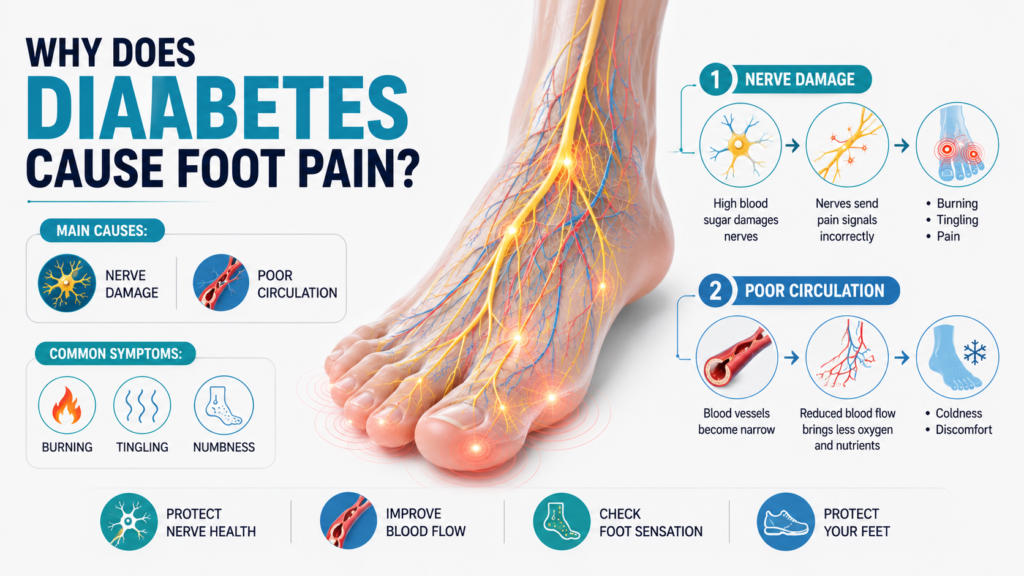
Some people experience burning, tingling, shooting pain, or extreme sensitivity because of nerve damage. Others develop pain from pressure points, calluses, deformities, infection, arthritis, tendon problems, or wounds. Poor circulation can also contribute to discomfort.
There is another important possibility: a serious diabetic-foot problem may cause very little pain when sensation has already been reduced by neuropathy.
This means both persistent pain and an unexpectedly painless wound deserve attention.
For people experiencing diabetic foot pain in Surat, the aim of assessment should be to identify the source of the pain rather than simply masking it with pain-relieving medication. EDFC’s preventive diabetic-foot care includes screening for neuropathy, deformity, callus, and other factors that can increase foot risk.
Key Takeaways
- Diabetes can cause burning, tingling, numbness, or shooting pain through nerve damage.
- Not all foot pain in a person with diabetes is caused by neuropathy.
- Calluses, deformities, infection, wounds, joints, and tendons can also hurt.
- Reduced sensation can allow serious foot damage to develop without strong pain.
- A new wound, swelling, colour change, or discharge should not be ignored simply because it is painless.
- Repeated pressure needs correction rather than pain relief alone.
- Early foot assessment can help identify problems before they progress to ulcers or infection.
What Does Diabetic Foot Pain Feel Like?
Diabetic foot pain can feel different depending on which structure is affected.
Nerve-related symptoms may include burning, pins and needles, electric-shock sensations, stabbing discomfort, or unusual sensitivity to touch. Some people notice symptoms more at night.
Mechanical pain can behave differently. A callus, joint problem, deformity, or pressure point may hurt more when standing or walking.
An infection can cause tenderness, swelling, warmth, or throbbing, although neuropathy may reduce these warning symptoms.
The type and location of pain therefore provide useful clues, but they do not replace examination.
Can Diabetic Neuropathy Cause Foot Pain?
Yes. Diabetic neuropathy can cause painful sensations even though the same nerve damage may eventually reduce normal sensation.
This can seem contradictory.
Damaged nerves may initially send abnormal pain signals, producing burning or shooting sensations. As neuropathy progresses, protective sensation can become weaker.
The patient may then stop feeling injuries that would normally be painful.
That loss of warning sensation is particularly important in diabetic-foot care because someone can continue walking on an injured area without realising how much damage is occurring.
Can Your Feet Hurt From Pressure and Calluses?
Yes.
A callus forms where the foot experiences repeated friction or pressure. If the pressure continues, the thickened area can become uncomfortable and may conceal deeper tissue injury.
Foot shape also matters.
Claw toes, prominent bones, bunions, muscle imbalance, or other deformities can shift body weight onto relatively small areas of skin. EDFC notes that diabetes-related muscle weakness can contribute to toe deformities and new pressure points.
The solution is therefore not always simply removing the callus.
The pressure causing it may also need to be addressed.
Can Poor Circulation Cause Foot Pain?
Reduced arterial blood flow can contribute to foot or leg discomfort and can also make wounds more difficult to heal.
Circulation-related symptoms can differ between patients. Some experience discomfort during activity, while more advanced circulation problems may cause pain even at rest.
A foot that becomes unusually cold, pale, blue, or dark also deserves assessment.
For diabetic-foot problems involving wounds or threatened tissue, circulation is particularly important because sufficient blood supply is needed for healing.
When circulation is suspected as part of the problem, it should be evaluated rather than assuming that every symptom comes from neuropathy.
Can an Infection Cause Foot Pain?
Yes. Infection may cause pain, warmth, redness, swelling, or tenderness.
But diabetes complicates this picture.
If neuropathy is advanced, an infected wound may not hurt as much as expected. This means absence of severe pain does not rule out a serious infection.
Deep or spreading infections, infection reaching the bone, gangrene, and wounds that cannot heal with routine dressings may require surgical assessment. EDFC’s diabetic-foot surgery pathway includes infection treatment, bone debridement, deformity correction, nerve and tendon procedures, and limb-salvage options when appropriate.
Why Can a Diabetic Foot Wound Be Painless?
A diabetic wound can be painless when neuropathy has reduced the nerves’ ability to detect injury.
This is one of the reasons daily foot inspection matters.
A person may develop a blister from a shoe, continue walking on it, and discover a wound only later because there was little warning pain.
The same issue can occur with calluses, nail injuries, burns, or small cuts.
For this reason, patients with reduced sensation should visually inspect their feet rather than relying on pain to tell them when something is wrong.
What If the Pain Comes From a Foot Deformity?
Diabetes can sometimes contribute to muscle and nerve changes that alter the mechanics of the foot.
When toes curl or a joint becomes prominent, pressure may become concentrated in places that were not designed to bear it.
Treatment may include suitable footwear, insoles, toe props, pressure redistribution, or selected corrective procedures depending on the deformity.
The objective is to reduce the mechanical cause rather than repeatedly treating the painful skin over it.
Can Offloading Help With Foot Pain?
Offloading means reducing pressure on a vulnerable or injured part of the foot.
This can be particularly important when pain is associated with a wound or high-pressure area.
Depending on the problem, offloading can involve specialised footwear, an insole, healing sandal, removable walker, or another device. Pressure-relieving footwear options at EDFC are selected according to the location of the wound or pressure point rather than using the same device for everyone.
Continuing to walk normally on a vulnerable pressure point may prevent it from settling, even when appropriate dressings are being used.
Does Better Blood Sugar Control Stop Foot Pain?
Good diabetes management remains important, but it should not be presented as an immediate cure for every type of foot pain.
Blood sugar control can help reduce the risk of further diabetes-related complications and supports overall healing. However, an existing pressure point, infected wound, structural deformity, or circulation problem may require its own treatment.
EDFC’s approach also connects foot care with broader metabolic management. Patients can read how EDFC approaches diabetes and foot health together rather than viewing them as completely separate problems.
When Should Foot Pain Be Checked Quickly?
Do not wait for routine follow-up if pain is accompanied by a new wound, increasing swelling, spreading redness, discharge, unusual warmth, blackening, or another significant colour change.
Sudden or rapidly worsening symptoms also deserve prompt attention.
For someone with neuropathy, the warning may instead be a visible change without pain.
A painless blister, open wound, swollen toe, or dark area can be just as important as a painful one.
What Can You Do to Protect Painful Diabetic Feet?
Check the entire foot every day, including between the toes and around the nails.
Wear footwear that fits properly and avoid repeatedly walking barefoot when protective sensation is reduced. Do not cut corns, calluses, or nail corners aggressively at home.
If pain keeps returning in exactly the same location, consider that a clue. Something may repeatedly be loading or irritating that area.
The broader foot-protection programme at EDFC includes screening, patient education, nail and skin care, and preventive strategies for people with diabetes, including those with neuropathy or previous ulcers.
Conclusion
Diabetic foot pain is a symptom, not a diagnosis.
Burning and tingling may come from neuropathy, while pressure points, calluses, deformities, infection, circulation problems, joints, tendons, and wounds can produce different types of discomfort.
More importantly, advanced neuropathy can make a dangerous foot problem surprisingly painless.
For patients in Surat, persistent or unexplained foot pain should therefore be assessed according to its cause. Treatment may involve nerve management, pressure relief, wound care, infection control, footwear changes, circulation assessment, or correction of an underlying structural problem.
The goal is not simply to make the foot hurt less. It is to understand why it hurts and whether the foot is at risk.
Looking Beyond Pain at EDFC
At Elegance Diabetic Foot & Ulcer Clinic, assessment is designed around the entire diabetic foot rather than one symptom in isolation. Its Surat head office provides preventive foot care, wound management, offloading, surgical treatment, and limb-salvage care.
Dr. Ashutosh Shah, M.S., M.Ch., founded EDFC with a reconstructive and limb-preservation approach. With more than 22 years of surgical experience, his work includes evaluating wounds, infection, deformity, and threatened tissue when diabetic-foot problems become complex. Patients can explore EDFC’s limb-preservation approach to understand how treatment may combine wound care, infection control, reconstruction, and pressure management.
Pain Is Useful Information – But So Is Numbness
If your foot keeps burning, aching, or hurting in one particular area, finding the cause early may prevent a small problem from becoming more difficult to treat. And if you have diabetes but cannot feel your feet normally, do not wait for pain before having a new wound or colour change examined. Patients in Surat can speak with the EDFC foot-care team for an individual foot assessment.
Frequently Asked Questions
Possible causes include neuropathy, pressure, calluses, deformities, infection, circulation problems, wounds, or unrelated musculoskeletal conditions.
It may feel like burning, tingling, pins and needles, stabbing, shooting pain, or unusual sensitivity.
Neuropathic symptoms can sometimes become more noticeable at night or when the feet are at rest.
Yes, but some ulcers cause little or no pain when neuropathy has reduced protective sensation.
Pressure points, calluses, deformity, joint or tendon problems, wounds, and circulation issues are among the possible causes. An examination is needed to distinguish them.
Not necessarily. Increasing numbness may indicate reduced protective sensation from neuropathy.